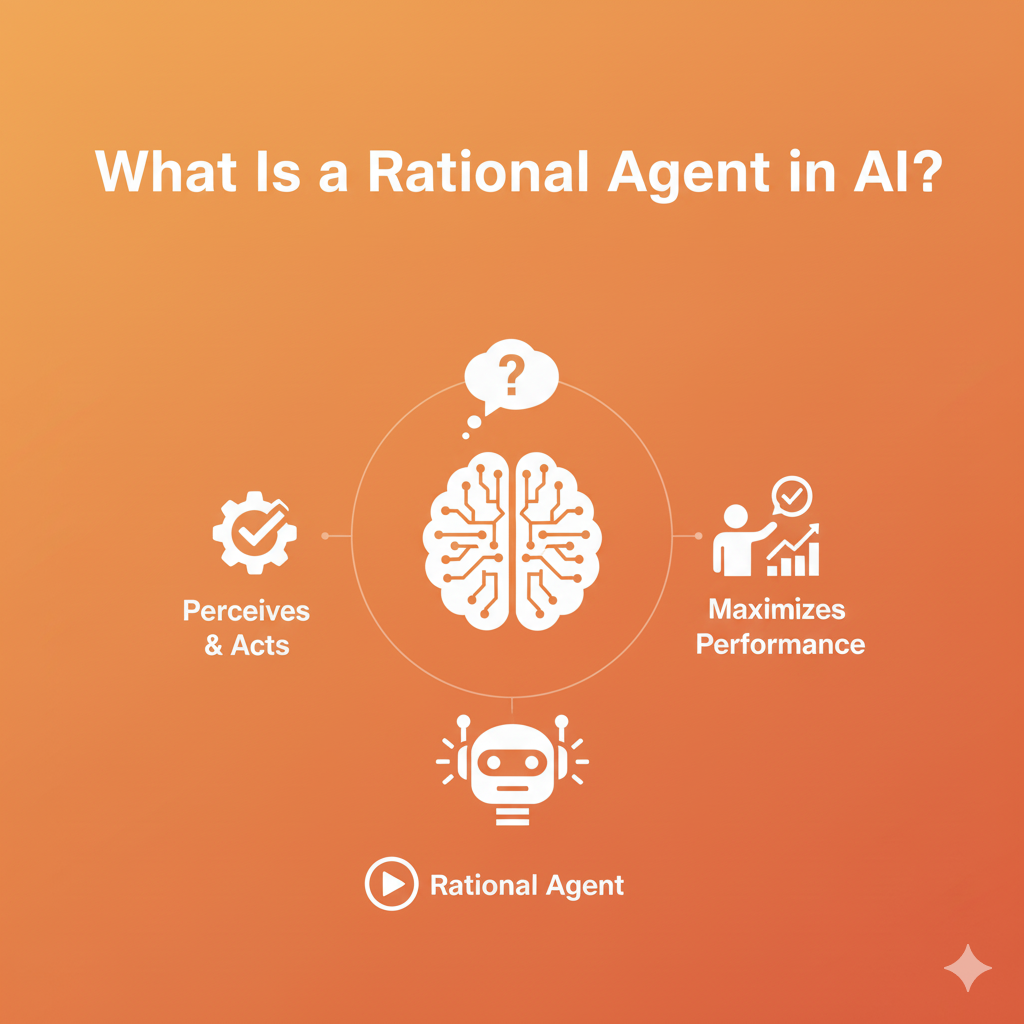

A rational agent in Artificial Intelligence (AI) is an entity that makes decisions or takes actions to achieve the best possible outcome based on the information it has. In simple terms, it’s an AI system that acts intelligently choosing the most logical and beneficial option in any given situation.
Now, let’s go deeper into what that really means, how it works, and why it matters.
Understanding the Concept of a Rational Agent
The term “agent” in AI simply refers to anything that can perceive its environment and act upon it.
A rational agent is a smart version of that it doesn’t act randomly or emotionally; it acts rationally, meaning its decisions are aimed at maximizing performance or achieving goals.
To put it simply:
A rational agent always tries to do the right thing the thing that leads to the best expected result, based on what it knows.
Example:
Imagine a self-driving car approaching a red light.
- It detects the red light (perception).
- It decides to stop (action).
That’s rational behavior because stopping at the red light maximizes safety and follows rules.
If the car keeps moving forward, that’s irrational, because it increases risk and breaks the traffic laws.
Breaking It Down: Agent, Environment, and Rationality
To understand rational agents clearly, let’s break down their basic structure.
1. Agent
An agent is the “doer” — an AI program or system that observes and acts.
It can be a chatbot, robot, self-driving car, recommendation system, or even a trading bot.
2. Environment
The environment is everything the agent interacts with.
For example:
- For a chess AI, the chessboard is its environment.
- For a cleaning robot, your living room is its environment.
- For an online shopping algorithm, user data is its environment.
3. Rationality
Now, rationality refers to the ability to make decisions that achieve the best expected outcome.
It doesn’t mean being perfect — it means doing the best you can with the information you have.
So, a rational agent might not always be 100% correct, but it always acts logically and purposefully.
The Core Idea: Perceive → Think → Act
Every rational agent in AI follows a simple cycle called the PEAS model, which stands for:
- P – Performance measure: Defines success (what makes the agent “good”).
- E – Environment: The external surroundings where the agent operates.
- A – Actuators: The parts that take actions.
- S – Sensors: The parts that perceive input.
This is how a rational agent works:
- Perceives information through sensors.
- Thinks or decides what to do next.
- Acts using actuators.
Let’s make that more real with an example.
Example: Self-Driving Car as a Rational Agent
| Component | Description |
|---|---|
| Performance Measure | Safety, obeying traffic rules, comfort, efficiency |
| Environment | Roads, traffic, pedestrians, signals |
| Actuators | Steering wheel, accelerator, brakes |
| Sensors | Cameras, radar, GPS, lidar |
A rational self-driving car processes data from its sensors (like cameras and GPS), decides on safe and optimal driving moves, and acts accordingly.
So, it’s rational not because it’s human-like — but because it acts in a way that leads to the best result under given conditions.
Rational Agent vs. Intelligent Agent
People often confuse rational agents with intelligent agents, but there’s a subtle difference.
| Basis | Rational Agent | Intelligent Agent |
|---|---|---|
| Definition | Acts to achieve the best outcome. | Can learn, reason, and adapt to achieve goals. |
| Decision-making | Based on logic and expected success. | Based on both logic and learning ability. |
| Example | A thermostat that maintains ideal temperature. | A smart AC that learns your temperature preferences. |
In short:
All intelligent agents are rational, but not all rational agents are necessarily intelligent.
A rational agent doesn’t need to “learn” it just needs to make logical, goal-oriented decisions.
Types of Rational Agents in AI
There are mainly five types of agents that can act rationally depending on how they process information and interact with their environment.
1. Simple Reflex Agent
Acts only on current perception — it doesn’t care about history or future states.
Example:
An automatic door opens when it senses someone nearby.
It’s rational because it reacts correctly to the stimulus — but it doesn’t learn.
2. Model-Based Reflex Agent
This agent uses an internal model of the world.
It keeps track of what’s happening and can make better decisions.
Example:
A robot vacuum remembers the layout of a room to clean it efficiently.
3. Goal-Based Agent
These agents have specific goals and act to achieve them.
They choose actions that lead closer to the goal.
Example:
A navigation AI plans routes to reach your destination as quickly as possible.
4. Utility-Based Agent
These agents aim for maximum satisfaction or utility, not just goal completion.
Example:
A music recommendation AI not only finds songs but also ranks them based on how much you’ll enjoy them.
5. Learning Agent
The most advanced type it learns from experience to improve performance over time.
Example:
ChatGPT or Google Assistant they learn from user interactions to give better responses.
How Rational Agents Make Decisions
A rational agent doesn’t just act randomly; it follows a decision-making process based on logic and data.
Here’s a simplified flow:
- Perception: Collect data about the current environment.
- Interpretation: Analyze what the data means.
- Evaluation: Consider all possible actions.
- Action Selection: Choose the one that maximizes performance.
- Execution: Perform the chosen action.
- Feedback: Learn (if applicable) from the outcome.
Example:
Imagine a trading bot that must decide whether to buy, sell, or hold a stock.
- It perceives market trends (price, volume, volatility).
- It evaluates potential outcomes (profit, loss).
- It acts rationally by choosing the move with the best expected profit.
That’s rational behavior the decision aligns with its performance measure (maximizing returns).
Key Properties of a Rational Agent
To be called “rational,” an AI agent must have certain characteristics:
1. Autonomy
It can operate independently without constant human control.
2. Flexibility
It can adapt to changes in the environment.
3. Goal-oriented
Every action aims to achieve a measurable outcome.
4. Reasoning Ability
It evaluates different possibilities and chooses the best one.
5. Learning (optional)
In advanced systems, it improves decisions over time based on experience.
What Makes an Agent Truly Rational?
A rational agent is judged by performance, not perfection.
AI pioneer Stuart Russell defined rationality as:
“Doing the right thing, given what the agent knows.”
So rationality depends on four main factors:
- Performance measure – defines what success looks like.
- Agent’s knowledge – what it knows about the environment.
- Possible actions – what choices it has.
- Percepts – what it can observe at any time.
The agent’s goal is not to be flawless, but to make the best possible decision with the information it has.
Examples of Rational Agents in Real Life
Let’s look at a few real-world AI systems that act as rational agents:
1. Google Maps
- Perceives traffic data and user location.
- Predicts best possible route.
- Chooses fastest or shortest path.
Rationality: It optimizes travel time — the performance measure.
2. Chatbots
- Understand user queries.
- Retrieve relevant responses.
- Learn from past interactions.
Rationality: Improves customer satisfaction with accurate, timely replies.
3. Smart Thermostat
- Detects room temperature.
- Turns heating/cooling on or off.
Rationality: Maintains comfort while saving energy.
4. Stock Trading AI
- Analyzes price trends and news sentiment.
- Executes trades with best risk-reward ratio.
Rationality: Maximizes return and minimizes loss.
5. Autonomous Drones
- Sense obstacles and routes.
- Choose efficient flight paths.
Rationality: Ensures safe, timely deliveries or surveillance.
All these systems act rationally they sense, reason, and act for the best expected result.
Rationality vs. Human Intelligence
It’s important to remember that rationality ≠ emotionless perfection.
Humans are often irrational emotions, bias, or incomplete knowledge affect our decisions.
But AI rational agents are logic-driven they focus only on outcomes, not feelings.
However, that doesn’t mean they are always “right.”
If an agent doesn’t have enough data or misinterprets information, it can still make mistakes but it will try to make the best possible decision under those circumstances.
Challenges of Building Rational Agents
Creating rational agents sounds ideal, but it’s not simple.
There are real-world challenges:
- Incomplete or Noisy Data: Agents often have limited or imperfect information.
- Uncertain Environments: Many environments are unpredictable (like the stock market).
- Computation Limits: Sometimes, calculating the absolute best decision takes too long.
- Ethical Decisions: Not all rational choices are morally acceptable (for example, in self-driving car crash scenarios).
- Dynamic Goals: In changing environments, what’s “rational” now might not be later.
So, rational agents are designed to approximate rationality, not achieve it perfectly.
Applications of Rational Agents in AI
Rational agents form the base of many AI applications today:
| Field | Example Application | Role of Rational Agent |
|---|---|---|
| Robotics | Autonomous robots | Navigation, obstacle avoidance |
| Finance | Trading bots | Risk-based decision making |
| Healthcare | Diagnosis systems | Suggest treatments based on data |
| Customer Support | Chatbots, virtual assistants | Query handling and resolution |
| Gaming | NPCs and opponents | Strategy-based decision-making |
| Smart Homes | IoT devices | Automated control and energy optimization |
In short, every intelligent system that acts logically and consistently toward its goal uses the principles of rational agency.
Future of Rational Agents in AI
With the rise of autonomous systems and generative AI, rational agents are becoming even more advanced.
Future agents won’t just react they’ll predict and plan in real time.
Imagine:
- AI assistants that not only reply but anticipate your next need.
- Robots that plan tasks weeks ahead.
- Traffic systems that optimize entire city routes dynamically.
All these rely on rational decision-making frameworks continuously learning, optimizing, and acting based on real-world feedback.
Wrapping Up
To wrap it up, a rational agent in AI is not about perfection it’s about acting with purpose and logic.
It perceives, thinks, and acts to achieve the best expected outcome under given circumstances.
Whether it’s a chatbot, a robot, or a self-driving car every AI system that makes thoughtful, goal-oriented decisions is essentially a rational agent.
As AI continues to evolve, these agents will get better at balancing data, logic, and human values making technology not just intelligent, but truly rational in serving our real-world goals.
Discover more from PratsDigital
Subscribe to get the latest posts sent to your email.


Pingback: What Is Agent Function in AI (Explained Simply) - PratsDigital
Pingback: What Is a Learning Agent in AI (Explained Simply) - PratsDigital