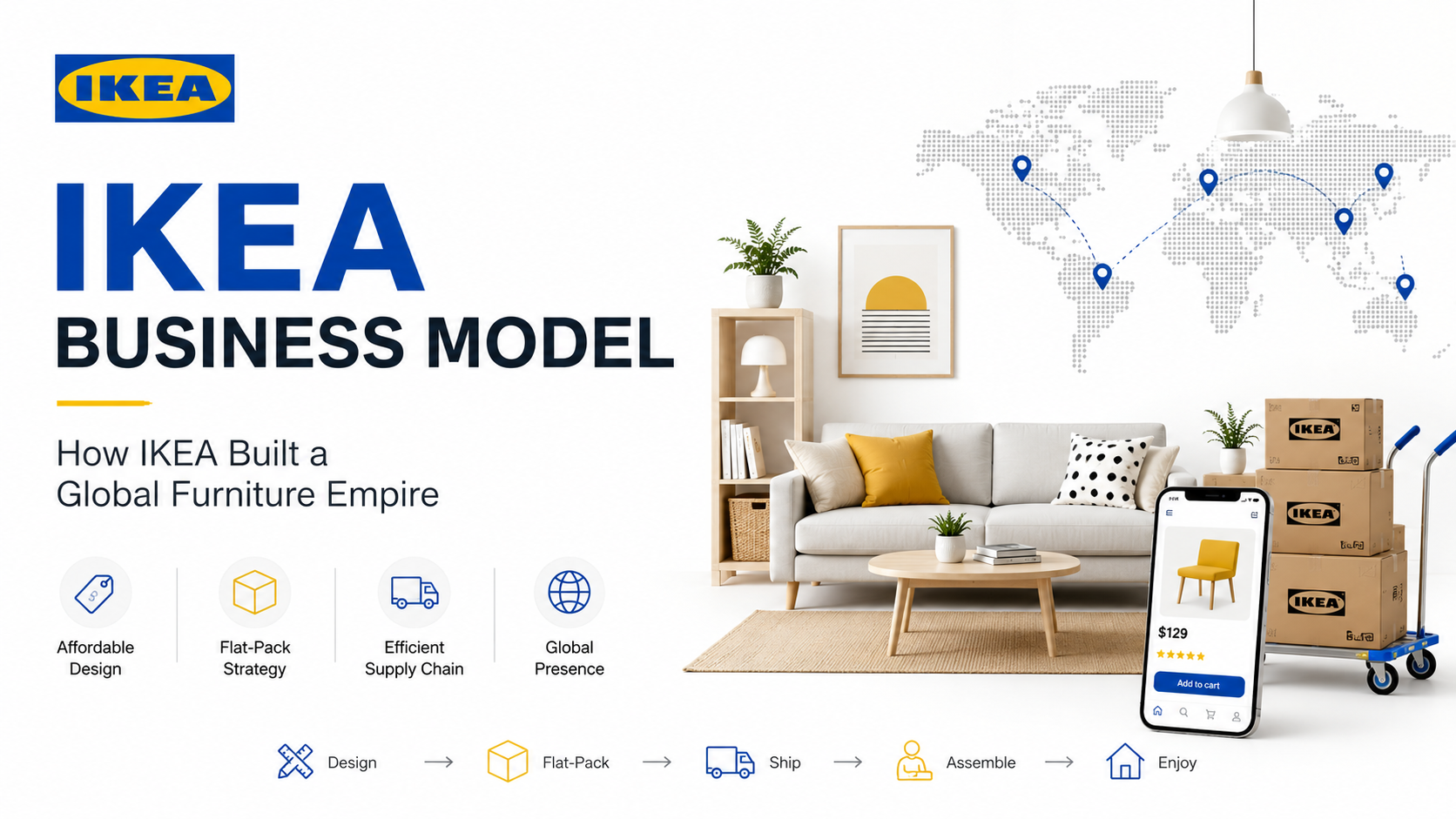
IKEA’s business model focuses on affordable flat-pack furniture, self-service shopping, large-scale supply chain optimization, and cost-efficient global operations.
IKEA stands as one of the most successful furniture companies in the world, transforming how millions of people furnish their homes. The Swedish giant has built an empire on simple principles: make furniture affordable, let customers do the work, and optimize every step of the process.
This blog breaks down exactly how IKEA makes money, why their strategy works, and what makes them different from every other furniture retailer on the planet.
What Is IKEA?
IKEA started in 1943 when Ingvar Kamprad, a 17-year-old Swedish entrepreneur, began selling small household items. The company name comes from his initials (IK) plus Elmtaryd and Agunnaryd, the farm and village where he grew up.
The first IKEA store opened in Älmhult, Sweden in 1958. Kamprad introduced flat-pack furniture after a worker removed table legs to fit them in a car, sparking the idea that would revolutionize furniture retail.
Today, IKEA operates over 460 stores in more than 60 countries. The company serves hundreds of millions of customers annually and generates over $45 billion in revenue.
IKEA’s Scandinavian Design Philosophy
IKEA builds its entire product line around Scandinavian design principles: minimalism, functionality, and beauty in simplicity. Every product must serve a purpose while looking good and staying affordable.
IKEA’s Target Customer Base
IKEA targets budget-conscious consumers who value style but won’t overpay for it. This includes young professionals, growing families, students, and anyone furnishing a home on a reasonable budget.
IKEA’s Global Expansion Journey
From a single store in rural Sweden, IKEA expanded across Europe in the 1970s, entered North America in the 1980s, and reached Asia in the 1990s. The company adapted its products for local markets while maintaining its core business model.
IKEA Business Model Overview
Quick Summary:
- Business Model Type: Low-cost, high-volume retail
- Revenue Model: Direct sales of furniture and home goods
- Customer Segment: Mass market, budget-conscious shoppers
- Value Proposition: Affordable, stylish, functional furniture
- Distribution Channels: Physical stores, e-commerce, catalogs
- Key Resources: Global supply chain, brand recognition, design expertise
How IKEA Makes Money
Furniture Sales
Furniture sales drive the majority of IKEA’s revenue. The company sells everything from beds and sofas to wardrobes and desks, all priced significantly below traditional furniture retailers.
IKEA keeps furniture affordable through flat-pack design, bulk manufacturing, and efficient logistics. A sofa that costs $2,000 at a traditional store might sell for $600 at IKEA.
Home Accessories and Decor
Smaller products like lamps, rugs, curtains, and decorative items carry higher profit margins than large furniture pieces. These accessories encourage impulse purchases and increase average transaction values.
Customers who come for a bookshelf often leave with picture frames, plants, and kitchen organizers.
Kitchen and Custom Solutions
IKEA’s modular kitchen systems generate substantial revenue. Customers design custom kitchens using IKEA’s planning tools, then purchase cabinets, countertops, and appliances as a complete package.
Storage solutions like PAX wardrobes work similarly, offering customizable configurations that fit specific spaces.
Food and Restaurant Revenue
IKEA restaurants serve Swedish meatballs, salmon, and other affordable meals. Food sales represent a small percentage of total revenue but serve a critical strategic purpose.
The food court keeps customers in stores longer, reduces shopping fatigue, and creates a positive association with the IKEA experience. A $5 meal makes spending an hour browsing furniture feel less exhausting.
Online Sales and E-Commerce
IKEA’s digital sales have grown rapidly, especially after 2020. The company invested heavily in e-commerce infrastructure, mobile apps, and augmented reality tools that let customers visualize furniture in their homes.
Online shopping complements the in-store experience rather than replacing it. Many customers browse online, then visit stores to see products in person.
IKEA Value Proposition
Affordable Pricing
IKEA designs products with cost in mind from day one. Designers must hit specific price targets, forcing creative solutions that reduce material costs without sacrificing quality.
This approach makes stylish furniture accessible to people who otherwise couldn’t afford it.
Functional Scandinavian Design
Every IKEA product balances form and function. A coffee table isn’t just a surface; it includes storage. A bed frame incorporates drawers. Lamps provide the right light while looking good.
DIY Furniture Assembly
Flat-pack furniture puts assembly in customers’ hands. This isn’t a bug; it’s a feature that dramatically reduces costs.
Customers accept the trade-off: lower prices in exchange for a few hours with an Allen wrench and instruction manual. Most people find assembly straightforward, and the savings make it worthwhile.
One-Stop Shopping Experience
IKEA stores offer everything needed to furnish a home:
- Living room furniture
- Bedroom sets
- Kitchen essentials
- Bathroom accessories
- Outdoor furniture
- Kids’ items
- Food and snacks
This convenience means fewer trips to multiple stores.
IKEA’s Flat-Pack Furniture Strategy
Flat-pack furniture means shipping furniture unassembled in flat, compact boxes. IKEA pioneered this approach in the 1950s and built their entire business around it.
Lower Transportation Costs
Flat boxes stack efficiently in trucks and shipping containers. A truck that carries 50 assembled chairs can transport 500 flat-packed chairs.
This efficiency cuts transportation costs by up to 85% compared to traditional furniture shipping.
Better Warehouse Efficiency
Flat-packed items take up less space in warehouses. IKEA can store more inventory in smaller facilities, reducing real estate costs.
Reduced Storage Costs
Customers store flat-pack boxes easily in their cars, apartments, or garages until assembly. Traditional furniture requires immediate space or expensive delivery.
Easier Global Shipping
Shipping furniture internationally gets expensive with assembled pieces. Flat-pack design makes global distribution economical, allowing IKEA to manufacture in low-cost countries and ship worldwide.
Example Comparison:
- Traditional sofa shipping: 1 truck carries 20 sofas
- Flat-pack sofa shipping: 1 truck carries 200 sofas
- Cost per unit: 90% reduction
IKEA Supply Chain Strategy
Global Supplier Network
IKEA works with over 1,000 suppliers across 50 countries. This global network provides access to the best materials at the lowest costs.
The company doesn’t own most factories. Instead, it partners with manufacturers who meet strict quality and sustainability standards.
Bulk Manufacturing
IKEA orders in massive quantities. A single product run might produce 100,000 units, driving per-unit costs down through economies of scale.
Suppliers dedicate entire production lines to IKEA, ensuring consistent quality and competitive pricing.
Cost Optimization
Every aspect of IKEA’s supply chain focuses on cost reduction:
Material Sourcing: IKEA negotiates directly with raw material suppliers, cutting out intermediaries.
Production Efficiency: Standardized designs allow factories to optimize manufacturing processes.
Packaging Efficiency: Products are designed to fit standard box sizes, maximizing shipping container utilization.
Sustainable Supply Chain
IKEA committed to using 100% renewable and recycled materials by 2030. The company invests in sustainable forestry, recycled plastics, and renewable energy.
These initiatives appeal to environmentally conscious consumers while reducing long-term material costs.
IKEA Customer Experience Strategy
Maze-Like Store Layout
IKEA stores guide customers through a predetermined path, showcasing products in room settings. This layout isn’t accidental.
The maze design increases exposure to products customers didn’t plan to buy. Walking through every department boosts impulse purchases and average basket size.
Customers who came for a lamp see kitchens, bedrooms, and living rooms along the way.
Self-Service Warehouses
After browsing showrooms, customers pick products from warehouse aisles themselves. This self-service model eliminates the need for sales staff to retrieve items.
Fewer employees means lower labor costs, translated into lower prices.
IKEA Showrooms
IKEA creates fully furnished room displays showing how products work together. These showrooms inspire customers and demonstrate product functionality.
Seeing a complete bedroom setup helps customers visualize products in their homes better than seeing individual pieces on shelves.
Affordable Food Courts
IKEA’s restaurants offer meals cheaper than most fast-food chains. A plate of Swedish meatballs costs less than a McDonald’s combo.
This affordable food keeps customers energized and willing to spend more time shopping. Happy, fed customers make better buying decisions.
IKEA Marketing Strategy
Catalog Marketing
For decades, IKEA’s annual catalog was the company’s primary marketing tool. At its peak, IKEA printed 200 million catalogs in 32 languages, making it one of the world’s most printed publications.
The catalog showcased products in realistic home settings, inspiring customers and driving store visits.
Digital Marketing
IKEA shifted marketing dollars to digital channels, including:
- Social media campaigns on Instagram, Facebook, and TikTok
- YouTube videos showing product assembly and design tips
- Email marketing with personalized product recommendations
- Search engine advertising targeting furniture keywords
Emotional Branding
IKEA’s advertising focuses on family, relationships, and everyday life moments. Commercials show real families using IKEA products to create comfortable homes.
This emotional connection builds brand loyalty beyond just selling furniture.
Sustainability Marketing
IKEA promotes its environmental initiatives aggressively. Marketing materials highlight sustainable materials, recycling programs, and renewable energy investments.
Younger consumers especially value brands that demonstrate environmental responsibility.
IKEA Revenue Streams
| Revenue Stream | Description |
|---|---|
| Furniture Sales | Beds, sofas, tables, chairs, storage units |
| Home Decor | Lamps, rugs, curtains, artwork, textiles |
| Kitchens | Modular cabinets, countertops, appliances |
| Food Services | Restaurants, bistros, Swedish food markets |
| E-commerce | Online furniture sales and delivery |
| Delivery & Assembly | Optional paid services for convenience |
IKEA Cost Structure
Manufacturing Costs
IKEA doesn’t own most factories but pays manufacturing partners. Bulk orders and long-term contracts keep production costs low.
Logistics and Warehousing
Transportation and storage represent significant expenses. IKEA optimizes these through flat-pack design, strategic warehouse locations, and efficient shipping routes.
Store Operations
Running large retail stores requires substantial investment in rent, utilities, and maintenance. IKEA locates stores in affordable areas outside city centers to minimize real estate costs.
Marketing and Branding
IKEA spends heavily on advertising, catalogs, and digital marketing. However, strong brand recognition means less spending per customer acquired than competitors.
Employee Salaries
IKEA employs over 200,000 people globally. The company pays competitive wages but reduces labor needs through self-service models.
Technology and E-Commerce
Digital transformation requires ongoing investment in website infrastructure, mobile apps, augmented reality features, and online payment systems.
IKEA Business Model Canvas
Key Partners: Suppliers, manufacturers, logistics companies, franchisees
Key Activities: Product design, supply chain management, retail operations, marketing
Key Resources: Brand reputation, supply chain network, store locations, design expertise
Value Propositions: Affordable furniture, Scandinavian design, DIY assembly, one-stop shopping
Customer Relationships: Self-service model, IKEA Family loyalty program, customer support
Channels: Physical stores, e-commerce platform, mobile app, catalog
Customer Segments: Budget-conscious consumers, young professionals, families, students
Cost Structure: Manufacturing, logistics, store operations, marketing, technology
Revenue Streams: Furniture sales, accessories, kitchens, food services, delivery fees
Why IKEA’s Business Model Works
Mass Market Appeal
IKEA targets the largest possible customer base by keeping prices low. Almost anyone furnishing a home can afford IKEA products.
Strong Brand Recognition
IKEA’s blue and yellow stores are instantly recognizable worldwide. The brand represents affordable style, Nordic quality, and democratic design.
Efficient Supply Chain
IKEA’s logistics system is a competitive advantage competitors struggle to match. Decades of optimization created a machine that delivers low costs at massive scale.
Global Scalability
The business model works in Sweden and Singapore equally well. Flat-pack furniture, self-service stores, and affordable pricing translate across cultures.
Affordable Yet Stylish Products
IKEA proves cheap doesn’t mean ugly. The company hires talented designers who create beautiful products at price points traditional furniture makers can’t touch.
Challenges in IKEA’s Business Model
Rising Raw Material Costs
Wood, steel, and plastic prices fluctuate globally. Rising costs squeeze margins unless IKEA raises prices or finds cheaper materials.
Competition From Online Furniture Brands
Companies like Wayfair, Article, and Amazon offer furniture delivered fully assembled. These competitors eliminate IKEA’s assembly hassle, appealing to convenience-focused customers.
Delivery and Logistics Challenges
Last-mile delivery for large furniture items costs significant money. IKEA’s stores require customers to transport purchases themselves, but online orders need reliable delivery networks.
Sustainability Pressure
Consumers demand environmentally responsible products. Transitioning to sustainable materials while maintaining low prices creates tension.
Changing Consumer Preferences
Younger consumers value experiences over possessions and move frequently. These trends could reduce demand for large furniture purchases.
IKEA Competitors
IKEA faces competition from multiple directions:
Wayfair: Online-only furniture retailer with massive selection and home delivery
Ashley Furniture: Traditional furniture chain with higher-quality, higher-priced products
Amazon: E-commerce giant selling furniture from thousands of brands
Walmart: Discount retailer offering budget furniture with local pickup
Local Furniture Retailers: Regional stores providing personalized service and unique selections
Comparison:
Pricing: IKEA typically offers the lowest prices among major retailers
Delivery: Competitors often provide free or cheap delivery; IKEA charges substantial delivery fees
Product Variety: IKEA offers curated collections; Amazon and Wayfair provide unlimited options
Shopping Experience: IKEA’s showrooms beat online browsing; traditional retailers offer more personalized service
Lessons Businesses Can Learn From IKEA
Simplify Products to Reduce Costs
IKEA proves that eliminating unnecessary complexity cuts costs dramatically. Every product component serves a purpose.
Apply this lesson: Identify where your product includes features customers don’t need. Remove them, reduce costs, and pass savings to customers.
Focus on Customer Experience
IKEA turns furniture shopping into an experience. Showrooms, food courts, and store layouts create memorable visits.
Apply this lesson: Consider how customers interact with your business beyond the transaction. Create touchpoints that build positive associations.
Build Efficient Supply Chains
IKEA’s supply chain excellence provides sustainable competitive advantage. Competitors can copy designs but struggle to match logistics efficiency.
Apply this lesson: Invest in operations and logistics. Supply chain improvements compound over time.
Use Smart Packaging Strategies
Flat-pack design revolutionized furniture retail by rethinking packaging.
Apply this lesson: Question assumptions about how products must be packaged and shipped. Creative solutions can unlock major cost savings.
Create a Strong Brand Identity
IKEA’s brand identity is unmistakable. Blue and yellow colors, Swedish names, and democratic design philosophy create cohesive branding.
Apply this lesson: Develop distinctive brand elements that customers recognize instantly and associate with your core values.
Future of IKEA
Smart Home Products
IKEA invests in smart lighting, blinds, and air quality sensors. Partnerships with tech companies bring affordable smart home solutions to mass markets.
AI and Digital Shopping
Augmented reality apps let customers visualize furniture in their homes before buying. AI-powered design tools help customers plan room layouts.
IKEA will likely expand these digital tools, making online shopping more interactive and reducing returns.
Sustainable Furniture
IKEA committed to becoming climate positive by 2030. Expect more products made from recycled materials, renewable resources, and circular design principles.
Buy-back programs will let customers return old furniture for recycling or resale.
Urban Small-Store Formats
Large suburban stores work well for car-dependent customers. IKEA is testing smaller urban stores and pickup points for city dwellers.
These formats offer limited inventory but provide convenient access points for online orders.
Growth in Emerging Markets
IKEA continues expanding in India, Southeast Asia, and Latin America. These markets represent billions of potential customers entering the middle class.
Wrapping Up
IKEA’s business model succeeds through relentless focus on affordability, efficiency, and customer experience. The company makes stylish furniture accessible to ordinary people by optimizing every aspect of design, manufacturing, and retail.
Flat-pack furniture, self-service stores, and global supply chains aren’t just operational choices. They’re strategic decisions that create competitive advantages competitors can’t easily copy.
IKEA remains dominant globally because the business model scales beautifully. The same principles that worked in 1950s Sweden work in 2020s Shanghai.
For entrepreneurs and business leaders, IKEA demonstrates that obsessive focus on core customer value combined with operational excellence creates lasting success.
FAQs
IKEA operates a low-cost, high-volume retail model selling affordable flat-pack furniture through self-service stores and e-commerce. The company reduces costs through bulk manufacturing, efficient logistics, and customer self-assembly.
IKEA maintains low prices through flat-pack shipping, bulk manufacturing, self-service stores, global supply chains, and designing products specifically to hit target price points. Customers handle assembly and transportation, reducing labor costs.
Flat-pack furniture reduces shipping costs by 85%, improves warehouse efficiency, enables global distribution, and allows customers to transport purchases in regular cars. The cost savings get passed to customers through lower prices.
IKEA generates revenue primarily from furniture sales, plus home accessories, modular kitchens, food services, e-commerce, and delivery fees. High sales volume at lower margins drives profitability.
IKEA succeeds through affordable pricing, strong brand recognition, efficient supply chains, Scandinavian design appeal, and unique shopping experiences. The business model scales globally while maintaining consistent customer value.
Major competitors include Wayfair, Ashley Furniture, Amazon, Walmart, and local furniture retailers. Each competes on different dimensions like delivery convenience, product quality, or personalized service.
Yes, IKEA generates billions in annual profit. The company’s high-volume, low-margin model produces substantial returns through operational efficiency and global scale.
IKEA’s unique elements include flat-pack furniture, maze-like store layouts, self-service warehouses, affordable in-store restaurants, democratic design philosophy, and vertical integration of the supply chain from design to retail.
Discover more from PratsDigital
Subscribe to get the latest posts sent to your email.