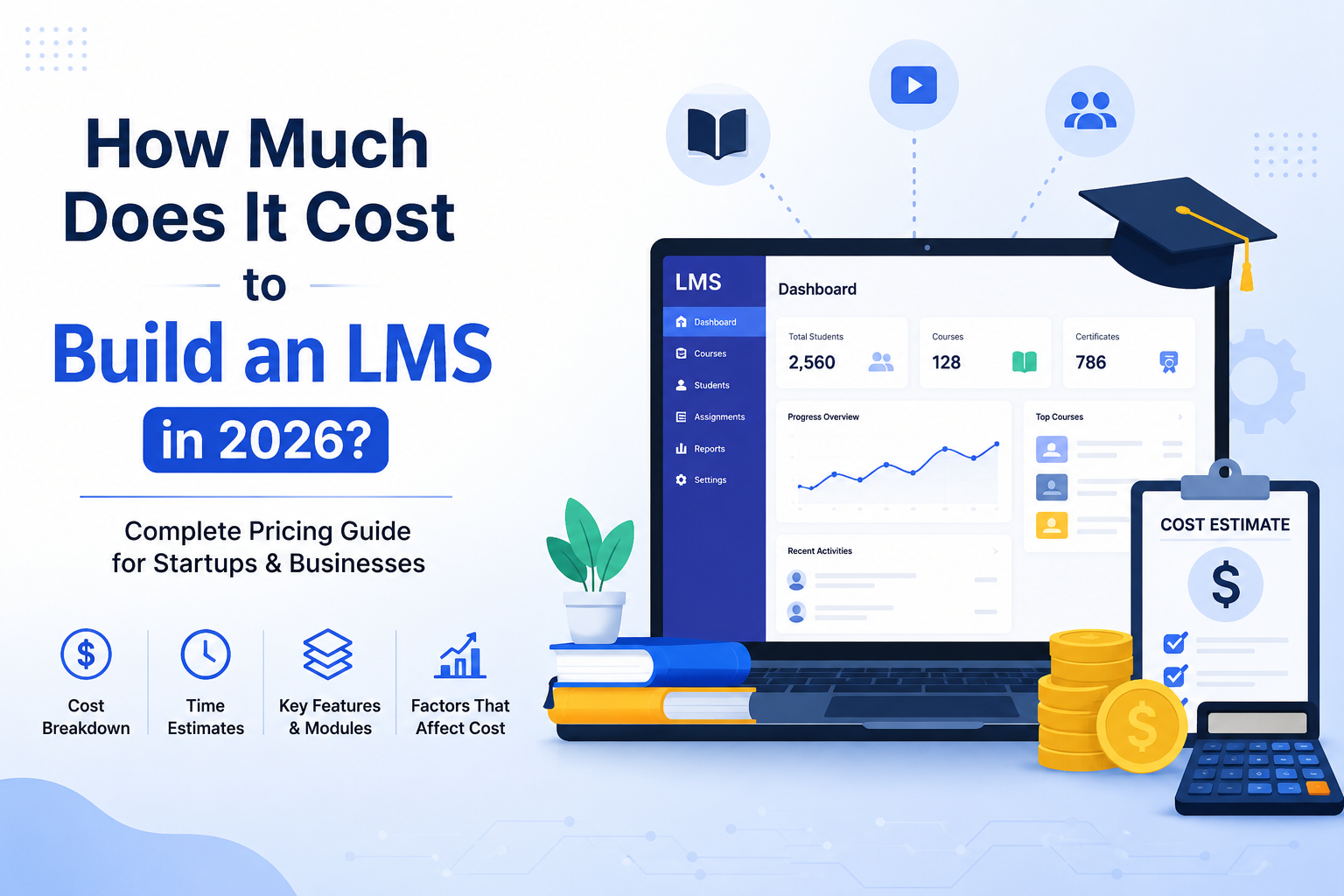

The short answer: Expect to pay anywhere from $25,000 for a basic custom LMS to over $150,000+ for an advanced enterprise system, while ready-made solutions can cost as little as $89 per month. Ultimately, the final cost depends entirely on your feature wishlist and user count.
Building a learning platform isn’t a cheap weekend project. But before you panic about the price tag, let’s break down exactly where your money goes. I’ll walk you through every option, hidden cost, and practical way to save.
Why Building an LMS Is a Big Deal
Let’s be real. Your users expect a seamless experience. They want to log in, find their courses, watch videos without buffering, and track their progress without a hitch .
Building that is like constructing a digital school. You need classrooms (courses), teachers (admin panels), and student records (tracking). It’s a ton of moving parts.
So, when you start budgeting, it’s crucial to understand that you’re not just paying for code. You’re paying for the brains behind the operation .
The Big Question: Which Path Should You Take?
You have three main roads to choose from when buying an LMS. Your choice here is the #1 factor that decides your final bill.
1. SaaS (Subscription) Models
These are the “rental” options like TalentLMS or Docebo. You pay a monthly or annual fee to use their software. It’s hosted on their servers.
The Good: Low upfront cost, no tech headaches, and they handle all the updates .
The Bad: The price skyrockets as your user count grows. Plus, you don’t own the code.
2. Open-Source (Free Software)
Think of platforms like Moodle. The software itself is free to download. Sounds amazing, right? Not so fast .
The Catch: You still need to pay for hosting, security, and a developer to set it up and customize it. If you don’t have an in-house tech team, this can actually end up costing more than a subscription .
3. Custom Development (Built from Scratch)
This is like building your own house instead of renting an apartment. You hire developers to create exactly what you envision .
The Good: You own everything. It can do exactly what you want and scale infinitely without per-user fees .
The Bad: It’s expensive and takes a long time to build.
Breaking Down Custom Development Costs
If you choose to build from scratch, your cost is usually broken down by development hours. Here is a realistic look at the ranges based on complexity .
Simple LMS ($25,000 – $35,000)
This is the “bare-bones” version. It handles basic sign-ins, course creation, and simple quizzes. It’s perfect for a small organization that doesn’t need fancy features.
Basic LMS ($35,000 – $50,000)
At this level, you can start adding subscription options for students and a wider variety of question types. It’s a step up but still a bit clunky.
Full-Fledged LMS ($50,000 – $80,000)
Here’s where things get interesting. You get a polished user interface, progress monitoring, certificates, and personalized recommendations for your users .
Advanced Enterprise ($80,000 – $150,000+)
This is the top tier. We’re talking AI-driven learning paths, complex gamification, advanced analytics, and integrations with your HR or CRM software .
| Complexity Level | Estimated Cost | Timeline |
|---|---|---|
| Simple | $25,000 – $35,000 | 2-3 months |
| Basic | $35,000 – $50,000 | 3-4 months |
| Full-Fledged | $50,000 – $80,000 | 4-6 months |
| Advanced Enterprise | $80,000 – $150,000+ | 8-12+ months |
Source: Estimates based on industry data from software development agencies .
The Hidden Costs That Catch Everyone Off Guard
Here’s the part no one likes to talk about. The “shelf price” of your LMS is rarely the final price. These surprise costs are what often blow up a budget.
1. The “User” Trap
Many SaaS platforms charge “per active user.” Sounds fair, right? But if you have 500 users and only 100 are active, you’re still paying a hefty fee . Custom development means you pay for capacity, not per head.
2. The Content Storage Problem
Video files are huge. If your LMS charges for storage or bandwidth, you could be slapped with a massive bill if your learners love watching your training videos .
3. The Maintenance Monster
This is crucial. If you build a custom LMS, you need to keep it alive. Security patches, bug fixes, and hosting fees can add 20-40% to your initial development cost annually .
4. The “Nice-to-Have” Features
Do you need it to connect to Salesforce or your email marketing tool? Integrations are expensive. Building an API to connect with other services can cost thousands of dollars .
Quick Price Check: SaaS vs. Open Source vs. Custom
It’s easier to see the difference when they’re side-by-side. I’ve put together a quick comparison based on the latest data.
Monthly/Annual Cost
- SaaS (TalentLMS): Starts at ~$119/month .
- Open Source (Moodle): $0 for software, but ~$120+/year for hosting .
- Custom Build: $0 ongoing license, but high initial cost.
Setup Time
- SaaS: Instant (usually).
- Open Source: Weeks to months.
- Custom Build: 3-12+ months.
Ownership
- SaaS: Renting.
- Open Source: You own it, but you host it.
- Custom Build: 100% yours.
User Limits
- SaaS: Capped by tier; pricey to scale.
- Open Source: Limited by your server capacity.
- Custom Build: Limited by your server capacity.
How to Save Money and Avoid Disaster
I believe in working smart, not just working hard. If you don’t have a massive budget, here is how to make your money stretch .
Start with an MVP (Minimum Viable Product)
Don’t try to build the next Google or Netflix on day one. Build a solid base with just the core features: user logins, course creation, and a quiz tool.
See what works. Get feedback. Then, use the revenue from your MVP to build the advanced AI features later.
Pick the Right Team
A huge chunk of your cost is labor. Hiring a developer in North America can cost over $150 an hour . However, teams in regions like Eastern Europe or Asia can deliver the same quality for much less.
Average Developer Rates:
The WordPress Route
If you already have a website or are on a tight budget, plugins like LearnPress or LearnDash are a lifesaver .
They run on your existing WordPress site. For a one-time cost of ~$300 for a pro bundle, you get unlimited courses and students. You avoid the monthly per-user fees altogether .
My Personal Take on LMS Development
Look, I get it. It’s scary to write a check for six figures on a software project. But in my opinion, the worst mistake you can make is buying a cheap SaaS solution that bottlenecks you later.
You think you’re saving money, but you end up paying for expensive add-ons and high-tier upgrades.
If you are planning to scale to thousands of users, investing in a custom LMS or a hybrid solution (like WordPress) gives you peace of mind. You own your data. You control your pricing. You aren’t a hostage to rising subscription fees.
Summary: What’s It Really Going to Cost You?
When you add it all up, there is no one-size-fits-all answer. Here is the bottom line.
- Small Business/Startup: Use a SaaS like TalentLMS (~$100/mo) or WordPress LearnPress (~$300/year). It keeps your costs low while you test the waters.
- Mid-Size Company: You’ll probably hit the limit of SaaS. Budget $50,000-$80,000 for a custom build that can handle your growth.
- Enterprise/University: You need the full power. Be ready to invest $100,000-$250,000+ for a robust, secure, and scalable system.
Take your time, talk to a few developers, and always ask about the hidden maintenance fees.
Frequently Asked Questions
Q: Can I build an LMS for free?
Yes, open-source platforms like Moodle are free. However, you’ll need to pay for hosting, a domain, and a developer to set it up. The “free” option usually ends up costing around $120 per year just for basic hosting .
Q: What is the most expensive part of building an LMS?
The development and design phase usually eats up the largest chunk of the budget. Specifically, building the backend architecture, admin panel, and custom integrations can be extremely costly .
Q: Is it cheaper to use a SaaS LMS or build one?
In the short term, SaaS is cheaper. You pay a small monthly fee. In the long term (3-5 years), custom becomes cheaper because you don’t pay per-user fees. If you have over 500 users, the numbers usually favor owning your own system .
Q: What are the hidden costs of an LMS?
The big ones are transaction fees (if you sell courses), storage fees for video, maintenance and security patches, and integration costs for connecting to your CRM or HR software .
Q: How long does it take to build an LMS?
A simple one can take 3 months. A highly advanced enterprise platform with AI and mobile apps can take anywhere from 8 to 18 months .
Discover more from PratsDigital
Subscribe to get the latest posts sent to your email.