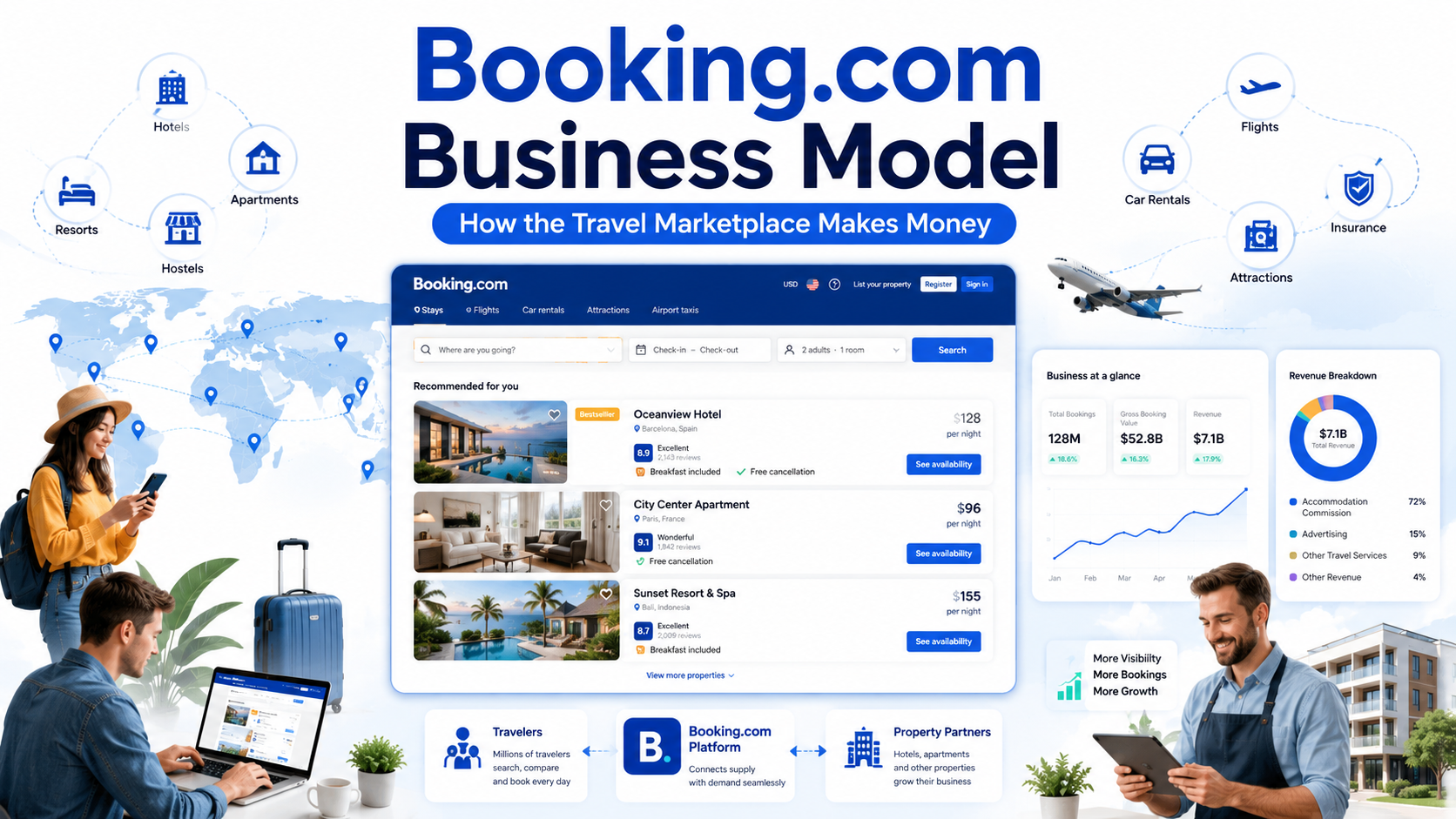
Booking.com is an online travel marketplace that connects travelers with hotels, apartments, flights, and travel services while earning money mainly through commissions and advertising. The platform operates as a massive intermediary between property owners and travelers, taking a percentage cut from each successful booking.
The company has grown into one of the world’s largest travel platforms by creating a win-win ecosystem where hotels get global visibility and travelers get competitive prices with extensive choices.
What Is Booking.com?
Booking.com started in 1996 in Amsterdam, Netherlands. Geert-Jan Bruinsma founded the company with a simple vision of making travel booking easier and more accessible online.
The platform is now owned by Booking Holdings, a publicly traded company that also operates Priceline, Kayak, Agoda, and OpenTable. This parent company creates a powerful network effect across multiple travel brands.
Global Presence
Booking.com operates in over 220 countries and territories. The platform supports 43 languages and offers properties in virtually every destination worldwide. This massive reach makes it one of the most recognized travel brands globally.
The company employs thousands of people across offices in Amsterdam, Singapore, and other major cities. Their technology teams constantly work on improving the platform’s search algorithms, pricing models, and user experience.
Services Offered
While Booking.com started as a hotel booking website, it has expanded significantly:
Accommodation Types
- Hotels and resorts
- Apartments and vacation rentals
- Hostels and budget stays
- Villas and luxury properties
- Bed and breakfasts
Travel Services
- Flight bookings
- Car rentals
- Airport taxis
- Attraction tickets
- Travel insurance
This evolution from a single-service platform to a comprehensive travel ecosystem demonstrates the company’s strategy to capture more value from each customer journey.
How Booking.com Works
The platform operates as a three-sided marketplace connecting travelers, property owners, and service providers.
For Travelers
The booking process is straightforward and designed for quick conversions.
Search and Discovery Users enter their destination, travel dates, and number of guests. The platform instantly shows available properties with real-time pricing and availability.
Comparison and Selection Travelers can filter results by price, location, amenities, and guest ratings. Each property listing includes photos, descriptions, reviews, and detailed information about facilities.
Booking Process Once a traveler selects a property, they enter payment details and confirm the reservation. Booking.com sends instant confirmation via email and app notification.
Payment Options The platform offers flexible payment methods including credit cards, debit cards, and digital wallets. Some properties allow pay-at-property options, reducing upfront payment concerns.
For Hotels and Property Owners
Property owners use Booking.com’s partner portal to manage their listings.
Listing Creation Hotels create detailed profiles with photos, amenities, room types, and pricing. The platform provides guidelines and tools to optimize listings for better visibility.
Inventory Management Property managers update room availability, pricing, and restrictions in real-time. The system integrates with many property management systems for automated updates.
Commission Structure Hotels agree to pay a commission percentage (typically 15-25%) on each booking. This commission is only charged when guests actually complete their stay, not at the time of booking.
Performance Analytics The partner portal provides detailed analytics on listing performance, booking trends, and competitor pricing. This data helps properties optimize their strategy.
For the Platform
Booking.com acts as the intermediary managing the entire ecosystem.
Matching Algorithm The platform uses sophisticated algorithms to match traveler preferences with suitable properties. Machine learning constantly improves search relevance based on booking patterns.
Customer Support Booking.com provides 24/7 customer service in multiple languages. This support covers booking issues, cancellations, and disputes between travelers and properties.
Payment Processing The platform handles all payment transactions, providing security and trust for both parties. This removes friction from the booking process.
Booking.com Business Model Explained
Booking.com operates on a marketplace business model combined with an aggregator approach.
Marketplace Business Model
A marketplace connects two distinct user groups: those who have something to offer (properties) and those who want to buy (travelers). Booking.com does not own the hotels or accommodations it lists.
This asset-light model allows massive scaling without the capital requirements of owning physical inventory. The company invests in technology and marketing instead of real estate.
Platform-Based Economy
The platform creates value by reducing transaction costs and information asymmetry. Before Booking.com, travelers had to call hotels directly or use travel agents. Properties had limited global reach.
The platform solved both problems by creating a centralized marketplace with standardized information, reviews, and booking processes.
Core Business Model Components
Supply Side Inventory
Hotels and Resorts Traditional hotels form the core of Booking.com’s inventory. From budget motels to five-star luxury properties, the platform lists millions of hotel rooms worldwide.
Alternative Accommodations Apartments, vacation rentals, villas, and unique properties compete with traditional hotels. This diversity attracts different traveler segments.
Budget Options Hostels, guesthouses, and budget hotels cater to price-sensitive travelers. These properties benefit from Booking.com’s global reach to fill rooms.
Demand Side Users
Leisure Travelers Vacationers and tourists form the largest segment. They book accommodations for personal travel, seeking value and convenience.
Business Travelers Corporate travelers need reliable booking for work trips. Booking.com’s extensive inventory and flexible cancellation options appeal to this segment.
Digital Nomads Long-term travelers and remote workers use the platform for extended stays. Monthly discounts and apartment listings serve this growing market.
Value Proposition
For Travelers
Convenience tops the list of benefits. Users can compare thousands of properties, read authentic reviews, and book in minutes without phone calls or emails.
Large selection means travelers find exactly what they need. Whether seeking budget hostels or luxury resorts, the platform has options.
Competitive pricing results from hotels competing for visibility. The platform’s price comparison tools help travelers find the best deals.
Reviews and ratings provide social proof. Millions of verified guest reviews help travelers make informed decisions and avoid bad properties.
For Property Owners
Global visibility instantly expands a property’s potential customer base. A small hotel in Thailand can attract guests from Europe, America, and Asia without expensive marketing.
More bookings result from increased exposure. Properties that might sit empty now fill rooms through Booking.com’s massive traffic.
Marketing exposure comes at no upfront cost. Properties only pay commissions on completed bookings, making it a performance-based marketing channel.
Demand generation happens automatically. The platform’s SEO, advertising, and brand recognition drive customers to property listings.
Revenue Model: How Booking.com Makes Money
Booking.com generates revenue through multiple streams, with commissions forming the backbone of its income.
Commission-Based Revenue
This is the primary revenue source, accounting for the majority of Booking.com’s income.
How It Works When a guest books a hotel through Booking.com and completes their stay, the hotel pays a commission. This commission typically ranges from 15% to 25% of the booking value, depending on the property type, location, and competitive landscape.
Merchant vs Agency Model
The agency model is most common. Booking.com acts as an agent, connecting travelers with hotels. The guest pays the hotel directly (or Booking.com collects payment and forwards it), and the hotel pays Booking.com a commission.
The merchant model involves Booking.com purchasing room inventory at wholesale rates and reselling at retail prices. The difference becomes profit. This model is less common but used for certain properties and deals.
Commission Percentage Factors
Location matters significantly. Hotels in competitive markets like Paris or New York might pay higher commissions for premium placement.
Property type influences rates. Luxury hotels may negotiate lower percentages due to their high booking values, while budget properties might pay standard rates.
Visibility boosting costs extra. Properties that want top placement in search results pay higher commission percentages for that privilege.
Advertising Revenue
Hotels and properties can pay for enhanced visibility beyond their organic ranking.
Sponsored Placements Properties can bid for top positions in search results. These sponsored listings appear prominently, driving more bookings. Hotels pay extra commission or flat fees for this visibility.
Visibility Boosting The platform offers various advertising products that increase a property’s exposure. This includes featuring in emails, app notifications, and search result highlights.
Performance Marketing Hotels can set budgets for performance-based advertising where they only pay when they receive bookings from promoted placements.
Booking Fees and Service Charges
Traveler Fees In some markets, Booking.com charges small service fees directly to travelers. These fees vary by region and booking type but generally remain modest to maintain price competitiveness.
Currency Conversion Margins When travelers book in currencies different from the property’s local currency, Booking.com earns a margin on the conversion rate. This passive revenue stream adds up across millions of international bookings.
Cancellation Fees For non-refundable bookings that get canceled, Booking.com may retain a portion of the cancellation fee. This compensates for processing costs and lost commission opportunities.
Partner Services Revenue
Car Rentals Booking.com partners with car rental companies, earning commissions on vehicle bookings made through their platform. This adds value to travelers planning complete trips.
Flight Bookings The platform integrates flight search and booking, earning commissions from airlines and flight aggregators. This moves Booking.com toward becoming a one-stop travel shop.
Travel Insurance Insurance products offered during checkout generate commission revenue. Many travelers add insurance for peace of mind, creating an additional income stream.
Local Experiences Attraction tickets, tours, and activities booked through Booking.com earn commissions. This taps into the growing experiences economy in travel.
Affiliate Partnerships
Booking.com runs an affiliate program where travel bloggers, websites, and influencers earn commissions for referring customers. While this costs Booking.com money, it drives incremental bookings that would not otherwise occur.
The company also receives affiliate commissions when partnering with other platforms and services, creating a two-way revenue opportunity.
Booking.com Pricing Strategy
The platform employs sophisticated pricing tactics to maximize bookings and revenue.
Dynamic Pricing
Real-Time Price Changes Hotel prices on Booking.com fluctuate constantly based on demand, availability, and competitive pricing. Algorithms analyze millions of data points to suggest optimal prices to properties.
Seasonal Demand Prices automatically adjust for peak seasons, holidays, and local events. A beach resort charges premium rates in summer, while ski lodges peak in winter.
Last-Minute Deals Properties often lower prices as check-in dates approach to fill empty rooms. Booking.com’s algorithms identify these opportunities and promote them to price-sensitive travelers.
Discounts and Offers
Genius Loyalty Program Frequent users unlock Genius status, receiving 10-20% discounts at participating properties. This program drives repeat bookings and customer loyalty.
Mobile-Only Discounts App users often see exclusive deals not available on desktop. This strategy pushes users toward the app, which has higher conversion rates and enables push notifications.
Flash Deals Limited-time offers create urgency. “Deal of the Day” and similar promotions drive immediate bookings from bargain hunters.
Psychological Pricing
Urgency Tactics Messages like “Only 1 room left!” or “In high demand” create fear of missing out. These scarcity indicators push hesitant users toward booking.
Social Proof Elements “Booked 5 times in the last 24 hours” and similar messages leverage social proof. Travelers feel more confident booking properties others are choosing.
Price Anchoring Showing crossed-out higher prices next to current rates makes deals seem more valuable. The original price becomes an anchor point for value perception.
Booking.com Marketing Strategy
The company invests heavily in marketing across multiple channels to drive traffic and bookings.
SEO Dominance
Massive Organic Traffic Strategy Booking.com ranks for millions of keywords related to travel and accommodations. Their SEO strategy is one of the most successful in e-commerce.
Destination Landing Pages The platform creates individual pages for countless destinations, from major cities to small towns. Each page targets location-specific search queries.
Long-Tail Keyword Targeting Beyond “hotels in Paris,” Booking.com ranks for ultra-specific queries like “pet-friendly hotels near Eiffel Tower with parking.” This captures high-intent traffic.
User-Generated Content Millions of reviews create fresh, unique content that search engines love. This content continuously updates and expands, improving SEO performance.
Paid Advertising
Google Ads Booking.com spends hundreds of millions annually on Google search ads. They bid on brand terms, destination keywords, and competitor names.
Meta Ads Facebook and Instagram advertising targets users based on travel interests, demographics, and behaviors. Retargeting campaigns follow users who searched but did not book.
Display Advertising Banner ads across the web keep Booking.com top-of-mind. Programmatic advertising targets users showing travel intent signals.
App Marketing
Mobile App Growth The Booking.com app receives heavy promotion through app store optimization, social media, and in-platform messaging encouraging downloads.
Push Notifications App users receive personalized travel deals, price drop alerts, and booking reminders. These notifications drive engagement and repeat bookings.
In-App Experience The app offers a streamlined booking process optimized for mobile. Features like saved searches and one-click rebooking reduce friction.
Email Marketing
Personalized Travel Recommendations Booking.com sends targeted emails based on browsing history, past bookings, and user preferences. Emails showcase relevant properties and destinations.
Re-Engagement Campaigns Abandoned search emails remind users about properties they viewed. Price drop notifications bring users back when rates decrease.
Post-Booking Communication After booking, travelers receive confirmation emails, trip reminders, and suggestions for additional services like car rentals and activities.
Referral and Loyalty Programs
Genius Membership The tiered loyalty program rewards frequent bookers with increasing benefits. This creates switching costs and encourages booking consolidation on Booking.com.
User Retention Tactics Exclusive member deals, early access to sales, and priority customer service keep loyal users engaged and reduce churn to competitors.
Technology Behind Booking.com
Advanced technology powers every aspect of the platform’s operations.
AI and Personalization
Personalized Recommendations Machine learning algorithms analyze user behavior to suggest properties matching individual preferences. Past bookings, searches, and even browsing patterns influence recommendations.
Smart Search Ranking AI determines which properties appear first in search results based on relevance, booking likelihood, and user preferences. This maximizes both user satisfaction and conversion rates.
Chatbots and Virtual Assistants AI-powered chat support handles common questions instantly. Natural language processing understands user queries and provides relevant answers.
Data Analytics
User Behavior Tracking Every click, search, and interaction gets tracked and analyzed. This data reveals patterns that inform product development and marketing strategies.
Dynamic Pricing Optimization Algorithms process millions of data points to help properties optimize their pricing. Factors include competitor rates, demand forecasts, and historical booking patterns.
Conversion Optimization A/B testing runs constantly on every element of the platform. Small improvements in conversion rates multiply across millions of users for significant revenue impact.
Mobile-First Experience
App Usability The mobile app prioritizes speed and simplicity. Travelers can search, compare, and book within minutes on their phones.
Fast Booking Experience Saved payment methods and traveler information enable one-tap booking for returning users. This reduces friction and abandoned bookings.
Offline Functionality The app allows users to access booking confirmations and property details without internet connection. This proves valuable when traveling internationally.
Customer Review System
Trust-Building Mechanism Verified reviews from actual guests create trust in the platform. Booking.com only accepts reviews from users who completed stays, ensuring authenticity.
Review Moderation While encouraging honest feedback, the platform moderates reviews to prevent abuse, profanity, and irrelevant content. This maintains review quality.
Response Mechanism Properties can respond to reviews, addressing concerns and thanking guests. This interaction demonstrates customer service quality to future bookers.
Network Effects in Booking.com’s Business Model
The platform benefits from powerful network effects that create competitive moats.
The Marketplace Flywheel
More Hotels Lead to More Customers Greater property selection attracts more travelers. Users choose platforms with the most options, increasing Booking.com’s value proposition.
More Customers Lead to More Hotels Higher traveler traffic attracts more properties to list on the platform. Hotels want access to Booking.com’s massive customer base.
Self-Reinforcing Growth This cycle accelerates over time. As both sides grow, the platform becomes increasingly valuable to each group, making it harder for competitors to catch up.
Data Network Effects
More bookings generate more data. This data improves personalization, pricing algorithms, and search relevance. Better algorithms drive more bookings, creating another reinforcing loop.
Reviews accumulate over time, providing newer properties and destinations with social proof. Established listings with thousands of reviews become even more attractive.
Competitive Advantages of Booking.com
Several factors help Booking.com maintain market leadership.
Huge Global Inventory
The platform lists over 28 million accommodation options worldwide. This massive inventory makes it difficult for travelers to find better selection elsewhere.
Properties in obscure destinations give Booking.com an edge. While competitors focus on popular tourist areas, Booking.com covers everywhere.
Strong Brand Recognition
Decades of operation and billions in marketing have made Booking.com a household name. Brand recognition reduces customer acquisition costs and increases direct traffic.
Trust in the brand leads to higher conversion rates. Users familiar with Booking.com book faster than those using unfamiliar platforms.
SEO Authority
Booking.com’s domain authority and vast content library make it nearly unbeatable in search rankings. Competing for visibility against them requires enormous investment.
Millions of indexed pages target every conceivable travel-related query. This SEO moat took years to build and remains difficult to replicate.
User Trust Through Reviews
With hundreds of millions of verified reviews, Booking.com offers unprecedented transparency. Travelers trust peer reviews more than marketing claims.
The review system creates accountability for properties. Poor-quality hotels face consequences through low ratings, while excellent properties gain visibility.
Localization Excellence
Support for 43 languages and local currencies makes the platform accessible worldwide. Travelers book confidently in their native language with familiar payment methods.
Localized content, customer service, and marketing campaigns resonate better than one-size-fits-all approaches from competitors.
Competitors of Booking.com
The online travel market includes several strong competitors.
Airbnb
Airbnb focuses primarily on vacation rentals and unique stays. Their peer-to-peer model differs from Booking.com’s property-focused approach.
While Airbnb excels in alternative accommodations, Booking.com dominates traditional hotel bookings. The two platforms increasingly compete as both expand their offerings.
Expedia
Expedia operates a similar commission-based model with comparable hotel inventory. The company also owns Hotels.com, Orbitz, and other travel brands.
Expedia competes directly on price and selection. Market share battles between these giants involve massive advertising spending.
Agoda
Owned by Booking Holdings (like Booking.com), Agoda focuses on the Asia-Pacific market. The two brands serve different geographic segments under the same corporate umbrella.
Agoda’s regional expertise in Asia complements Booking.com’s global presence. This multi-brand strategy captures more market share overall.
Tripadvisor
Tripadvisor started as a review platform but now facilitates bookings through partnerships. Their strength lies in user-generated content and destination information.
While Tripadvisor attracts research traffic, they often redirect bookings to other platforms, including Booking.com, through affiliate relationships.
MakeMyTrip
This Indian company dominates the South Asian market with local expertise and payment options. Regional players like MakeMyTrip compete effectively in their home markets.
Booking.com competes for Indian travelers but faces strong local competition from established regional brands.
Platform Comparison
| Feature | Booking.com | Airbnb | Expedia |
|---|---|---|---|
| Main Focus | Hotels & all accommodations | Vacation rentals & experiences | Full travel packages |
| Revenue Model | Commission (15-25%) | Service fees (host & guest) | Commission & merchant |
| Inventory Size | 28M+ properties | 7M+ listings | 3M+ properties |
| Founded | 1996 | 2008 | 1996 |
| SEO Strength | Extremely strong | Strong | Very strong |
| Loyalty Program | Genius | Superhost/Superguest | Expedia Rewards |
| Unique Stays | Growing | Core offering | Limited |
| Flight Booking | Yes | Limited partnerships | Yes, comprehensive |
Challenges in Booking.com’s Business Model
Despite success, the platform faces ongoing challenges.
High Competition
The online travel market attracts constant new entrants and aggressive competition from established players. Price wars and commission battles pressure profit margins.
Hotels increasingly develop direct booking channels to avoid commission costs. “Book direct” campaigns from hotel chains threaten Booking.com’s intermediary role.
Dependence on Google Traffic
A significant portion of Booking.com’s traffic comes from Google search. Algorithm changes or increased competition for keywords could dramatically impact customer acquisition.
Rising Google Ads costs squeeze marketing ROI. As competition intensifies, the cost to acquire each customer through paid search increases.
Commission Pressure
Hotels resist high commission rates, viewing them as excessive. Some properties limit inventory on Booking.com or offer better rates through direct channels.
Rate parity clauses face regulatory scrutiny. Several countries have banned or limited Booking.com’s ability to require hotels to offer their lowest rates on the platform.
Fake Reviews and Trust Issues
Despite verification systems, fake reviews occasionally slip through. Competitors may post negative reviews, or properties might attempt to manipulate ratings.
Maintaining review authenticity requires constant vigilance and sophisticated fraud detection. Trust erosion from fake reviews could damage the platform’s core value proposition.
Regulatory Challenges
Different countries impose varying regulations on online travel platforms. Compliance complexity increases as Booking.com expands globally.
Tax collection requirements, consumer protection laws, and competition regulations create operational hurdles. Some jurisdictions impose fees or restrictions on online booking platforms.
Future Growth Opportunities
Booking.com continues evolving to capture new revenue streams.
AI-Based Travel Planning
Advanced AI could create complete trip itineraries, not just accommodation bookings. Imagine describing your ideal vacation and receiving a fully planned trip with hotels, activities, and transportation.
Conversational AI assistants might replace traditional search interfaces. Natural language processing could understand complex travel preferences and constraints.
Sustainable Travel
Growing environmental consciousness creates opportunities for eco-focused features. Highlighting sustainable properties and carbon-neutral travel options appeals to conscious travelers.
Carbon offset programs integrated into booking could generate additional revenue while supporting environmental goals.
Expansion Into Experiences
Beyond accommodations, the experiences market offers massive potential. Tours, activities, dining reservations, and event tickets represent incremental booking opportunities.
Creating a comprehensive travel ecosystem where Booking.com handles every aspect of a trip increases customer lifetime value.
Smart Travel Ecosystem
Integration with smart home devices, wearables, and IoT could create seamless travel experiences. Imagine your hotel room adjusting to your preferences automatically upon arrival.
Blockchain technology might streamline identity verification, payments, and loyalty programs across the travel industry.
Emerging Markets Growth
Developing countries with growing middle classes represent massive opportunities. As more people gain disposable income for travel, Booking.com can capture this new demand.
Localization for emerging markets requires understanding unique payment methods, cultural preferences, and infrastructure limitations.
Lessons Businesses Can Learn From Booking.com
The platform’s success offers valuable insights for other companies.
Marketplace Scaling
Building both supply and demand simultaneously is crucial. Booking.com mastered the chicken-and-egg problem by initially focusing on getting hotels onboard, then driving traffic through marketing.
Network effects create defensible moats. Once a marketplace reaches critical mass, it becomes increasingly difficult for competitors to displace it.
Trust-Based Marketing
User reviews and transparency build trust more effectively than traditional advertising. Booking.com’s review system differentiates it from competitors and drives conversion.
Authenticity matters in the digital age. Verified reviews from real customers carry more weight than marketing claims.
SEO as Growth Engine
Organic search can be the most cost-effective customer acquisition channel. Booking.com’s investment in SEO created a sustainable competitive advantage.
Content creation at scale requires systems and processes. Destination pages, reviews, and property descriptions generate millions of indexed pages.
Data-Driven Personalization
Using data to personalize experiences increases conversion and customer satisfaction. Every user interaction creates data that improves the platform.
Machine learning and AI amplify human decision-making. Algorithms can process far more data than humans to optimize pricing, search results, and recommendations.
Customer-Centric UX
Reducing friction in the booking process directly impacts revenue. Every unnecessary click or form field costs bookings.
Mobile optimization is no longer optional. With most travel searches happening on mobile devices, mobile-first design is essential.
Final Verdict
Booking.com became one of the world’s most valuable travel companies by perfecting the marketplace business model. The platform creates value for both travelers and properties while capturing a portion of each transaction through commissions.
Their success stems from combining powerful technology, massive marketing investment, and relentless focus on user experience. SEO dominance drives organic traffic, while paid advertising maintains top-of-mind awareness.
Trust built through verified reviews differentiates Booking.com from competitors. Travelers rely on peer feedback to make confident booking decisions, and properties benefit from transparent reputation systems.
The network effects inherent in marketplace models create competitive moats. More hotels attract more travelers, which attracts more hotels in a self-reinforcing cycle. Breaking this cycle requires enormous investment from competitors.
Booking.com’s evolution from simple hotel booking site to comprehensive travel ecosystem demonstrates strategic vision. By expanding into flights, car rentals, and experiences, they increase customer lifetime value and reduce dependence on any single revenue stream.
The commission-based revenue model aligns incentives between the platform and properties. Hotels only pay for results, making Booking.com a performance marketing channel rather than a cost center.
While challenges exist around competition, commission pressure, and regulatory scrutiny, Booking.com’s scale and brand strength position them well for continued success. Future growth opportunities in AI, sustainable travel, and emerging markets offer paths to sustained revenue expansion.
Discover more from PratsDigital
Subscribe to get the latest posts sent to your email.