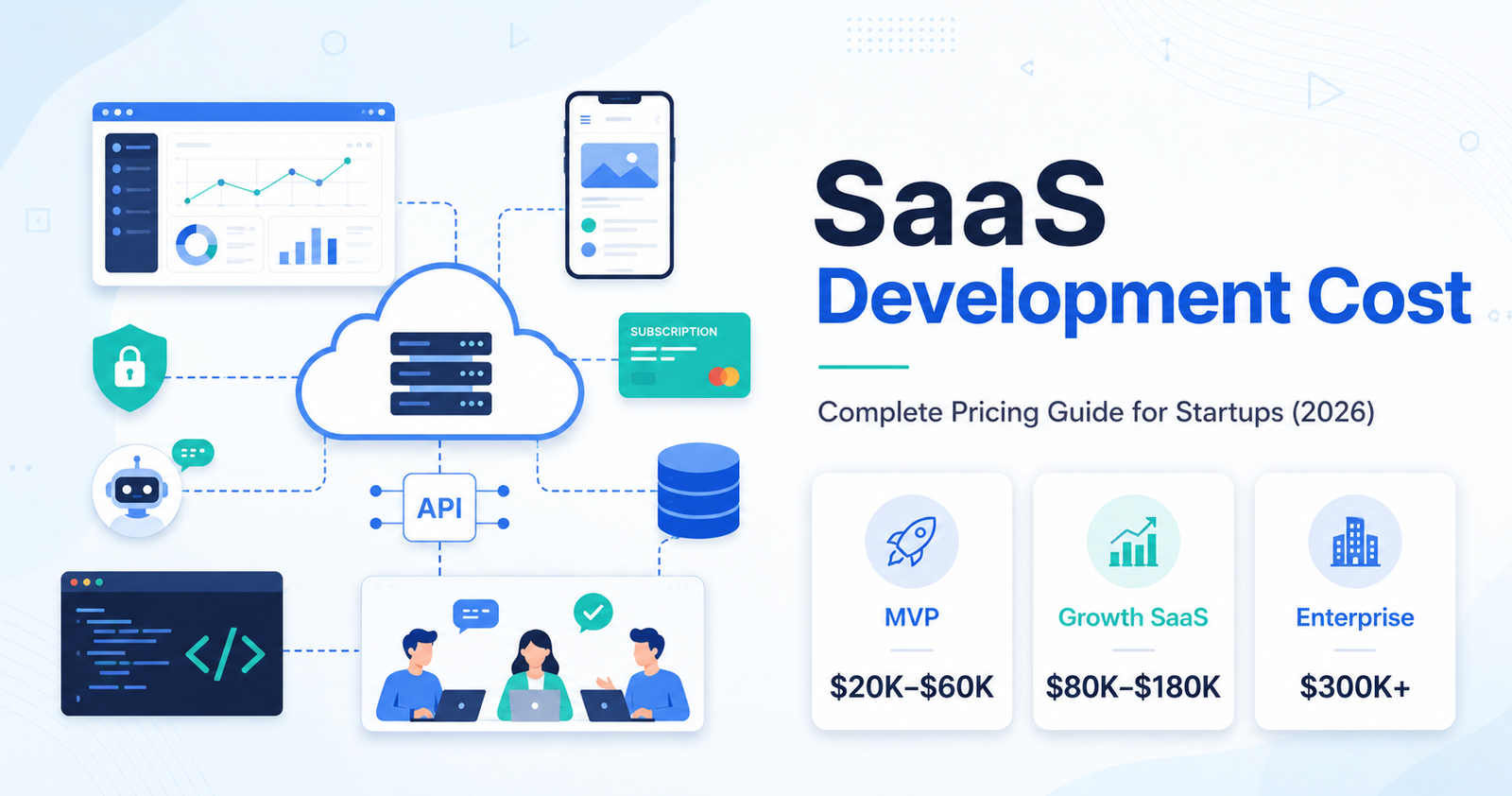
How Much Does It Cost to Build a SaaS Product? Complete SaaS Development Cost Guide

SaaS development costs vary dramatically based on product complexity, features, integrations, security requirements, team location, and scalability. A basic SaaS MVP typically costs between $20,000 and $60,000, while enterprise SaaS platforms can exceed $300,000, with some complex implementations reaching $1 million or more .
Introduction
SaaS has become the preferred software model for businesses of all sizes because it offers predictable subscription costs, automatic updates, and accessibility from anywhere with an internet connection. Companies like Slack, Notion, Shopify, and Zoom have proven that cloud-based software can scale to serve millions of users while generating recurring revenue.
Why does SaaS development pricing vary so dramatically? The answer lies in the countless decisions that shape a project: feature scope, technology choices, team location, security requirements, and scalability needs. A simple appointment booking tool costs a fraction of what a healthcare platform with HIPAA compliance demands.
This guide covers everything founders, entrepreneurs, and investors need to know about SaaS development costs in 2026. We will break down costs by project stage, complexity level, feature set, and team location, while highlighting hidden expenses that often catch businesses off guard.
What Is SaaS Development?
SaaS development refers to building cloud-hosted software applications that customers access through a subscription model. Unlike traditional software that requires installation on individual computers, SaaS products run on centralized servers and serve multiple customers simultaneously through a multi-tenant architecture.
Popular examples include Slack for team communication, Notion for documentation, Shopify for e-commerce, Canva for design, and Zoom for video conferencing. These platforms share common characteristics: they are cloud-based, subscription-driven, and built to scale.
How Much Does SaaS Development Cost?
| SaaS Type | Estimated Cost |
|---|---|
| SaaS MVP | $20,000–$60,000 |
| Basic SaaS | $40,000–$90,000 |
| Medium Complexity | $80,000–$180,000 |
| Advanced SaaS | $150,000–$350,000 |
| Enterprise SaaS | $300,000–$1M+ |
These estimates represent typical market ranges for projects with clearly defined scope and disciplined execution . The wide variation reflects differences in feature complexity, integration requirements, team composition, and architectural decisions. A product built by an offshore team will cost significantly less than one built by a US-based agency for the same feature set.
SaaS Development Cost by Project Stage
Discovery and Planning
Market research, requirement gathering, wireframing, and technical architecture planning form the foundation of any successful SaaS project. Skipping this phase to save money often leads to costly rework later. A proper discovery phase typically prevents three times its cost in rework by catching architectural mistakes before they become expensive technical debt .
Estimated cost: $3,000–$10,000
UI/UX Design
User flows, dashboard design, mobile responsive layouts, and design systems require professional attention. A confusing dashboard is the fastest way to lose paying customers in their first week. Investment in quality design from the start is your single most important retention lever.
Estimated cost: $5,000–$20,000
Frontend Development
React, Vue, and Angular are the most popular frontend frameworks for SaaS development. React leads the market due to its component-based architecture and extensive ecosystem. The choice of framework affects development speed and hiring costs.
Estimated cost: Varies based on complexity and screen count
Backend Development
APIs, authentication, business logic, and databases form the backbone of any SaaS application. Backend development typically accounts for 25 to 35 percent of the total project budget .
Estimated cost: $20,000–$100,000+
Database Architecture
PostgreSQL, MongoDB, and Redis each serve different use cases. PostgreSQL works well for relational data, MongoDB for document storage, and Redis for caching. The choice impacts performance and scalability.
Estimated cost: $5,000–$20,000
Cloud Infrastructure
AWS, Azure, and Google Cloud provide the infrastructure for hosting SaaS applications. Monthly hosting costs range from $50 to $200 for a simple MVP and can exceed $5,000 per month as user bases scale .
Admin Dashboard
Admin dashboards require role-based permissions, user management, and system monitoring capabilities. The complexity of administration features directly impacts development cost.
Estimated cost: $5,000–$25,000
API Development
Well-designed APIs enable integrations with other systems. REST and GraphQL are the most common approaches, with GraphQL offering more flexibility at higher initial development cost.
Estimated cost: $3,000–$15,000
Third-party Integrations
Stripe, PayPal, Twilio, OpenAI, Google Workspace, and Slack are common integrations. Every API connection adds both time and cost, with complex integrations ranging from $2,000 to $10,000 each depending on API depth .
Security Implementation
SSL, multi-factor authentication, role-based access control, encryption, and compliance measures protect user data. Security is not optional and must be built in from the start.
Estimated cost: $5,000–$30,000+
Testing and Quality Assurance
Functional, integration, and regression testing ensure product reliability. Testing typically accounts for 8 to 12 percent of total development cost .
Estimated cost: $5,000–$25,000
Deployment
CI/CD pipeline setup, cloud configuration, and environment management prepare the product for launch.
Estimated cost: $3,000–$10,000
Ongoing Maintenance
Monthly maintenance covers bug fixes, security patches, dependency updates, and performance tuning. A reasonable maintenance budget is 15 to 20 percent of the initial development cost per year .
Estimated monthly cost: $1,500–$8,000+
SaaS Development Cost by Complexity
Basic SaaS
Examples include appointment booking systems and lightweight CRM tools. These applications feature basic user authentication, simple dashboards, and minimal integrations.
Estimated cost: $25,000–$50,000
Medium SaaS
HR software, inventory management systems, and project management tools fall into this category. These products include advanced user management, third-party integrations, and enhanced data analytics.
Estimated cost: $50,000–$150,000
Enterprise SaaS
ERP systems, healthcare platforms, and financial technology solutions require robust security, compliance certifications, and complex workflows. Enterprise SaaS platforms demand stronger security, deeper compliance, real multi-tenant architecture, and cloud deployment built to hold up at actual scale .
Estimated cost: $150,000–$500,000+
SaaS Development Cost by Business Type
| Business Type | Estimated Cost |
|---|---|
| Startup MVP | $20,000–$60,000 |
| SMB SaaS | $40,000–$120,000 |
| Enterprise SaaS | $150,000–$500,000+ |
| Marketplace SaaS | $80,000–$250,000 |
| AI SaaS | $150,000–$450,000+ |
AI SaaS platforms cost more because the model training, data processing, and integration into workflows add significant complexity . Healthcare and fintech SaaS carry compliance requirements that add 20 to 50 percent to the budget .
SaaS Development Cost by Team Location
| Region | Hourly Rate |
|---|---|
| India | $25–$60 |
| Eastern Europe | $40–$85 |
| USA | $100–$150+ |
| UK | $80–$150+ |
| Australia | $80–$130+ |
Offshore development can cut engineering costs to roughly one quarter of US rates, but only if you have strong in-house technical leadership managing the specification and quality . Without that management layer, offshore productivity falls and the savings disappear.
Factors That Affect SaaS Development Cost
Number of Features
Every feature adds scope, time, and complexity. User authentication, payment integration, and AI features each contribute to the total cost. Product complexity and feature scope are the most significant cost drivers .
Multi-Tenant Architecture
Multi-tenancy enables a single instance of the software to serve multiple customers while keeping data isolated. Building multi-tenant architecture from day one avoids expensive rewrites later .
User Roles and Permissions
Basic products operate with two to three user roles. Enterprise platforms often require granular role-based access control with custom permission hierarchies, significantly increasing backend development complexity and QA time .
Reporting Dashboard
A few simple charts are cheap. Real-time data across thousands of users is a different project entirely .
Mobile App Support
Native mobile apps add significant cost. Cross-platform frameworks like React Native offer more budget-friendly alternatives.
API Integrations
Every CRM, ERP, or payment gateway connection adds its own testing and upkeep requirements .
Scalability
Building for scale costs more upfront but prevents expensive rewrites later.
Security Compliance
GDPR, HIPAA, and SOC 2 requirements add significant cost. Building compliance in from the start is cheaper than retrofitting .
DevOps Infrastructure
CI/CD pipelines, monitoring, and automated deployments require ongoing investment.
Third-Party Licenses
External service fees add up quickly. Map out every external service your product depends on and price out the usage tiers at different growth stages .
SaaS Development Cost by Feature
| Feature | Estimated Cost |
|---|---|
| User Login and Authentication | $2,000–$8,000 |
| Dashboard | $3,000–$15,000 |
| Subscription Billing | $5,000–$20,000 |
| Chat | $5,000–$25,000 |
| Notifications | $3,000–$10,000 |
| Analytics | $5,000–$30,000 |
| Admin Panel | $5,000–$25,000 |
| AI Chatbot | $10,000–$50,000+ |
| Search | $3,000–$15,000 |
| Reporting | $5,000–$20,000 |
These estimates vary based on implementation complexity and integration requirements. AI features cost swings wildly depending on the model, the data feeding it, and how deeply it is wired into the actual workflow .
Hidden Costs Most Founders Forget
Cloud hosting fees grow with user volume. CDN costs increase with traffic. Domain registration and SSL certificates require annual renewal. Monitoring tools like Datadog or New Relic add monthly expenses. Customer support platforms like Intercom or Zendesk charge per user. Analytics services like Mixpanel or Amplitude have usage-based pricing. Email services like SendGrid or Mailchimp scale with volume. Third-party API usage incurs charges. Regular backups require storage. Security audits and penetration testing add significant expense.
Infrastructure costs scale with your business. The issue is they don’t always scale predictably. Build a realistic cost projection before launch and revisit it every quarter .
SaaS MVP Cost
A Minimum Viable Product is a working product, not a rough demo. It is the smallest version that delivers real value to real customers and generates feedback you can learn from . MVPs include core authentication, basic workflows, and simple subscription mechanics. They exclude advanced features, complex integrations, and enterprise-level security.
Typical pricing ranges from $20,000 to $60,000, with a timeline of three to five months .
SaaS Development Timeline
| Stage | Estimated Time |
|---|---|
| Planning | 2–4 weeks |
| Design | 3–6 weeks |
| Development | 3–6 months |
| Testing | 2–4 weeks |
| Launch | 1–2 weeks |
A simple MVP typically takes three to five months. Mid-level products run five to nine months. Enterprise builds with complex integrations and compliance requirements can extend beyond a year .
How to Reduce SaaS Development Cost
Build an MVP first to validate your idea before committing full budget . Prioritize core features using the MoSCoW framework: Must Have, Should Have, Could Have, Won’t Have . Reuse components and proven libraries instead of building everything from scratch. Use cloud services for infrastructure rather than maintaining physical servers. Choose scalable architecture from day one to avoid expensive rewrites. Avoid overengineering features that can be simplified. Automate testing to catch issues early. Use agile development methodologies to adapt quickly. Outsource wisely to regions with competitive rates while maintaining quality oversight.
Every feature you defer costs nothing now. Features you build must be developed, tested, documented, and maintained .
Build In-House vs SaaS Development Company
| Factor | In-House | Development Company |
|---|---|---|
| Cost | Higher | Lower to moderate |
| Time | Slower to start | Faster ramp-up |
| Expertise | Limited to hires | Broad team expertise |
| Scalability | Slower to scale | Flexible scaling |
| Maintenance | Ongoing overhead | Handoff after build |
| Communication | Direct | Managed |
| Long-term ROI | Higher after years | Good for initial build |
A good development agency brings a full cross-functional team without the overhead of full-time salaries across every role. The key is picking a partner with relevant experience. A team that has built similar products before can save you from architectural decisions that look fine early and cause problems at scale .
Why Businesses Choose Custom SaaS Development
Custom SaaS development offers full ownership of intellectual property, the ability to scale on your terms, better security through controlled architecture, seamless integrations with existing systems, competitive advantage through unique features, and automation of internal workflows.
The build versus buy decision requires a five-year lens. Buying almost always looks cheaper in year one. By year three, the lines converge. By year five, custom software often has lower total cost of ownership .
Common Mistakes That Increase SaaS Development Cost
No clear requirements lead to scope creep and rework. Feature creep adds features that don’t serve the core value proposition. Poor UI planning results in user churn and redesign costs. Ignoring scalability forces expensive rewrites later. Weak testing allows bugs to compound. Delayed feedback from stakeholders slows development. Wrong technology stack limits hiring and increases maintenance.
The most expensive MVP feature is the one you build before validating it. Establish a brutal MVP scope document with explicit must have, should have, and won’t have designations before any code is written .
Conclusion
SaaS development costs vary based on complexity, features, architecture, integrations, and long-term scalability. Building an MVP first helps validate the idea while controlling costs. Choosing the right technology stack and experienced development team can significantly improve ROI and reduce future maintenance expenses.
The initial build is the smallest part of total SaaS development costs. Ongoing engineering, infrastructure, and maintenance dwarf it within 18 months. Well-managed development spend that builds a real, systematized engineering capability raises your company’s valuation and positions you for long-term success .
Build Your SaaS Product with Confidence
Whether you are validating a startup idea or planning an enterprise-grade SaaS platform, understanding development costs is the first step toward a successful launch. At PratsDigital, we help founders estimate budgets, define feature roadmaps, and connect with experienced development teams to build scalable SaaS products efficiently.
Ready to estimate your SaaS development cost? Contact PratsDigital for a personalized consultation and project cost breakdown.
Frequently Asked Questions
How much does SaaS development cost?
The average SaaS development cost ranges from $20,000 to $500,000+, depending on product complexity, features, integrations, security requirements, team location, and scalability. A basic SaaS MVP typically costs $20,000 to $60,000, while enterprise SaaS platforms can exceed $300,000 .
How much does it cost to build a SaaS MVP?
A focused MVP typically runs $20,000 to $60,000. A mid-level product with more features and integrations falls between $50,000 and $120,000. Enterprise SaaS starts at $120,000 and scales with complexity, compliance requirements, and infrastructure .
What factors affect SaaS development cost?
Product complexity, feature scope, and team structure move the number more than anything else. Compliance requirements and third-party integrations add significantly for specific product categories .
Is SaaS expensive to maintain?
A reasonable maintenance budget is 15 to 20 percent of the initial development cost per year. Monthly support and maintenance can range between $1,500 and $8,000 or more depending on the product’s scale and complexity .
How long does SaaS development take?
An MVP typically takes three to five months. Mid-level products run five to nine months. Enterprise builds with complex integrations and compliance requirements can extend beyond a year .
How much does cloud hosting cost?
A simple MVP runs on $50 to $200 per month. As your user base scales, infrastructure costs can climb to $5,000 per month or more .
How much does enterprise SaaS cost?
Enterprise SaaS platforms range from $300,000 to $700,000 or more. Enterprise just needs more across the board: stronger security, deeper compliance, real multi-tenant architecture, and cloud deployment built to hold up at actual scale .
Should startups build an MVP first?
Yes. Build the core use case only. Skip anything that isn’t essential to validating your product. You can get to a real working product in the $20,000 to $35,000 range with a disciplined MVP approach .
Is outsourcing SaaS development cheaper?
For most startups and growing businesses, yes. A good agency brings a full cross-functional team without the overhead of full-time salaries across every role. Teams from regions with lower living costs offer significant savings while maintaining quality .
Can AI features increase SaaS development cost?
Yes. AI features can significantly increase development cost. Cost swings wildly depending on the model, the data feeding it, and how deeply it is wired into the actual workflow .
Discover more from PratsDigital
Subscribe to get the latest posts sent to your email.

[…] six figures on a software project. But in my opinion, the worst mistake you can make is buying a cheap SaaS solution that bottlenecks you […]