Hiring Developers vs Outsourcing Software Development: Which Costs Less in 2026?

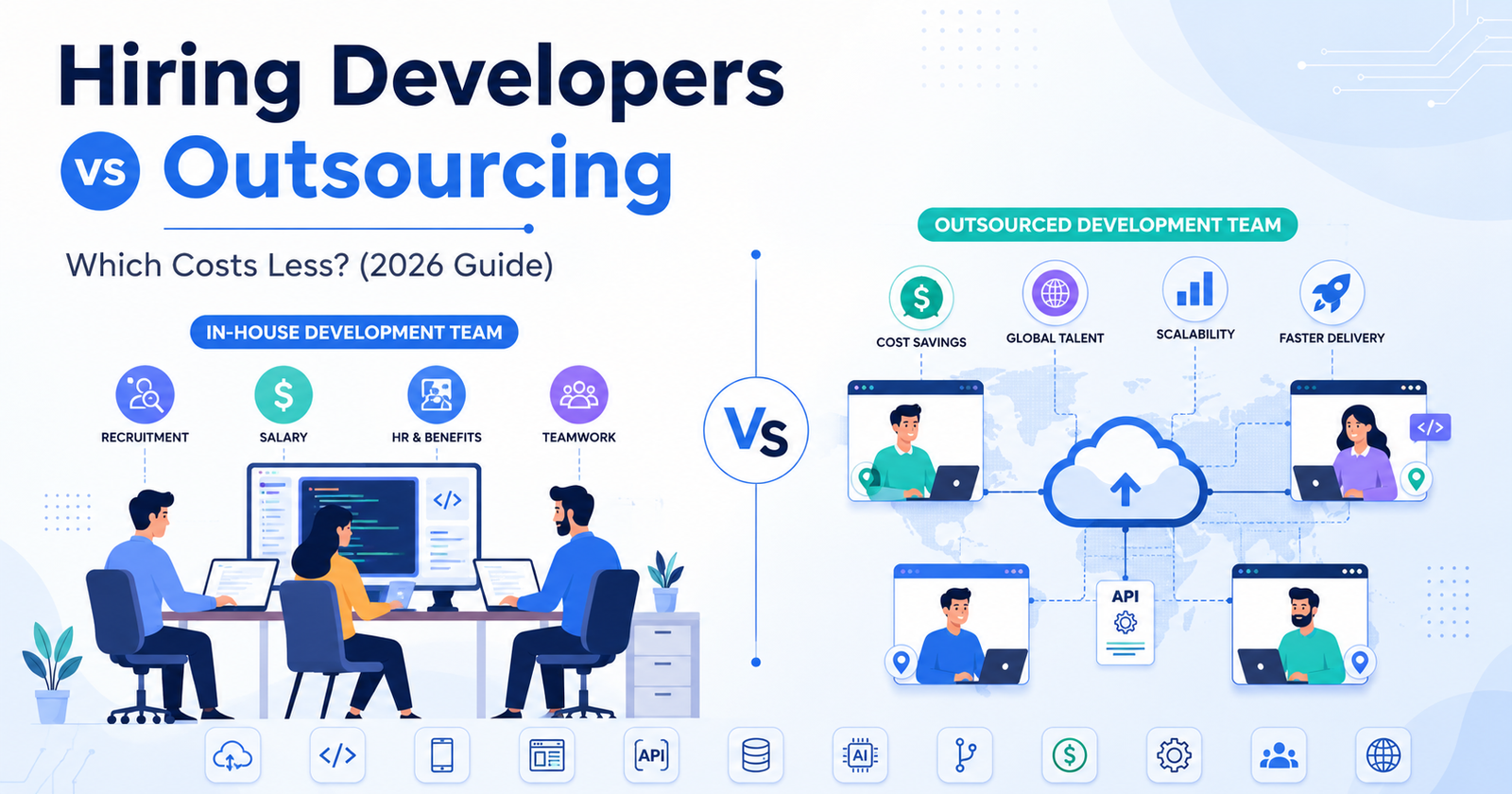
Hiring developers usually costs more in the long run because of salaries, recruitment, benefits, infrastructure, and management overhead. Outsourcing software development often reduces upfront costs and gives businesses access to experienced teams. The better choice depends on project size, budget, timeline, and long-term business goals.
Many businesses struggle to choose between hiring developers and outsourcing software development. The decision affects your budget, timeline, product quality, and company structure for years.
A common misconception is that hiring is always better because you have more control, or that outsourcing is always cheaper but lower quality. Neither is entirely true. The real answer depends on your specific situation.
This guide compares the true costs of both approaches in 2026. We break down salaries, hidden expenses, recruitment fees, and long-term total cost of ownership. You will learn when each model makes sense and how to avoid costly mistakes.
What Does Hiring Developers Mean?
Hiring developers means building an in-house software team that works exclusively for your company as full-time employees.
This process includes recruiting candidates, conducting interviews, and making offers. You pay competitive salaries plus benefits like health insurance, retirement plans, and paid time off. You also provide office space or remote setup, equipment, software licenses, and ongoing training. HR costs and management overhead add to the total.
Hiring involves long-term commitment. Employees expect career growth, raises, and job security. If your project ends or pivots, you still have payroll obligations. This model gives you full control but requires significant resources.
What Is Software Development Outsourcing?
Software outsourcing means hiring an external software company or dedicated development team to build and maintain your application.
There are different types of outsourcing. Offshore outsourcing uses teams in distant countries like India or Southeast Asia, typically offering the lowest rates. Nearshore outsourcing uses teams in nearby regions like Eastern Europe or Latin America, balancing cost with time zone overlap. Onshore outsourcing uses teams in your own country, offering the most alignment but highest costs.
Dedicated development teams work exclusively on your product, integrating with your workflows while being employed by the outsourcing partner. Project-based outsourcing handles defined deliverables on a fixed budget. Each model has different cost structures and benefits.
Hiring Developers vs Outsourcing Software Development: Cost Comparison
The table below compares major cost factors between hiring developers and outsourcing.
| Cost Factor | Hiring Developers | Outsourcing |
|---|---|---|
| Recruitment | High (USD 30,000-50,000 per hire) | None (vendor handles) |
| Salary | Very high (USD 150,000-250,000+ annually) | Included in service fee |
| Employee Benefits | Required (25-40% of salary) | Not required |
| Office Equipment | Required (USD 5,000-10,000 per seat) | Not required |
| Software Licenses | Required (USD 300-800 per month per dev) | Usually included |
| Project Management | Internal team required | Shared or included |
| Scaling Team | Slow (months to hire) | Fast (weeks to add members) |
| Maintenance | Internal team | Flexible (vendor or internal) |
Actual Cost Breakdown for 2026
Cost of Hiring an In-House Developer
Most companies underestimate the true cost of hiring by 40-60 percent. Salary is just the beginning.
For a senior software developer in the United States, base salary ranges between USD 150,000 and 250,000 per year. Benefits add 25 to 40 percent of salary, or USD 30,000 to 40,000. Payroll taxes add another USD 8,000 to 15,000. Equipment like laptops, monitors, and software licenses cost USD 5,000 to 10,000. Office space per seat runs USD 5,000 to 15,000 annually. Recruitment costs, amortized over time, add USD 15,000 to 30,000 per hire. Training and conferences cost USD 3,000 to 7,000. Management overhead, including engineering managers and tech leads, adds USD 10,000 to 20,000 per developer.
A developer with a USD 150,000 salary may actually cost your company over USD 200,000 annually after additional expenses. For a team of five developers, you are looking at USD 1 million to 1.3 million per year.
Cost of Outsourcing Software Development
Outsourcing pricing models vary based on location, engagement type, and project scope.
Hourly Pricing
- Junior developers: USD 12-25 per hour (offshore)
- Mid-level developers: USD 25-40 per hour (offshore)
- Senior developers: USD 40-80 per hour (nearshore), USD 60-150 (onshore)
Fixed Price
Fixed price contracts work best for clearly scoped projects like MVPs, small apps, or websites. Typical budgets in 2026 are:
- Small app or MVP: USD 15,000-40,000
- Mid-size platform: USD 40,000-100,000
- Enterprise system: USD 100,000+
Dedicated Team
Dedicated team pricing uses monthly retainers. This model works best for SaaS products, enterprise software, and long-term development. Costs per developer per year typically range from USD 36,000 to 60,000 for offshore teams, compared to USD 200,000 to 300,000 for US-based in-house teams.
This represents 40 to 60 percent savings over in-house teams in the first year. The gap narrows after 2-3 years as your in-house team matures and turnover stabilizes.
Hidden Costs Most Businesses Forget
Several hidden costs catch businesses off guard regardless of which model they choose.
Employee turnover is a major expense. The average US software developer stays at a company for 2.1 years. Replacing a mid-senior engineer costs 50 to 200 percent of their annual salary in recruiting, lost productivity, and knowledge transfer.
Hiring delays create opportunity cost. Filling a senior developer role takes 3 to 6 months. During that time, your product is not shipping features, not responding to user feedback, and not beating competitors to market.
Paid vacations and sick leave add 2 to 4 weeks of paid non-productivity per developer annually. Software subscriptions for development tools, CI/CD pipelines, and monitoring cost USD 300-800 per developer per month.
Team management requires engineering managers at USD 180,000-250,000 per year for every 5 to 7 engineers. Productivity loss occurs during onboarding, which takes 2 to 4 weeks for augmented developers and 3 to 6 months for new hires.
Project delays from scope changes or communication issues can add 15 to 25 percent to total project cost.
Outsourcing-specific hidden costs include requirements documentation at USD 15,000-40,000 for complex projects, project management overhead at 15-25 percent of total budget, and knowledge transfer when the contract ends at 20-30 percent of original project cost.
Advantages of Hiring Developers
Pros
Hiring developers gives you full control over daily activities, priorities, and team culture. You can make immediate changes and have direct access to team members.
Your team builds deep company knowledge over time. They understand your business, customers, and internal processes intimately. This institutional knowledge stays in-house and contributes to long-term product success.
Long-term ownership means the codebase, intellectual property, and technical decisions remain under your control. You are not dependent on a vendor for ongoing work.
Better collaboration comes from same timezone, same office, and shared culture. Communication is faster and alignment is easier.
Security is stronger because you control access, data storage, and compliance measures directly. This is especially important in regulated industries.
Cons
High cost is the biggest drawback. Total cost per developer reaches USD 200,000-300,000 annually.
Slow hiring means it takes months to find, hire, and onboard qualified engineers. During this time, projects stall.
Difficult scaling requires lengthy recruitment processes to expand and difficult decisions to downsize. You cannot easily adjust team size based on workload.
HR management adds significant overhead. You need to handle payroll, benefits, performance reviews, and employee relations.
Advantages of Outsourcing Software Development
Pros
Lower development cost is the primary advantage. Outsourcing saves 40 to 60 percent compared to in-house teams.
Faster project delivery comes from immediate access to skilled engineers. Instead of spending months hiring, you can start delivering in weeks.
Experienced specialists are available on demand. You can access AI experts, blockchain developers, or niche skills without recruiting them yourself.
Easier scaling lets you add or remove team members in weeks, not months. This flexibility is valuable for startups and dynamic markets.
Latest technologies are often already part of the vendor’s toolset. You benefit from their investment in modern frameworks and best practices.
Reduced hiring effort means no recruitment costs, no interview time, and no HR management for those team members.
Cons
Less day-to-day control requires trusting the vendor’s processes and management. You may not have direct oversight of individual developers.
Communication differences can cause misunderstandings and delays. Language barriers, cultural differences, and time zone challenges require extra effort.
Time zone challenges mean limited overlap for real-time collaboration. This can slow feedback cycles and bug resolution.
Vendor dependency creates risk. Switching providers mid-project is painful and costly. You need to transfer code, documentation, and institutional knowledge. Plan for 3 to 4 weeks of reduced velocity.
Cost Comparison by Business Size
Startups
Outsourcing usually offers the lowest initial investment and fastest path to launch. Startups need to validate ideas quickly with limited runway. A fixed-price MVP costs USD 15,000-40,000, far less than hiring a full team.
Small Businesses
Small businesses benefit from outsourcing because they cannot afford the overhead of full-time employees. They need specialized skills for specific projects without long-term commitments. Outsourcing delivers predictable costs and faster execution.
Mid-Sized Companies
Mid-sized companies often use a hybrid approach. They maintain a core internal team for product vision and architecture while outsourcing execution and specialized engineering. This balances cost, control, and speed.
Enterprise Companies
Enterprise companies may find in-house teams worthwhile for long-term products that are core to their business. When software is the product, internal control and institutional knowledge provide competitive advantage. However, many enterprises still outsource non-core projects or use dedicated teams for specific initiatives.
When Hiring Developers Is the Better Choice
Hiring developers is better when software is your core product and competitive advantage. Long-term product development requires deep institutional knowledge that only internal teams can build over time.
Sensitive data or highly regulated industries like healthcare and fintech may require direct employment for compliance reasons. You cannot outsource responsibility for security and data protection.
Continuous feature releases benefit from dedicated teams that understand your product intimately. Fast iteration requires immediate feedback and minimal communication overhead.
Internal software that supports your core operations may require long-term maintenance and deep business integration.
Large engineering departments with hundreds of developers naturally need internal hiring and management. Scale makes outsourcing less practical for core work.
When Outsourcing Is the Better Choice
Outsourcing is better for MVP development. Startups need to validate ideas quickly and cheaply. A fixed-price MVP allows testing the market without large upfront investment.
Startup launch often happens on a tight budget and timeline. Outsourcing provides immediate engineering capacity without months of hiring.
Budget limitations make outsourcing attractive. You get experienced developers at lower rates without benefits and overhead costs.
One-time projects like app rebuilds, migrations, or new product initiatives do not justify full-time hires. Once completed, you do not need ongoing development.
Specialized expertise is hard to recruit locally. Outsourcing gives you access to AI, blockchain, or niche technology specialists.
Tight deadlines require immediate team ramp-up. You cannot wait 3 to 6 months to hire senior engineers. Outsourcing teams can start within weeks.
In-House vs Outsourcing: Real-World Scenarios
Scenario 1: Startup building an MVP
Winner: Outsourcing. A fixed-price MVP for USD 25,000-40,000 lets you test product-market fit without burning runway on full-time salaries. You can iterate based on feedback before committing to a larger investment.
Scenario 2: Enterprise maintaining ERP software
Winner: Hiring. ERP systems require deep institutional knowledge, security compliance, and continuous updates. Internal teams provide long-term stability and control.
Scenario 3: AI startup
Winner: Hybrid. Keep core algorithm development in-house while outsourcing supporting infrastructure, mobile apps, or admin panels. This balances IP protection with cost efficiency.
Scenario 4: Healthcare app
Winner: Depends on compliance requirements. If handling protected health information, internal teams provide stronger control and auditability. If building non-clinical features, outsourcing may be acceptable with proper security agreements.
Hybrid Development Model
Many successful companies use a hybrid development model. They keep product vision and architecture in-house while outsourcing execution and specialized engineering.
A common hybrid structure includes:
- Internal product manager and technical leadership
- Outsourced development team for coding and testing
- External QA specialists
- UI/UX agency for design
- DevOps consultant for infrastructure
This model gives you control over roadmap and architecture while leveraging external expertise for implementation. It balances cost, speed, and quality.
Decision Framework
Answer these questions to determine the best option for your situation.
- Is your budget under USD 100,000?
- Do you need to launch within 3 months?
- Is this a long-term product (over 2 years)?
- Will you need ongoing development and maintenance?
- Do you have technical leadership to manage external teams?
- Is security highly regulated (healthcare, finance, defense)?
If you answered YES to budget under USD 100,000 and launch within 3 months: Outsourcing is likely your best option.
If you answered YES to long-term product, ongoing development, and technical leadership: Hiring or hybrid may be better.
If you answered YES to regulated security: Consider hiring or carefully vet an outsourcing partner with compliance expertise.
Common Mistakes Businesses Make
Hiring too early is a common mistake. Many startups spend their entire seed round on hiring before writing a single line of production code. Build an MVP first, then hire when you have product-market fit.
Choosing the cheapest outsourcing company often leads to poor quality, missed deadlines, and hidden costs. Low rates usually mean low skills, poor communication, and high turnover. Focus on value, not just price.
Ignoring communication creates delays and misunderstandings. Time zone differences and language barriers require structured communication and clear documentation.
No documentation makes it impossible to transfer knowledge or maintain the codebase. Good documentation is essential whether you hire or outsource.
Poor project planning leads to scope creep and budget overruns. Define requirements clearly before engaging any team.
Underestimating maintenance costs catches many businesses off guard. Budget approximately 15 to 20 percent of build cost annually for ongoing maintenance and support.
Key Takeaways
Hiring developers provides greater long-term control but comes with higher fixed costs. Total cost per developer reaches USD 200,000-300,000 annually including all overhead.
Outsourcing minimizes upfront investment and accelerates development. Savings range from 40 to 60 percent in the first year.
Startups generally benefit more from outsourcing, especially when building MVPs with limited budgets.
Enterprises often adopt a hybrid model combining internal leadership with external specialists. This balances control, cost, and speed.
The right choice depends on your budget, timeline, compliance requirements, and product roadmap. There is no one-size-fits-all answer.
Need Help Choosing Between Hiring and Outsourcing?
Whether you are building an MVP, SaaS platform, AI application, or enterprise solution, PratsDigital helps businesses evaluate development options based on budget, timeline, and business goals. We connect companies with trusted software development partners, estimate project costs, and create scalable technology roadmaps so you can invest with confidence.
Talk to our experts today to determine the most cost-effective approach for your next software project.
Frequently Asked Questions
Is outsourcing software development cheaper than hiring developers?
Yes, outsourcing is typically 40 to 60 percent cheaper for the first 12 to 18 months. A senior US-based developer costs USD 210,000-380,000 annually while equivalent outsourced talent costs USD 55,000-115,000.
How much does it cost to hire software developers?
A senior software developer in the US costs USD 200,000-300,000 per year in total cost of ownership. This includes salary, benefits, recruitment, equipment, and management overhead.
What are the hidden costs of hiring developers?
Hidden costs include recruitment fees (USD 30,000-50,000 per hire), turnover (50-200% of annual salary), onboarding time (3-6 months to full productivity), management overhead, and idle time between projects.
Is outsourcing good for startups?
Yes, outsourcing is excellent for startups building MVPs. Fixed-price projects cost USD 15,000-40,000, far less than hiring a full team. It allows fast validation without burning runway.
Can outsourced teams build enterprise software?
Yes, dedicated development teams can build enterprise software for long-term products. Many enterprises use dedicated teams for specific initiatives while maintaining internal leadership.
Is a dedicated development team better than freelancers?
Dedicated teams provide continuity, deep knowledge, and team cohesion. Freelancers are temporary and knowledge remains shallow. Dedicated teams are better for long-term product development.
What is the biggest risk of outsourcing software development?
The biggest risk is vendor dependency. Switching providers mid-project is painful and costly. You need to transfer code, documentation, and institutional knowledge, losing 3-4 weeks of momentum.
Should I hire developers after building an MVP?
Yes, if your MVP succeeds and you need long-term development. Hiring provides control, institutional knowledge, and faster iteration for ongoing product development.
Discover more from PratsDigital
Subscribe to get the latest posts sent to your email.