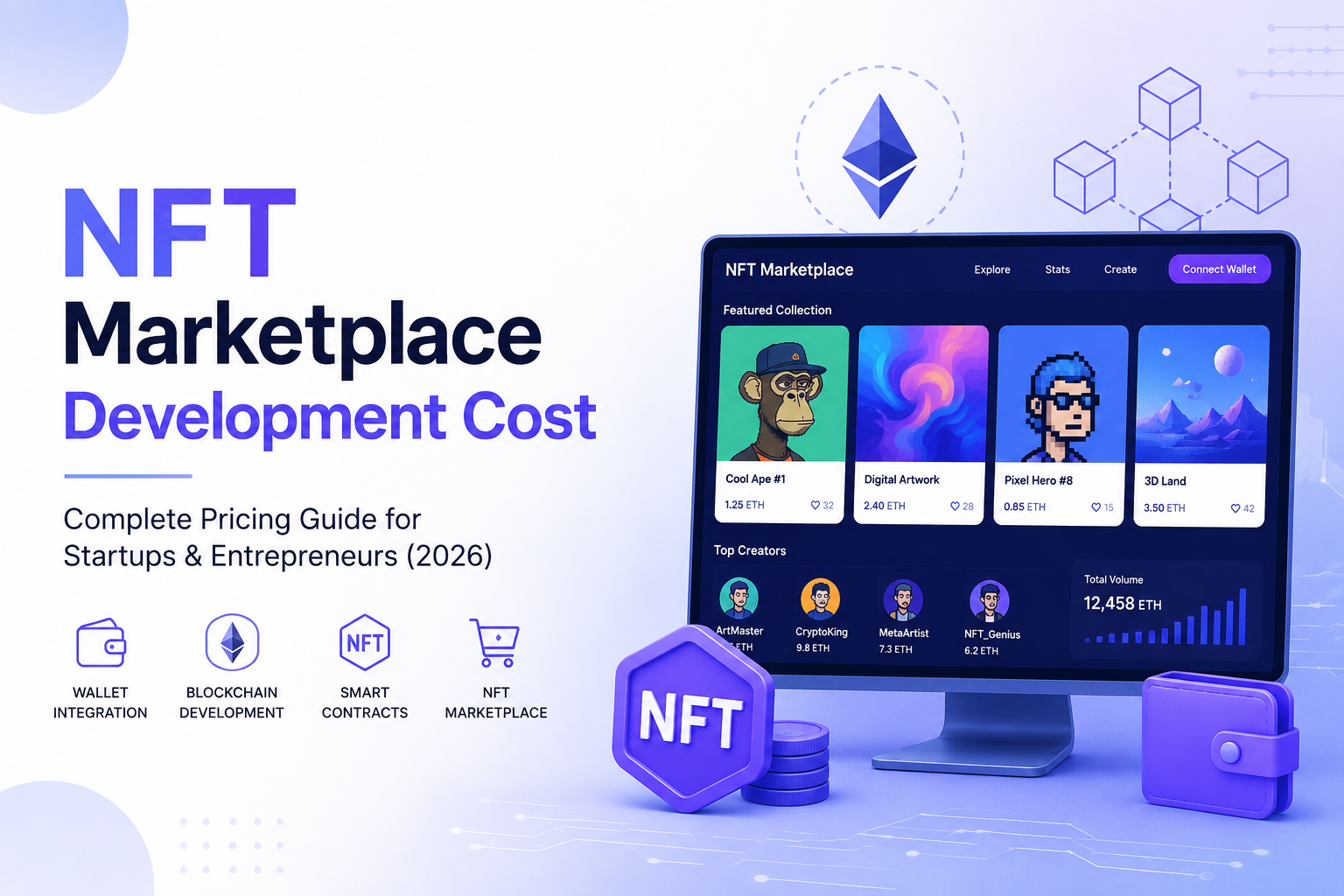

So, you’ve been hearing about NFTs and thinking about building your own marketplace. That’s exciting. The space is growing fast, and there’s real money flowing through these platforms. But before you jump in, let’s talk about what it actually costs to build one. The numbers can be all over the place, and I want to give you a realistic picture.
Quick Answer: How Much Does It Cost to Build an NFT Marketplace?
The cost to build an NFT marketplace in 2026 typically ranges from $20,000 for a basic MVP to over $250,000+ for an enterprise-grade platform with multi-chain support and advanced features. A simple marketplace with wallet integration, minting, and fixed-price sales starts around $20,000 to $40,000. A mid-tier platform with auctions, royalties, and better search runs $40,000 to $80,000. Complex platforms with multi-chain support, AI features, and full compliance can cost $80,000 to $150,000+. Smart contract audits alone can add $5,000 to $25,000 to your budget. And remember, ongoing maintenance will cost you 15–25% of the initial development cost each year.
So, You Want to Build an NFT Marketplace?
Every day, I see people talking about building the next OpenSea. But here’s the thing: it’s not just about slapping together some code and calling it a day.
You’re building a platform where people will trade real value. Digital art, collectibles, in-game items, maybe even real-world assets. That means security is everything. One bug in a smart contract can cost users thousands of dollars.
The costs can be intimidating, but once you know where the money goes, it’s much easier to plan. Let me walk you through what you’re really getting into.
The Feature List: The Biggest Cost Driver
Think of your marketplace like building a high-end retail store. A small pop-up shop costs way less than a multi-level department store with security, escalators, and fancy displays. Same goes for NFT marketplaces.
Must-Have Features (The MVP)
If you want to test the waters without spending a fortune, you start with a Minimum Viable Product. This includes only the essentials to get the platform working.
User Accounts and Profiles
Users need to create accounts and manage their profiles. This is the identity layer of your platform. It connects Web2 login flows to blockchain identities. This typically costs $2,000 to $8,000 and takes 1-2 weeks.
Wallet Integration
This is non-negotiable. Users need to connect their crypto wallets like MetaMask or WalletConnect. This is how they prove ownership of their assets and send transactions. It needs to be clean, reliable, and secure. Expect to spend $3,000 to $12,000 on this.
NFT Minting Module
This is where users upload their digital assets and turn them into NFTs. They can add attributes, set royalties, and generate metadata. Smart contracts control the whole process. This is typically $6,000 to $25,000 and takes 2-5 weeks.
Marketplace Listings
Users need to list their NFTs for sale at a fixed price. This includes ownership checks, price validation, and marketplace fee enforcement. Costs run $6,000 to $20,000.
Search and Filters
Without proper discovery tools, your NFTs will get lost. Users need keyword search, category filters, and sorting options. This costs $4,000 to $15,000.
NFT Detail Page
This page shows the NFT’s full info: ownership history, transaction history, properties, and more. It’s usually the most visited page on your platform. Expect to pay $3,000 to $10,000.
Creator Royalties and Platform Fees
Smart contracts automatically distribute royalties to creators and fees to the marketplace. This is key for creator retention. Costs run $4,000 to $18,000.
Admin Dashboard
You need a way to manage users, collections, listings, and reports. A basic admin panel costs $5,000 to $20,000.
MVP Total: You’re looking at $30,000 to $120,000 for an MVP with all these features. Development takes about 8 to 16 weeks.
Advanced Features (The Competitive Edge)
Once your MVP is validated, you’ll want to add features that make you stand out and generate more revenue. This is where the cost really climbs.
Auctions and Bidding
This adds competitive dynamics to your platform. Buyers can bid against each other. You need logic for bid increments, time limits, and anti-sniping rules. This costs $10,000 to $40,000.
Multi-Chain Support
Supporting multiple blockchains (Ethereum, Polygon, Solana, etc.) broadens your user base. But it adds serious complexity. Each chain requires separate smart contracts and testing. Costs run $20,000 to $80,000.
Fiat On-Ramp Integration
Letting users pay with regular money lowers the barrier to entry. You need to integrate with third-party providers and add compliance measures. This costs $10,000 to $50,000.
KYC and AML Compliance
If you’re targeting regulated markets, you’ll need identity verification and risk scoring. This can add $15,000 to $80,000 to your budget.
AI Integration
AI-powered features are becoming more common in 2026. Think AI-generated NFTs, smart recommendations, automated moderation, and fraud detection. This adds both development and ongoing operational costs.
Smart Contract Audits
This isn’t a feature you can skip. A professional audit ensures your smart contracts are secure. A basic audit costs $5,000 to $15,000. Enterprise-grade audits can run $50,000 to $150,000+.
The Team: Where Your Money Goes
The developers you hire make a huge difference in both cost and quality.
Here’s what a typical NFT development team looks like:
- Business Analyst
- Project Manager
- Blockchain/NFT Developers
- Solution Architect
- QA Engineers
- UI/UX Designers
Developer rates vary wildly by location. A developer in North America might charge $100 to $200+ per hour. In Europe, it’s more like $80 to start. This adds up fast.
My Take: Don’t go for the cheapest option. Web3 development is complex. Bugs in smart contracts can be catastrophic. Pay for experience. It’s cheaper than fixing a hack later.
Hidden Costs: The “Tech Debt” Tax
Launch day is just the beginning. There are ongoing costs you absolutely need to plan for.
Smart Contract Audits
I mentioned this earlier, but it’s worth repeating. A good audit costs $5,000 to $25,000 depending on complexity. This isn’t optional. Skip it at your own risk.
Infrastructure and Hosting
Your platform needs servers, databases, and blockchain nodes. Monthly costs typically run $500 to $5,000 depending on your scale. As your user base grows, these costs increase.
Maintenance and Updates
Plan for 15-25% of your initial development cost per year just for maintenance. This covers bug fixes, security updates, and performance improvements.
Legal and Compliance
Depending on your jurisdiction, you might need legal consultation. If you’re handling regulated assets or serving US users, KYC/AML integration is often required. This can add $5,000 to $15,000.
Gas Fees
Every transaction on the blockchain has a fee. This depends on which chain you choose and how busy it is. These fees add up and affect your users’ experience.
Different NFT Marketplace Types and Their Costs
Not all NFT marketplaces are the same. The type you build impacts the cost significantly.
Open or Public Marketplaces
Anyone can mint, list, and trade NFTs. Think OpenSea. These require complex moderation, search, filtering, and highly scalable architecture. Costs run $50,000 to $150,000.
Curated Marketplaces
Creators and collections are pre-approved. This builds trust but adds workflows for applications, content moderation, and admin approvals. Costs run $80,000 to $200,000.
Collectibles Marketplaces
Platforms for trading digital collectibles like sports cards or art. Examples include NBA Top Shot. Costs run $60,000 to $250,000.
Gaming Marketplaces
These allow trading of in-game assets. They’re the most expensive category because they need integration with game engines, complex economic models, and high bandwidth for micro-transactions. Costs run $100,000 to $500,000.
White-Label Solutions
You can buy pre-built marketplace software and rebrand it. This is cheaper and faster, costing $10,000 to $30,000 with a 2-6 week timeline. But customization is limited, and scaling can become expensive later.
Detailed Cost Breakdown by Component
Here’s a more detailed look at what each component costs, based on actual project data:
| Component | Basic MVP | Mid-Tier | Enterprise |
|---|---|---|---|
| Smart Contract Development | $3,000 – $8,000 | $8,000 – $20,000 | $20,000 – $50,000+ |
| Smart Contract Audit | $5,000 – $8,000 | $8,000 – $15,000 | $15,000 – $25,000+ |
| Frontend (Web) | $5,000 – $10,000 | $10,000 – $20,000 | $20,000 – $40,000 |
| Backend & API | $4,000 – $8,000 | $8,000 – $18,000 | $18,000 – $35,000 |
| Admin Panel | $2,000 – $5,000 | $5,000 – $12,000 | $12,000 – $25,000 |
| KYC/AML Integration | — | $5,000 – $10,000 | $10,000 – $20,000 |
| Mobile Apps | — | $15,000 – $30,000 | $30,000 – $60,000 |
| Secondary Market/Orderbook | — | — | $20,000 – $40,000 |
| Hosting & Infrastructure (monthly) | $500 – $1,000 | $1,000 – $2,000 | $2,000 – $5,000 |
How Blockchain Choice Affects Cost
The blockchain you choose affects development complexity and long-term costs.
Ethereum Mainnet: Higher gas fees but the most secure and liquid ecosystem.
Layer 2 Networks (Polygon, Base, Arbitrum): Lower transaction costs and faster speeds.
Solana: High throughput, low fees, but more complex smart contract architecture.
Multi-Chain: Supporting multiple networks adds significant cost. Each chain requires separate smart contracts, testing, and bridging mechanisms.
Making It Cheaper: Smart Strategies
If the numbers seem high, you’re not alone. Here’s how to manage costs effectively.
Start with a White Label Solution
For $10,000 to $30,000, you can get a functional marketplace fast. It’s perfect for validating your idea and finding early users.
Build an MVP First
Focus on core functionality. Don’t try to build the perfect platform on day one. You’ll learn what users actually want and save money.
Choose Your Blockchain Carefully
Some chains are just cheaper to build on and maintain. Layer 2 solutions like Polygon can save you money both upfront and ongoing.
Work with Experienced Developers
I know it sounds counterintuitive, but experienced developers can save you money. They avoid common mistakes. They work faster. And they build more secure code.
Summary: What’s the Real Cost?
Let’s recap the numbers. There’s a wide range because there are so many choices.
- Simple MVP: $20,000 – $40,000. Good for testing your idea with basic features.
- Mid-Tier Marketplace: $40,000 – $80,000. Includes auctions, royalties, and better infrastructure.
- Enterprise-Grade: $80,000 – $250,000+. Multi-chain support, AI features, full compliance, and serious security.
So, what’s your next move?
Start with a clear plan. Define your must-have features. Choose your blockchain. Interview development teams. Get multiple quotes.
Remember, you’re not just building a marketplace. You’re building a business. It’s a significant investment. But with a smart strategy and a solid MVP, you can create something valuable that stands out in this rapidly growing market.
Don’t let the cost scare you off. Every successful platform started somewhere. With careful planning, you can build something amazing.
Frequently Asked Questions (FAQs)
1. What’s the absolute minimum to build an NFT marketplace?
The cheapest route is a white-label solution, costing $10,000 to $30,000. For a custom MVP, expect $20,000 to $40,000. Be very wary of offers under $10,000. You’ll likely get poor-quality code that will cost more to fix later.
2. Can I build an NFT marketplace for free?
No, not a custom one. Even white-label solutions cost money. You could try building with open-source tools, but you’ll still need to pay for hosting, developer time, and smart contract audits.
3. How long does it take to build an NFT marketplace?
An MVP typically takes 2 to 4 months. A mid-tier marketplace takes 3 to 6 months. Enterprise-grade platforms can take 6 to 12+ months. The timeline depends on features and team size.
4. What’s the most expensive part of the marketplace to develop?
Smart contract development and audits are typically the most expensive parts. A complex smart contract with advanced logic can cost $20,000 to $50,000+. Security audits add another $5,000 to $25,000+. Multi-chain support is also a major cost driver.
5. How much does it cost to maintain an NFT marketplace?
Plan for 15-25% of the initial development cost per year. For a $100,000 marketplace, that’s roughly **$15,000 to $25,000 annually**. This covers hosting, bug fixes, updates, and ongoing security.
6. What blockchain should I use for my NFT marketplace?
It depends. Ethereum is the most established but expensive. Polygon and other Layer 2 solutions are cheaper and faster. Solana offers high speed but is more complex. Many platforms start with one chain and expand later.
7. Do I need a smart contract audit?
Yes, absolutely. This is non-negotiable. Smart contracts handle real money and assets. A vulnerability can lead to major financial losses. A good audit costs $5,000 to $25,000 depending on complexity.
8. What’s the difference between an open and curated marketplace?
Open marketplaces (like OpenSea) let anyone list NFTs. They require more moderation and scalable architecture. Curated marketplaces pre-approve creators and collections. They build trust but add admin workflows. Curated marketplaces typically cost more to develop.
9. How do I choose a development team?
Look for teams with specific experience building NFT marketplaces or similar Web3 projects. Check their portfolio and ask for references. Get multiple quotes and compare them. Don’t just choose the cheapest option. Quality matters.
10. What about marketing costs?
Marketing can cost as much as the development itself. You need to attract creators and buyers to your platform. Budget for app store optimization, social media, influencer partnerships, and community building. This is often underestimated.
Discover more from PratsDigital
Subscribe to get the latest posts sent to your email.