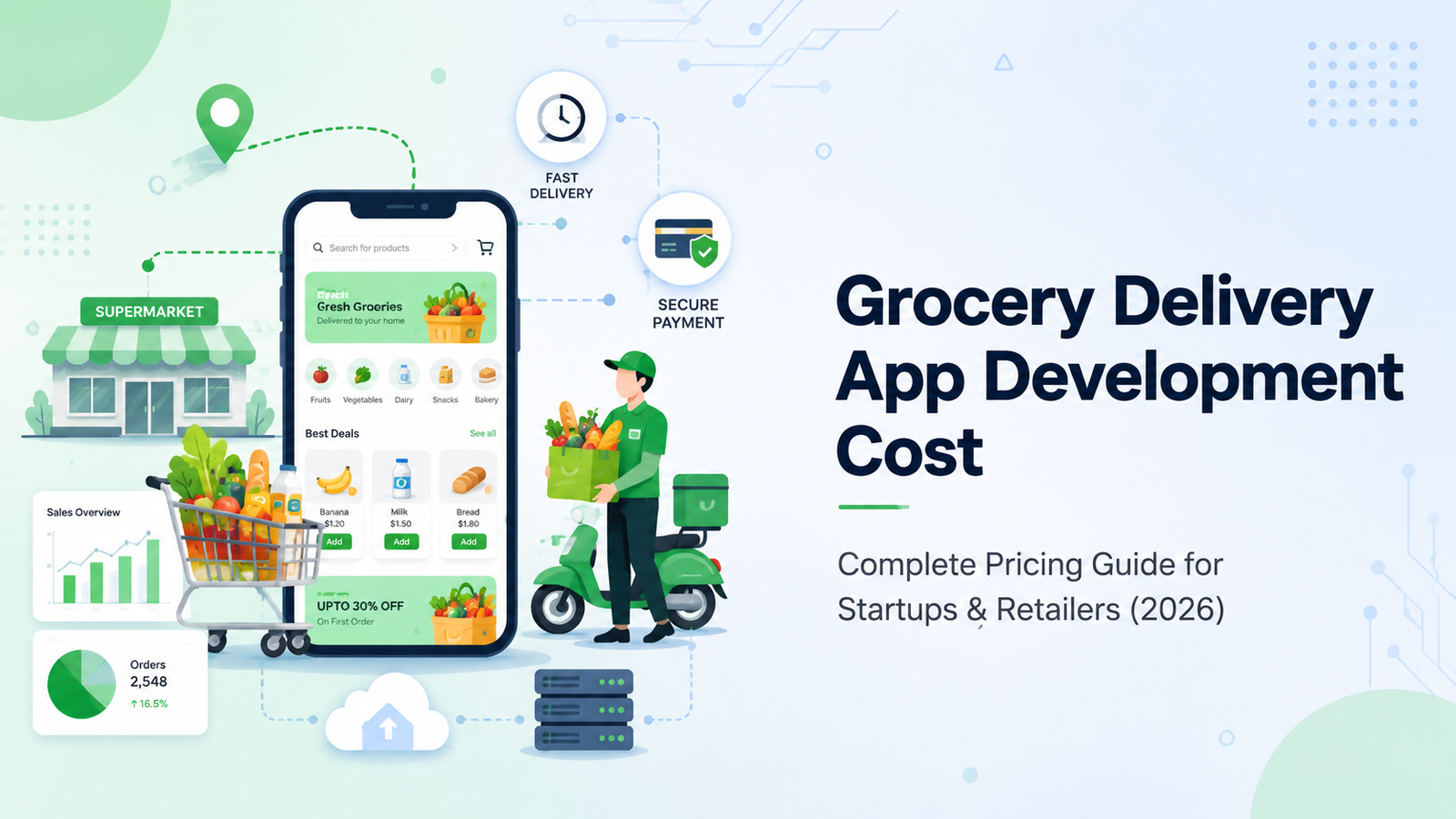

Grocery delivery app development typically costs between $20,000 and $300,000+, depending on features, platform, business model, technology stack, integrations, and development location. A basic MVP can cost around $20,000 to $50,000, while enterprise-grade platforms similar to Instacart or BigBasket often exceed $250,000. This guide breaks down exactly what you need to budget and why.
| App Type | Estimated Cost |
|---|---|
| MVP | $20,000 – $50,000 |
| Startup App | $50,000 – $120,000 |
| Marketplace | $80,000 – $180,000 |
| Enterprise | $180,000 – $300,000+ |
These estimates include UI/UX design, backend development, API integrations, testing, deployment, and project management.
Table of Contents
- How Much Does Grocery Delivery App Development Cost?
- Grocery Delivery App Cost Breakdown
- Cost by Business Model
- Features That Affect Cost
- Cost by Platform
- Cost by Region
- Technology Stack Impact
- Integrations and Their Costs
- Development Timeline
- Hidden Costs Most Businesses Forget
- Maintenance Cost
- MVP vs Full App
- How to Reduce Costs
- Real-World Cost Examples
- Frequently Asked Questions
How Much Does Grocery Delivery App Development Cost?
The average grocery delivery app development cost ranges from $20,000 for a basic MVP to over $300,000 for a full-featured enterprise platform . The final price depends on your feature set, business model, platform choice, and development team location.
The market for grocery delivery apps is growing rapidly. Online grocery adoption is expected to reach around 15% e-commerce penetration by 2026 . With monthly online grocery sales in the U.S. hitting billions of dollars, investing in a grocery delivery app can be a smart business move.
Here is what you can expect at each tier:
- MVP (Minimum Viable Product): $20,000 to $50,000. Includes user login, product listing, cart, checkout, and a basic admin panel.
- Mid-Level App: $50,000 to $120,000. Adds real-time order tracking, multiple payment options, push notifications, and vendor management.
- Advanced App: $120,000 to $300,000+. Includes AI recommendations, route optimization, advanced analytics, and multi-region scaling capabilities .
Grocery Delivery App Cost Breakdown
Understanding where your budget goes helps you make smarter decisions. Here is a component-by-component breakdown of grocery delivery app development pricing.
| Component | Estimated Cost |
|---|---|
| Discovery Phase | $3,000 – $12,000 |
| UI/UX Design | $8,000 – $20,000 |
| Frontend Development | $10,000 – $30,000 |
| Backend Development | $15,000 – $40,000 |
| API Integrations | $5,000 – $15,000 |
| Database Setup | $3,000 – $8,000 |
| Testing & QA | $5,000 – $15,000 |
| DevOps & Deployment | $3,000 – $10,000 |
| Project Management | $5,000 – $15,000 |
Discovery Phase
This stage includes requirement gathering, competitor research, wireframing, and user journey mapping. Many businesses underestimate this stage, but it is critical for avoiding costly mistakes later. The discovery phase typically costs between $3,000 and $12,000 . Skipping this step often leads to feature creep and budget overruns.
UI/UX Design
The user interface and user experience design determines how your app looks and feels. Custom design with animations and interactive elements costs more than using standard templates. Expect to spend between $8,000 and $20,000 depending on the complexity of your design requirements .
Frontend Development
This is the part users see and interact with. Building the customer app, driver app, and merchant panel all fall under frontend development. Costs range from $10,000 to $30,000 .
Backend Development
The backend handles business logic, order processing, user management, and database operations. A well-architected backend is essential for handling order volumes and scaling your platform. Backend development typically costs between $15,000 and $40,000 .
API Integrations
Payment gateways, maps, notifications, and other third-party services all need integration. Each API adds to development time and ongoing costs. Budget $5,000 to $15,000 for integrations .
Database Setup
Your database stores user profiles, product catalogs, order histories, and inventory data. Database setup costs range from $3,000 to $8,000 depending on complexity and scalability requirements .
Testing & Quality Assurance
Thorough testing prevents post-launch crashes and expensive fixes. A well-tested app requires $5,000 to $15,000 in QA investment .
DevOps & Deployment
Setting up cloud infrastructure, continuous integration, and deployment pipelines costs between $3,000 and $10,000 .
Grocery Delivery App Development Cost by Business Model
Your business model is one of the biggest factors affecting grocery app development cost. Here is how each model impacts your budget.
Single Grocery Store App
Ideal for local supermarkets and independent stores. The app connects a single inventory with customers for ordering and delivery. This is the simplest and most affordable option.
- Estimated Cost: $18,000 – $35,000
- Timeline: 3 to 4 months
- Pros: Lower complexity, faster launch, easier to manage
- Cons: Limited to one store, less scalability potential
Multi-Vendor Marketplace
Like Instacart or BigBasket, a multi-vendor marketplace connects multiple stores with customers. Each vendor manages their own inventory and pricing.
- Estimated Cost: $80,000 – $180,000
- Timeline: 6 to 9 months
- Pros: Greater product variety, scalable, higher revenue potential
- Cons: Higher complexity, vendor management challenges, real-time sync requirements
A marketplace app requires vendor onboarding, commission management, and order routing between multiple stores .
Subscription Grocery Delivery
Monthly or annual subscription models provide delivery benefits in exchange for recurring fees. Think Amazon Prime for groceries.
- Estimated Cost: $40,000 – $90,000
- Timeline: 4 to 6 months
- Pros: Recurring revenue, higher customer retention
- Cons: Requires subscription management systems, needs recurring billing integration
Hyperlocal Delivery App
Delivering from nearby stores within minutes. Apps like Zepto and Blinkit fall into this category.
- Estimated Cost: $80,000 – $200,000+
- Timeline: 6 to 10 months
- Pros: Meets demand for ultra-fast delivery, high customer satisfaction
- Cons: Requires real-time tracking, route optimization, and dark store integration
Speed is the core feature here, which adds significant complexity and cost .
Grocery Delivery App Features That Affect Development Cost
Features are the single biggest cost driver in grocery delivery app development pricing. Here is what each major feature costs and why.
Customer App Features
| Feature | Complexity | Cost Impact |
|---|---|---|
| Registration & Login | Low | $1,000 – $3,000 |
| Product Search & Filters | Medium | $2,000 – $5,000 |
| Product Categories | Low | $1,000 – $3,000 |
| Product Detail Pages | Medium | $1,500 – $4,000 |
| Shopping Cart | Medium | $3,000 – $8,000 |
| Coupons & Promo Codes | Medium | $2,000 – $5,000 |
| Payment Gateway | High | $2,000 – $6,000 |
| Live Order Tracking | High | $5,000 – $15,000 |
| Order History | Low | $1,000 – $2,000 |
| Reviews & Ratings | Medium | $1,500 – $3,000 |
| Push Notifications | Medium | $1,000 – $4,000 |
| In-App Chat | High | $3,000 – $8,000 |
| Voice Search | High | $5,000 – $12,000 |
| AI Recommendations | High | $8,000 – $20,000 |
Merchant Panel Features
| Feature | Complexity | Cost Impact |
|---|---|---|
| Item Management | Medium | $2,000 – $5,000 |
| Coupon Management | Medium | $1,000 – $3,000 |
| Order Management | High | $3,000 – $8,000 |
| Payment Tracking | Medium | $2,000 – $5,000 |
| Inventory Updates | High | $8,000 – $20,000 |
| Analytics Dashboard | High | $4,000 – $10,000 |
Driver App Features
| Feature | Complexity | Cost Impact |
|---|---|---|
| Delivery Requests | Medium | $2,000 – $5,000 |
| Push Notifications | Medium | $1,000 – $3,000 |
| Map Integration | High | $3,000 – $8,000 |
| Turn-by-Turn Navigation | High | $4,000 – $10,000 |
| Availability Toggle | Low | $500 – $1,500 |
| Work History | Medium | $1,000 – $3,000 |
| Earnings Reports | Medium | $2,000 – $4,000 |
Admin Dashboard Features
| Feature | Complexity | Cost Impact |
|---|---|---|
| User Management | Medium | $2,000 – $5,000 |
| Product Management | Medium | $2,000 – $5,000 |
| Order Management | High | $3,000 – $8,000 |
| Driver Management | Medium | $2,000 – $5,000 |
| Payment Management | Medium | $2,000 – $5,000 |
| Campaign Management | High | $3,000 – $8,000 |
| Analytics Dashboard | High | $5,000 – $12,000 |
| Content Management | Medium | $2,000 – $4,000 |
Grocery Delivery App Development Cost by Platform
Your platform choice significantly affects development cost and reach.
| Platform | Development Cost | Pros | Cons |
|---|---|---|---|
| Android Native | $25,000 – $50,000 | Largest user base, lower Play Store fees | Development for one platform only |
| iOS Native | $25,000 – $50,000 | Higher spending users, consistent experience | Development for one platform only |
| Flutter (Cross-Platform) | $30,000 – $65,000 | Single codebase for both platforms, fast development | Some performance trade-offs |
| React Native (Cross-Platform) | $30,000 – $65,000 | Large ecosystem, web reuse potential | Some native features harder to implement |
| Web App (PWA) | $5,000 – $15,000 | No app store fees, accessible via browser | Limited native functionality |
| All Platforms | $50,000 – $100,000+ | Full market coverage | Highest upfront cost, ongoing maintenance |
Cross-platform development with Flutter or React Native can save $15,000 to $25,000 compared to building separate native apps for both platforms .
Grocery Delivery App Development Cost by Region
Where you hire your development team has a massive impact on cost. Here is what hourly rates look like around the world.
| Region | Hourly Rate | Total Cost Range |
|---|---|---|
| USA / Canada | $100 – $180 | $80,000 – $250,000 |
| Western Europe | $70 – $140 | $60,000 – $180,000 |
| Eastern Europe | $40 – $80 | $30,000 – $100,000 |
| India / APAC | $18 – $40 | $8,000 – $60,000 |
| Latin America | $40 – $70 | $30,000 – $80,000 |
India and APAC remain the most cost-effective regions for full-cycle product development . Many companies adopt a hybrid model with design and strategy in the US or Europe and development handled offshore. This approach often saves 40-60% while maintaining quality control.
Technology Stack and Its Impact on Cost
Your technology choices directly affect development cost and future scalability.
| Layer | Technologies | Cost Impact |
|---|---|---|
| Frontend (Mobile) | Flutter, React Native, Swift, Kotlin | Cross-platform cheaper than native |
| Frontend (Web) | React.js, Angular | Custom dashboards add cost |
| Backend | Node.js, Django, Laravel, Spring Boot | Complex logic increases development hours |
| Database | PostgreSQL, MySQL, MongoDB | Real-time sync requires advanced databases |
| Cloud Platform | AWS, Google Cloud, Azure | Cost increases with scalability needs |
| Maps & GPS | Google Maps API, Mapbox | API usage costs add up with order volume |
| Payment Gateway | Stripe, Razorpay, PayPal | Each gateway adds integration cost |
| Notifications | Firebase, Twilio, SendGrid | Per-message costs apply |
| Authentication | OAuth, JWT | Security adds development and testing time |
| Analytics | Google Analytics, Mixpanel | Advanced analytics require more setup |
Grocery Delivery App Integrations and Their Costs
Third-party integrations are essential for functionality but add to your grocery app development pricing.
| Integration | Monthly Cost | Purpose |
|---|---|---|
| Stripe (Payments) | 2.9% + $0.30 per transaction | Process credit card payments |
| Razorpay (Payments) | Varies by region | Indian payment processing |
| Google Maps API | $2 – $7 per 1,000 requests | Delivery tracking and routing |
| Mapbox | $2 – $5 per 1,000 requests | Alternative mapping solution |
| Twilio (SMS) | $0.0075 – $0.015 per message | SMS notifications |
| Firebase (Push) | Free – $0.006 per message | Push notifications |
| SendGrid (Email) | $15 – $90 per month | Email notifications |
| AWS | Varies by usage | Cloud hosting and infrastructure |
| Cloudinary | $99+ per month | Image optimization and CDN |
Grocery Delivery App Development Timeline
Here is a realistic timeline for grocery delivery app development.
| Phase | Duration | Description |
|---|---|---|
| Discovery & Planning | 2 – 4 weeks | Requirements gathering, wireframing |
| UI/UX Design | 4 – 8 weeks | Visual design, prototyping, user flow validation |
| Development | 12 – 24 weeks | Frontend, backend, API integrations, database setup |
| Testing & QA | 4 – 8 weeks | Functional testing, security testing, bug fixing |
| Deployment | 1 – 2 weeks | App store submission, server setup, launch preparation |
Total Timeline: 3 to 10 months depending on complexity
An MVP typically takes 2-3 months. A production-ready platform with real-time inventory sync, shopper app, and automated routing runs 20-28 weeks . Enterprise builds can take 9-12+ months.
Hidden Costs Most Businesses Forget
Beyond the initial development cost, there are significant hidden costs that can derail your budget.
App Store Fees
- Apple Developer Program: $99/year
- Google Play Developer Account: $25 one-time
Cloud Hosting and Infrastructure
$500 – $5,000+ per month depending on traffic and usage. As your user base grows, hosting costs increase significantly.
Domain and SSL
$20 – $200 per year for domain registration and SSL certificates.
Third-Party API Usage
APIs charge based on usage. As orders grow, your monthly API bills grow too.
Customer Support
$1,000 – $5,000+ per month depending on the size of your support team.
Marketing and User Acquisition
You need a budget to attract users. Marketing costs often exceed development costs for consumer apps.
Legal and Compliance
- Privacy policy creation
- Terms of service
- Data protection compliance
- Payment compliance
Analytics and Monitoring Tools
Tools for crash reporting, performance monitoring, and user analytics add $100 – $500+ per month.
Bug Fixes and Emergency Updates
Unexpected issues arise after launch. Budget 15-25% of initial development cost for post-launch fixes .
Grocery Delivery App Maintenance Cost
Maintenance is an ongoing cost that many businesses underestimate. Here is what to expect.
| Cost Type | MVP App | Mid-Level App | Enterprise App |
|---|---|---|---|
| Monthly Maintenance | $500 – $2,000 | $1,500 – $4,000 | $3,000 – $10,000+ |
| Annual Maintenance | $6,000 – $24,000 | $18,000 – $48,000 | $36,000 – $120,000+ |
What Maintenance Includes
- Server Costs: Cloud hosting and database fees
- Bug Fixes: Addressing issues discovered after launch
- Security Updates: Patching vulnerabilities and platform changes
- Compatibility Updates: Keeping up with iOS and Android OS changes
- Minor Improvements: Small feature enhancements based on user feedback
- Performance Monitoring: Ensuring app speed and reliability
Annual maintenance typically costs 15-25% of the initial development cost .
MVP vs Full Grocery Delivery App Cost
Starting with an MVP is often the smartest approach for new businesses.
| Factor | MVP | Full App |
|---|---|---|
| Cost | $20,000 – $50,000 | $120,000 – $300,000+ |
| Time to Launch | 2 – 3 months | 6 – 12+ months |
| Risk Level | Low | High |
| Features | Basic ordering flow only | AI, automation, scaling systems |
| Best For | Validating your idea | Scaling an existing business |
An MVP includes user registration, product listing, cart, checkout, and a basic admin panel. It lets you test market demand before investing heavily. Advanced apps with AI features, route optimization, and multi-region support only make sense when you have proven traction .
How to Reduce Grocery Delivery App Development Cost
Here are practical strategies to keep your budget under control.
Build an MVP First
Start with essential features and add advanced functionality later based on real user feedback. Most early-stage products don’t need advanced features from day one.
Use Cross-Platform Development
Build with Flutter or React Native to save $15,000 – $25,000 compared to separate native apps .
Avoid Unnecessary AI Features
AI recommendations and demand forecasting are valuable but add significant cost. Build them only when you have enough data to make them useful.
Use Cloud Services
Leverage managed cloud services to reduce development time and avoid building infrastructure from scratch.
Choose Experienced Developers
A more experienced team may charge more per hour but works faster and makes fewer mistakes.
Reuse APIs
Don’t build custom solutions for standard features. Use third-party APIs for payments, maps, and notifications.
Launch Locally First
Start with a single city or region to reduce infrastructure and operational costs.
Scale Gradually
Add new features and regions as your user base grows, not before.
Use White-Label Solutions Cautiously
White-label solutions are cheaper upfront but limit customization and scalability. Custom development is better for long-term growth.
Grocery Delivery App Cost Examples
Here are realistic scenarios showing what different businesses can expect to pay.
Example 1: Local Supermarket App
- Budget: $25,000 – $40,000
- Timeline: 3 months
- Team: 1 Project Manager, 1 UI/UX Designer, 2 Developers, 1 QA
- Includes: Basic customer app, admin panel, simple ordering flow, one store integration
Example 2: Regional Startup
- Budget: $60,000 – $100,000
- Timeline: 5 – 6 months
- Team: 1 PM, 1 Designer, 3 Developers, 2 QA, 1 DevOps
- Includes: Customer app, driver app, admin dashboard, real-time tracking, multiple payment options, vendor management
Example 3: Multi-City Marketplace
- Budget: $120,000 – $250,000
- Timeline: 8 – 12 months
- Team: 1 PM, 2 Designers, 6 Developers, 3 QA, 1 DevOps, 1 Security Specialist
- Includes: Full marketplace platform, multi-store support, AI recommendations, advanced analytics, route optimization, scalability
Grocery Delivery Apps You Can Learn From
Here is a comparison of leading grocery delivery apps and their estimated development complexity.
| App | Key Features | Estimated Complexity |
|---|---|---|
| Instacart | Marketplace, real-time delivery, multi-store support | Very High |
| BigBasket | Inventory management + delivery, subscription model | High |
| Blinkit | Hyperlocal delivery, 10-minute promise | Very High |
| Zepto | Ultra-fast logistics, dark store model | Very High |
| Walmart Grocery | Omnichannel shopping, in-store pickup integration | Enterprise |
What makes these apps successful and expensive to build:
- Instacart: Multi-vendor marketplace with complex commission splitting and real-time inventory syncing
- Blinkit/Zepto: Dark store integration and real-time dispatch logistics
- Walmart: Omnichannel capabilities connecting online and in-store inventory
Final Verdict
Grocery delivery app development costs range from $20,000 for a basic MVP to over $300,000 for enterprise platforms. The final price depends on your feature set, business model, platform choice, and development team location.
For startups and new entrants, starting with an MVP is the most cost-effective path. It lets you validate your idea and gather real user feedback before investing heavily. Budget $25,000-$50,000 for your initial launch.
For established businesses and enterprise clients, planning for scalability, security, and ongoing maintenance from the outset is essential. Enterprise platforms with AI features, multi-store support, and advanced analytics cost $180,000-$300,000+.
Remember that maintenance costs add 15-25% of your initial development cost annually. Build with growth in mind, but don’t overbuild before you have proven demand.
Frequently Asked Questions
How much does it cost to build a grocery delivery app?
A grocery delivery app costs between $20,000 and $300,000+. An MVP costs $20,000-$50,000, while an enterprise-grade platform costs $180,000-$300,000+ .
How long does grocery app development take?
An MVP takes 2-3 months to build. A production-ready platform takes 5-7 months. Enterprise builds can take 9-12+ months .
Is Flutter good for grocery apps?
Yes. Flutter is a solid choice for grocery apps because it allows a single codebase for both iOS and Android. It saves $15,000-$25,000 compared to building separate native apps .
How much does an Instacart clone cost?
An Instacart-like app costs $80,000 – $150,000+ due to the complexity of multi-vendor marketplace features, real-time inventory sync, and commission management .
What is the monthly maintenance cost?
Monthly maintenance ranges from $500 for a basic MVP to $3,000-$10,000+ for an enterprise app. This covers server costs, bug fixes, security updates, and platform compatibility .
Which features are essential for an MVP?
User registration, product listing, cart and checkout, basic order tracking, and a simple admin panel are essential for an MVP .
Can I launch with Android only?
Yes. Launching on Android first is more affordable and gives you access to a larger user base. You can add iOS later once your app proves successful .
What affects grocery app development pricing the most?
Features are the biggest cost driver. Real-time systems like live tracking, inventory sync, and multi-user workflows add significant complexity and cost .
How much do third-party APIs cost?
API costs vary. Google Maps charges $2-$7 per 1,000 requests. Stripe charges 2.9% + $0.30 per transaction. SMS services cost fractions of a cent per message. These costs grow with your order volume.
How much should startups budget?
Startups should budget $25,000-$50,000 for an MVP to test the market. Additional funding should be secured for scaling once traction is proven .
Discover more from PratsDigital
Subscribe to get the latest posts sent to your email.