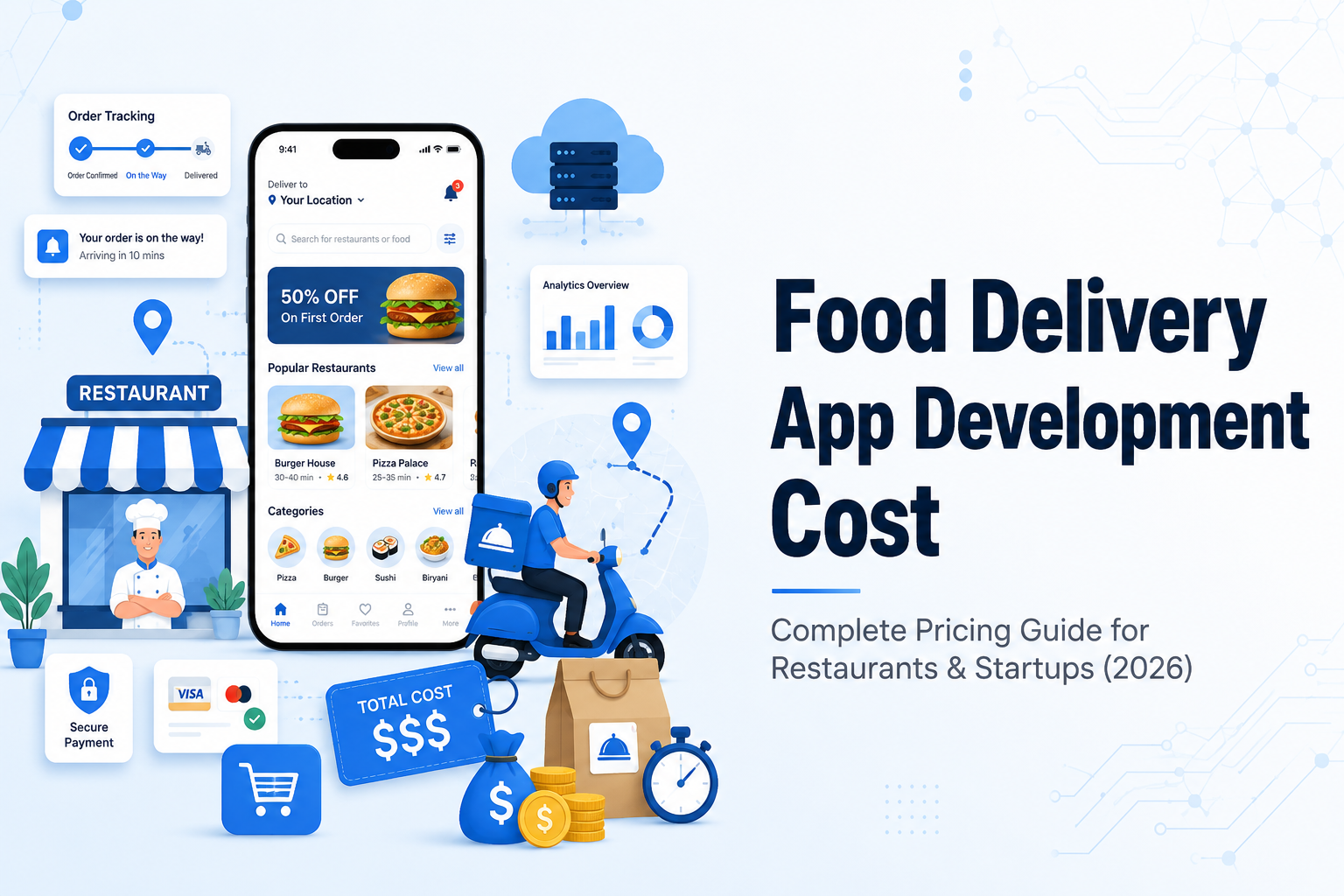

The global food delivery market continues its explosive growth, making 2026 a prime year for entrepreneurs and restaurants to enter this space. More restaurants are choosing to build their own apps rather than paying hefty commissions to third-party platforms. The rise of cloud kitchens has also created new opportunities for delivery-only business models.
Understanding the actual cost to build a food delivery app is crucial before starting development. Many business owners underestimate the investment required, leading to budget overruns or failed projects. This guide provides a comprehensive breakdown of all cost factors, feature pricing, hidden expenses, and practical ways to optimize your development budget.
The average food delivery app development cost ranges from $20,000 to $250,000+, depending on app complexity, platforms, features, technology stack, integrations, and development location. A basic MVP costs around $20,000 to $50,000, while enterprise-level platforms similar to Uber Eats or DoorDash can exceed $300,000.
How Much Does Food Delivery App Development Cost?
The cost to build a food delivery app varies significantly based on scope and complexity. Here is a direct pricing breakdown for different types of apps.
| App Type | Estimated Cost |
|---|---|
| Basic MVP | $20,000–$50,000 |
| Standard App | $50,000–$100,000 |
| Advanced Platform | $100,000–$250,000 |
| Enterprise Solution | $250,000–$500,000+ |
A basic MVP is suitable for startups testing their concept with essential features like menu browsing, ordering, and basic payment processing . This gets you to market quickly to validate demand.
A standard app includes multiple user panels, real-time GPS tracking, and proper restaurant management capabilities . This is the minimum viable product for a multi-restaurant marketplace.
An advanced platform adds AI-powered recommendations, loyalty programs, sophisticated analytics, and multi-city operations . These apps compete directly with established players.
Enterprise solutions include all advanced features plus custom integrations, extensive scalability infrastructure, and white-label capabilities. These are built for national or global expansion.
What Determines Food Delivery App Development Cost?
Multiple factors influence your final development budget. Understanding each helps you make informed decisions and avoid unnecessary expenses.
App Complexity
App complexity is the primary cost driver. A basic ordering app for a single restaurant costs significantly less than a multi-vendor marketplace with real-time logistics.
Basic apps include menu browsing, cart functionality, checkout, and order confirmation. These typically serve one restaurant with simple delivery operations.
Medium complexity apps add restaurant dashboards, driver management, live order tracking, and payment gateway integration. These support multiple vendors.
Advanced apps incorporate AI recommendations, predictive analytics, dynamic pricing, route optimization, and sophisticated fraud detection .
Enterprise platforms include all features plus custom reporting, advanced security protocols, and infrastructure designed for millions of users.
Number of User Panels
Food delivery apps are not single applications but interconnected systems serving different user groups . Each panel adds significant development cost.
The customer app allows users to browse restaurants, place orders, track deliveries, and leave reviews. This is the primary user-facing component.
The restaurant dashboard lets vendors manage menus, accept or reject orders, track inventory, and view analytics.
The delivery partner app enables drivers to accept jobs, navigate to locations, update delivery status, and track earnings.
The admin panel gives platform owners control over users, restaurants, drivers, payments, and platform settings .
An analytics portal provides detailed insights into platform performance, user behavior, and operational metrics.
A support dashboard helps customer service teams handle order issues, disputes, and user inquiries.
Each panel requires separate design, development, and testing efforts, increasing the total cost. A full ecosystem with all six panels typically costs $85,000–$205,000 .
Platform Selection
Your choice of platforms directly impacts development time and cost. Each option has trade-offs between budget and performance.
Native development for iOS and Android separately offers the best performance but doubles development costs. Each platform requires its own codebase, testing, and maintenance.
Cross-platform development using React Native or Flutter allows a single codebase to deploy on both iOS and Android . This reduces costs by 30 to 50 percent compared to building separate native apps .
Progressive Web Apps provide a mobile-friendly website experience without app store deployment. These are cheaper but lack native device features.
Hybrid approaches combine web technologies within a native wrapper, offering a middle-ground solution.
Most food delivery startups choose cross-platform development to maximize reach while controlling costs. The performance difference on modern hardware is negligible for most use cases.
UI/UX Design
Design quality significantly impacts user adoption and retention. Professional design involves multiple stages, each adding to the budget.
Wireframes establish the app’s layout and user flow before visual design begins. This foundational step prevents costly changes later.
Prototypes create interactive models for user testing and stakeholder approval. This catches usability issues early.
Brand identity includes color schemes, typography, and visual elements that create a cohesive experience.
Animations and micro-interactions enhance user engagement but require additional development work.
Dark mode and accessibility features expand your user base but add complexity.
A simple functional design may cost $5,000–$50,000, while high-quality custom design can range from $50,000–$130,000 .
Backend Infrastructure
The backend powers everything your app does. Solid infrastructure ensures reliability, speed, and scalability.
User authentication manages secure login, password recovery, and session handling. This includes social login options like Google or Facebook.
Database architecture stores user profiles, orders, menus, and platform data. This must be designed for efficient queries and growth.
Cloud storage handles menu images, user photos, and other media files. AWS, Google Cloud, and Azure are common choices.
Notification systems send real-time updates about order status, promotions, and delivery progress.
Load balancing distributes traffic across servers to maintain performance during peak hours.
API development connects your frontend apps to backend services and third-party integrations.
Scaling capabilities allow your infrastructure to grow with your user base. This is critical for successful platforms.
Real-Time Features
Real-time functionality is what makes food delivery apps valuable. These features also represent major cost drivers.
GPS tracking creates persistent connections between driver phones, backend systems, and customer screens . This requires WebSocket or long-polling architecture with location updates every few seconds.
Live order status updates keep customers informed from order placement to delivery. Each status change triggers notifications across multiple systems.
Maps integration displays driver locations and delivery routes. Google Maps API alone can cost $1,000–$3,000 monthly at moderate order volumes .
Estimated delivery times calculate based on restaurant preparation, driver distance, and traffic conditions.
Building real-time tracking from scratch adds $25,000–$50,000 to the total cost . However, this is essential for any marketplace platform.
Payment Gateway Integration
Payment processing requires careful implementation to ensure security and reliability. Multiple payment options increase development time.
Stripe, PayPal, and Razorpay are common payment processors with well-documented APIs. Each requires integration and testing.
Apple Pay and Google Pay provide convenient mobile payment options for users.
Digital wallets allow users to store funds within your app for faster checkout.
Split payments handle transactions where multiple users share an order.
Tax calculation must comply with local regulations across different jurisdictions.
A marketplace commission model requires deducting platform fees and routing proper amounts to restaurants and drivers . This adds significant complexity.
Third-Party APIs
Integrating external services expands functionality but adds cost. Common integrations include:
- Google Maps for navigation and location services
- Twilio for SMS messaging
- Firebase for push notifications and real-time databases
- Analytics platforms like Google Analytics or Mixpanel
- Fraud detection services
- Email delivery services
Each integration requires development time and ongoing fees. Payment gateways charge per transaction, and SMS notifications are billed per message .
Admin Dashboard
The admin dashboard is the control center for platform operations. A comprehensive dashboard includes:
- Restaurant management for onboarding and verification
- Coupon and promotion tools
- Order monitoring and dispute handling
- User management with role-based permissions
- Refund processing
- Analytics and reporting
- Customer support interfaces
A proper admin dashboard adds $10,000–$25,000 to the development cost .
Development Team Location
Where you hire your development team dramatically affects costs. Regional rates vary significantly based on local living costs, experience levels, and demand.
| Region | Hourly Rate |
|---|---|
| India | $20–50 |
| Eastern Europe | $35–80 |
| Latin America | $40–90 |
| Western Europe | $80–150 |
| USA | $120–250 |
North American developers charge the highest rates but offer timezone alignment and communication advantages. Indian and Eastern European developers provide significant cost savings with strong technical skills .
Many US companies use hybrid models with US-based product management and offshore development teams. This approach delivers enterprise-quality output at 40–50 percent lower cost .
Food Delivery App Cost by Development Stage
Understanding costs at each development phase helps with budgeting and timeline planning.
Market Research
Market research costs $2,000–$8,000 and takes 2–4 weeks. This includes competitor analysis, user research, and validation of your business model. Skipping research leads to product-market fit problems later.
UI/UX Design
Design costs $5,000–$50,000 for basic designs and $50,000–$130,000 for custom high-quality work . Timeline ranges from 4–10 weeks depending on complexity.
Frontend Development
Frontend development covers all user-facing applications. The customer app costs $25,000–$60,000 . The restaurant app adds $25,000–$60,000. The driver app costs $18,000–$60,000. Combined frontend development takes 3–6 months.
Backend Development
Backend development includes API creation, database architecture, authentication, and cloud setup. This typically costs $20,000–$50,000 and takes 3–5 months. Strong backend infrastructure is essential for reliability and scaling.
Testing
Quality assurance prevents costly issues after launch. Testing costs $8,000–$25,000 for mid-level apps and takes 4–8 weeks . This includes manual testing, automated testing, performance testing, and security audits.
Deployment
Deployment covers App Store and Google Play submission, server setup, and monitoring implementation. This costs $3,000–$10,000 and takes 2–4 weeks. App store fees are $99 annually for Apple and $25 one-time for Google Play.
Feature-Wise Food Delivery App Development Cost
Each feature adds specific costs to your project. Here is a comprehensive feature pricing breakdown.
| Feature | Estimated Cost |
|---|---|
| Login and Registration | $2,000–$5,000 |
| Restaurant Listing | $3,000–$7,000 |
| Search and Filters | $3,000–$8,000 |
| Menu Display | $4,000–$8,000 |
| Cart Management | $3,000–$6,000 |
| Checkout | $4,000–$8,000 |
| Payment Integration | $5,000–$15,000 |
| Order Tracking | $6,000–$15,000 |
| Push Notifications | $3,000–$8,000 |
| Ratings and Reviews | $2,000–$5,000 |
| Coupons and Promotions | $4,000–$10,000 |
| Digital Wallet | $5,000–$12,000 |
| Referral Program | $4,000–$8,000 |
| Loyalty Program | $4,000–$12,000 |
| Live Chat | $5,000–$12,000 |
| AI Recommendations | $8,000–$20,000 |
Essential MVP features for launch include registration, restaurant discovery, menu browsing, cart, checkout with basic payment, order tracking, notifications, and ratings . Advanced features like AI recommendations and loyalty programs can wait until after validating demand.
The 80/20 rule applies to food delivery apps, where 80 percent of user value comes from 20 percent of features. Focus on core functionality first and add premium features later .
Food Delivery App Development Timeline
Development timeline depends on scope and team size. Here is a realistic timeline breakdown.
| Phase | Weeks |
|---|---|
| Planning | 2–4 |
| Design | 4–10 |
| Development | 12–24 |
| Testing | 4–8 |
| Launch | 2–4 |
A basic MVP typically takes 3–4 months . A standard multi-restaurant platform requires 5–7 months. An advanced platform with AI features and multi-city operations takes 8–12 months or more.
Food Delivery App Panels Explained
Customer App Features
The customer app is the primary revenue driver. Key features include:
- Registration and login with email, phone, or social accounts
- Restaurant search with filters for cuisine, rating, price, and location
- Menu browsing with item details, modifiers, and customizations
- Cart management with quantity adjustments and special instructions
- Multiple payment options including cards, wallets, and cash on delivery
- Real-time order tracking with driver location and ETA
- Ratings and reviews for restaurants and deliveries
- Order history for reordering and tracking past orders
- Favorite restaurants for quick access
- Customer support through chat or phone
Restaurant Panel
The restaurant panel enables vendors to manage their operations. Features include:
- Order management with accept, reject, and ready status updates
- Menu and pricing management with availability toggling
- Inventory tracking to prevent overselling
- Analytics dashboard for sales, popularity, and performance
- Promotion and discount creation
- Delivery management for restaurants using their own drivers
- Support integration for handling customer issues
Delivery Partner App
The driver app is optimized for on-the-go use. Features include:
- Order acceptance with offer details and earnings
- Turn-by-turn navigation with route optimization
- Delivery status updates at each stage
- Earnings tracking per shift and overall
- Customer ratings and performance metrics
- Availability toggling for active hours
- Wallet for earnings management and withdrawals
- Delivery history for record keeping
Admin Dashboard
The admin dashboard provides platform control. Features include:
- User management for customers, restaurants, and drivers
- Restaurant verification and onboarding
- Driver verification and performance monitoring
- Payment oversight and commission management
- Refund processing and dispute handling
- Analytics and reporting for business decisions
- Customer support interface
- CMS for content and promotions
- Marketing tools for email, notifications, and offers
- Coupon and loyalty program management
Food Delivery App Cost by Business Type
Single Restaurant App
A single restaurant app costs $35,000–$70,000 and takes 10–14 weeks . This is best for independent restaurants wanting to eliminate third-party commissions. Features include menu display, ordering, payment, and order management. Delivery is handled by the restaurant’s own staff.
Restaurant Chain App
Restaurant chain apps cost $60,000–$120,000 and include multi-location support, centralized menu management, and chain-wide analytics. These are suitable for regional or national chains with multiple outlets.
Marketplace App
Multi-vendor marketplace apps cost $70,000–$120,000 and take 20–32 weeks . These connect multiple restaurants to customers and manage delivery logistics. This model earns revenue through commissions and delivery fees.
Cloud Kitchen Platform
Cloud kitchen platforms cost $85,000–$155,000. These support multiple virtual brands operating from the same kitchen. Features include brand management, order routing, and POS integration .
Grocery and Food Hybrid App
Hybrid apps combining food delivery with grocery delivery cost $100,000–$200,000+. These require additional inventory management and shopper app functionality.
AI Features That Increase Development Cost
Artificial intelligence features are becoming standard for competitive platforms. Each AI feature adds significant development cost.
AI-powered recommendations analyze user behavior to suggest relevant restaurants and dishes. This costs $8,000–$20,000 to implement.
Smart search understands natural language queries and delivers relevant results. This adds $5,000–$12,000.
AI chatbots handle customer inquiries and support without human intervention. Implementation costs $8,000–$15,000.
Demand prediction helps restaurants prepare appropriate food quantities. This reduces waste and improves efficiency.
Dynamic pricing adjusts delivery fees based on demand, weather, and traffic. This optimizes revenue and driver utilization.
Route optimization reduces delivery times and costs through intelligent driver assignment. This adds $8,000–$15,000 .
Fraud detection identifies suspicious transactions and prevents chargebacks. This protects platform revenue.
Voice ordering enables orders through voice assistants or speech recognition. This is still emerging but adds significant cost.
Predictive analytics provides insights for business decisions and operational improvements.
Enterprise platforms with comprehensive AI features typically cost $200,000–$400,000 or more .
Food Delivery App Development Cost by Platform
Platform choice directly impacts your budget. Here are cost estimates by platform.
Android-only development costs $30,000–$55,000 for basic apps and $150,000–$230,000 for advanced platforms . Android has a larger global market share.
iOS-only development costs $25,000–$50,000 for basic apps and $130,000–$200,000 for advanced platforms. iOS users tend to have higher spending patterns.
Cross-platform development using React Native or Flutter costs $35,000–$60,000 for basic apps and $140,000–$220,000 for advanced platforms . This is the most cost-effective approach for most startups.
Web applications add $10,000–$30,000 for basic functionality and $30,000–$80,000 for full-featured dashboards.
Progressive Web Apps provide mobile experiences through browsers without app store deployment. These cost $15,000–$40,000.
Most food delivery startups choose cross-platform development to reach both major platforms while keeping costs manageable.
Cost of Building Apps Like Popular Food Delivery Platforms
| App | Estimated Custom Build Cost |
|---|---|
| Uber Eats Clone | $80,000–$200,000+ |
| DoorDash Clone | $80,000–$200,000+ |
| Zomato Clone | $70,000–$180,000 |
| Swiggy Clone | $70,000–$180,000 |
| Deliveroo Clone | $80,000–$200,000 |
| Grubhub Clone | $70,000–$180,000 |
Custom building a platform like Uber Eats takes 4–12 months and requires significant investment . White-label solutions are available for $10,000–$30,000 with faster launch timelines .
The difference between these platforms lies in their specific features, geographic capabilities, and monetization models. Uber Eats clones typically include multi-currency and multi-language support for global deployment .
Hidden Costs of Food Delivery App Development
Beyond initial development, ongoing costs can add up quickly. Plan for these expenses.
App maintenance costs 15–25 percent of the initial development budget annually . This covers bug fixes, updates, and improvements.
Cloud hosting costs $500–$5,000+ monthly depending on usage and scale. This increases with user growth.
API charges include ongoing fees for Google Maps, Twilio, and other services. Google Maps alone can cost $1,000–$3,000 monthly .
Payment gateway fees typically charge 2.9 percent plus $0.30 per transaction for card payments.
SMS and email costs depend on volume. Each notification adds incremental expense.
App store fees are $99 annually for Apple and $25 one-time for Google Play.
Customer support requires staffing for phone, email, and chat. This grows with your user base.
Marketing and promotion are essential for acquiring users. App store optimization, social media, and paid advertising all require budget.
Security audits help protect user data and maintain compliance. These are recommended annually.
Compliance with data protection laws and food delivery regulations may require legal consultation.
Insurance protects against delivery incidents and liability claims.
Server upgrades and hardware scaling are needed as usage grows.
Bug fixes and emergency patches require developer time beyond planned maintenance.
Food Delivery App Maintenance Cost
Ongoing maintenance is essential for keeping your app functional and competitive.
Monthly maintenance costs range from $1,500–$10,000 depending on app complexity. This covers bug fixes, monitoring, and minor updates.
Annual maintenance typically costs 15–25 percent of the initial development cost . For a $100,000 app, expect $15,000–$25,000 annually.
Feature updates add new capabilities and improvements. These are often budgeted separately as new development.
Infrastructure costs include hosting, CDN, and data storage. These scale with your user base.
Monitoring ensures app performance and detects issues before users notice.
Support includes customer service for users and restaurants.
Security updates protect against new threats and vulnerabilities.
How to Reduce Food Delivery App Development Cost
Start with MVP
Build only essential features for launch. The minimum viable product should include registration, restaurant discovery, ordering, basic payment, and simple tracking. Everything else can be added after validating demand .
Choose Cross-Platform Development
React Native or Flutter reduce costs by 30–50 percent compared to native development . This reaches both iOS and Android users with a single codebase.
Use Cloud Services
Cloud platforms like AWS, Firebase, and Google Cloud provide ready-made infrastructure. This reduces development time and maintenance costs.
Leverage Ready-Made Authentication
Authentication services like Auth0 or Firebase Authentication reduce development work for login, password recovery, and social login.
Adopt Agile Development
Regular sprints and stakeholder feedback prevent costly changes late in development. This ensures your budget goes to features users actually want.
Prioritize Features
Focus on revenue-generating features first. Advanced analytics, AI recommendations, and loyalty programs can wait.
Use Open-Source Frameworks
Open-source libraries and frameworks reduce development time. Many common problems already have proven solutions.
Partner with Experienced Developers
Experienced development partners avoid rework and costly mistakes. They know what works and what doesn’t.
Avoid Overengineering
Build for current needs rather than imagined future scale. You can optimize and refactor as your user base grows.
Technology Stack Used for Food Delivery Apps
Frontend
React Native and Flutter are the leading cross-platform frameworks. React Native has a longer track record while Flutter offers tighter UI consistency. Native development uses Swift for iOS and Kotlin for Android.
Backend
Node.js, Django, and Ruby on Rails are common backend frameworks. Node.js handles real-time applications well. Django offers strong security features. Ruby on Rails enables rapid development.
Database
PostgreSQL with PostGIS handles geospatial queries for location-based features . MongoDB offers flexibility for unstructured data. Firebase Realtime Database enables real-time updates.
Cloud
AWS, Google Cloud, and Azure provide cloud infrastructure. AWS has the most services and largest market share. Google Cloud excels at data analytics and machine learning.
Payment
Stripe Connect handles multi-party payouts for marketplace models. PayPal offers global reach. Razorpay is popular in India and Southeast Asia.
Notifications
Firebase Cloud Messaging provides push notifications for Android and iOS. Twilio handles SMS and voice communication. SendGrid or Amazon SES manage email delivery.
Analytics
Google Analytics and Mixpanel provide user behavior insights. Custom analytics dashboards track platform-specific metrics.
Build In-House vs Outsource Development Cost
| Factor | In-House | Outsource |
|---|---|---|
| Cost | $100,000–$250,000+ annually | $50,000–$150,000 per project |
| Timeline | 6–12 months | 3–8 months |
| Management | Full control | Requires oversight |
| Scalability | Limited by team size | Access to larger teams |
| Quality | Consistent | Varies by partner |
| Risk | High hiring costs | Project risks |
| Budget | Fixed salaries | Project-based pricing |
In-house development provides full control and cultural alignment but requires significant investment in hiring and infrastructure. This is suitable for funded startups and established companies.
Outsourcing offers cost savings and access to specialized expertise. This is ideal for early-stage companies and projects with defined scope.
Most successful food delivery startups use a hybrid approach with US-based product management and offshore development teams .
Food Delivery App Development Cost by Company Size
Freelancers
Freelancers charge $20–$100 per hour and offer the lowest rates. Pros include direct communication and flexible hiring. Cons include variable quality, limited availability, and no redundancy. Best for small, straightforward projects.
Small Agencies
Small agencies charge $50–$120 per hour and provide dedicated teams. Pros include coordinated efforts and project management. Cons include limited specialization and capacity constraints. Good for MVPs and mid-size projects.
Mid-Sized Companies
Mid-sized companies charge $80–$150 per hour and offer diverse expertise. Pros include established processes and specialization. Cons include less personal attention. Suitable for full-scale platforms.
Enterprise Software Companies
Enterprise companies charge $120–$250+ per hour and provide comprehensive services. Pros include scale, reliability, and end-to-end solutions. Cons include high cost and slower processes. Best for large-scale enterprise platforms.
Common Mistakes That Increase Development Costs
Skipping MVP
Building full-featured apps before validating market demand wastes budget on unused features. Start small and learn.
Changing Requirements Frequently
Scope creep adds weeks or months to timelines. Lock in requirements before development begins.
Poor UX Planning
Usability issues after launch require expensive fixes. Invest in user research and testing early.
Ignoring Scalability
Underestimating growth leads to expensive re-architecture later. Plan for growth from day one.
Weak Backend Architecture
Costly redesigns result from poor initial backend decisions. Invest in proper architecture and documentation.
No Automated Testing
Manual testing for every release is time-consuming and error-prone. Automation saves money over time.
Wrong Technology Stack
Choosing unfamiliar or inappropriate technology creates problems. Use proven solutions with good documentation.
Lack of Documentation
Poor documentation makes maintenance and updates expensive. Document decisions and code.
Is Building a Food Delivery App Worth the Investment?
Food delivery apps generate revenue through multiple channels. Understanding these models helps assess potential returns.
Commission fees charge restaurants 15–30 percent per order . This is the primary revenue source for marketplace models.
Delivery fees charged to customers add to platform revenue. These can be fixed or dynamic based on distance and demand.
Subscription programs like Uber One or DashPass provide recurring revenue and increase user loyalty.
Advertising revenue from promoted restaurants and featured listings provides additional income.
Featured restaurant fees for premium placement and increased visibility.
Loyalty programs encourage repeat orders and increase customer lifetime value.
Cloud kitchen partnerships enable platform-owned brands operating from shared kitchen spaces.
Most food delivery platforms become profitable after achieving sufficient order volume. The breakeven point typically requires thousands of orders per day.
Conclusion
Food delivery app development in 2026 ranges from $20,000 for a basic MVP to $250,000+ for enterprise platforms. Your actual cost depends on app complexity, number of user panels, platform selection, design quality, backend infrastructure, real-time features, payment processing, third-party integrations, and development team location.
The most important decision is starting with an MVP that validates your business model before investing in advanced features. Focus on essential functionality, choose cross-platform development to reduce costs, and work with experienced development partners who can avoid costly mistakes.
Plan for ongoing maintenance costs of 15–25 percent annually. Factor in hidden expenses like cloud hosting, API fees, payment processing, and marketing.
With the right approach, a food delivery app can generate significant returns through commissions, delivery fees, subscriptions, and advertising.
Frequently Asked Questions
How much does it cost to develop a food delivery app?
Food delivery app development costs range from $20,000 for a basic MVP to $250,000+ for enterprise platforms. Most standard marketplace apps cost $70,000–$120,000 .
How long does it take to build a food delivery app?
A basic MVP takes 3–4 months to build. Standard platforms require 5–7 months. Advanced enterprise solutions take 8–12 months or more .
How much does a DoorDash clone cost?
A custom DoorDash clone costs $80,000–$200,000+ and takes 4–12 months to build. White-label solutions are available for $8,000–$25,000 with faster deployment .
What is the cost of building an Uber Eats clone?
Custom Uber Eats clone development ranges from $80,000–$200,000+ . White-label solutions cost $10,000–$30,000 and launch in 4–8 weeks.
Can I build a food delivery MVP under $30,000?
Yes, a basic MVP with essential features can be built for $20,000–$40,000. This includes menu browsing, ordering, and basic payments .
Which platform should I launch first?
Cross-platform development using React Native or Flutter is recommended for most startups. This reaches both iOS and Android users with one codebase .
What are the monthly maintenance costs?
Maintenance typically costs 15–25 percent of the initial development budget annually. For a $100,000 app, expect $15,000–$25,000 per year or $1,250–$2,000 monthly .
Is Flutter cheaper than native development?
Yes, Flutter and React Native cost 30–50 percent less than building separate native apps for iOS and Android . The code is shared across platforms.
Which features are essential for an MVP?
Essential features include registration, restaurant discovery, menu browsing, cart management, checkout, basic payment processing, order status updates, push notifications, and ratings.
How much does cloud hosting cost?
Cloud hosting costs $500–$5,000+ monthly depending on usage. This increases with user growth and order volume.
How do food delivery apps make money?
Food delivery apps earn through restaurant commissions (15–30%), delivery fees, subscription programs, advertising, and featured restaurant fees .
Should restaurants build their own app or use marketplaces?
Restaurant-owned apps eliminate third-party commissions and build direct customer relationships. Single-restaurant apps cost $35,000–$70,000 . Marketplaces provide broader reach but charge commissions.
How much does GPS integration cost?
Real-time GPS integration adds $25,000–$50,000 to development costs . Google Maps API also charges $1,000–$3,000 monthly at moderate volumes .
What is the cost difference between a single-restaurant app and a marketplace?
Single-restaurant apps cost $35,000–$70,000 . Multi-restaurant marketplace apps cost $70,000–$120,000 . The difference is due to multiple user panels, real-time tracking, and commission management.
Can AI reduce operational costs in food delivery apps?
Yes, AI reduces costs through dynamic pricing, route optimization, demand prediction, and automated customer support. AI implementation adds $20,000–$50,000 to development costs .
Discover more from PratsDigital
Subscribe to get the latest posts sent to your email.