Grab started as a simple taxi-booking app. Today, it processes millions of transactions daily across eight countries, spanning rides, food, payments, and loans. That evolution did not happen by accident.
This post breaks down exactly how Grab makes money, why its business model works, and what challenges it still faces.
What Grab Does (Quick Answer)
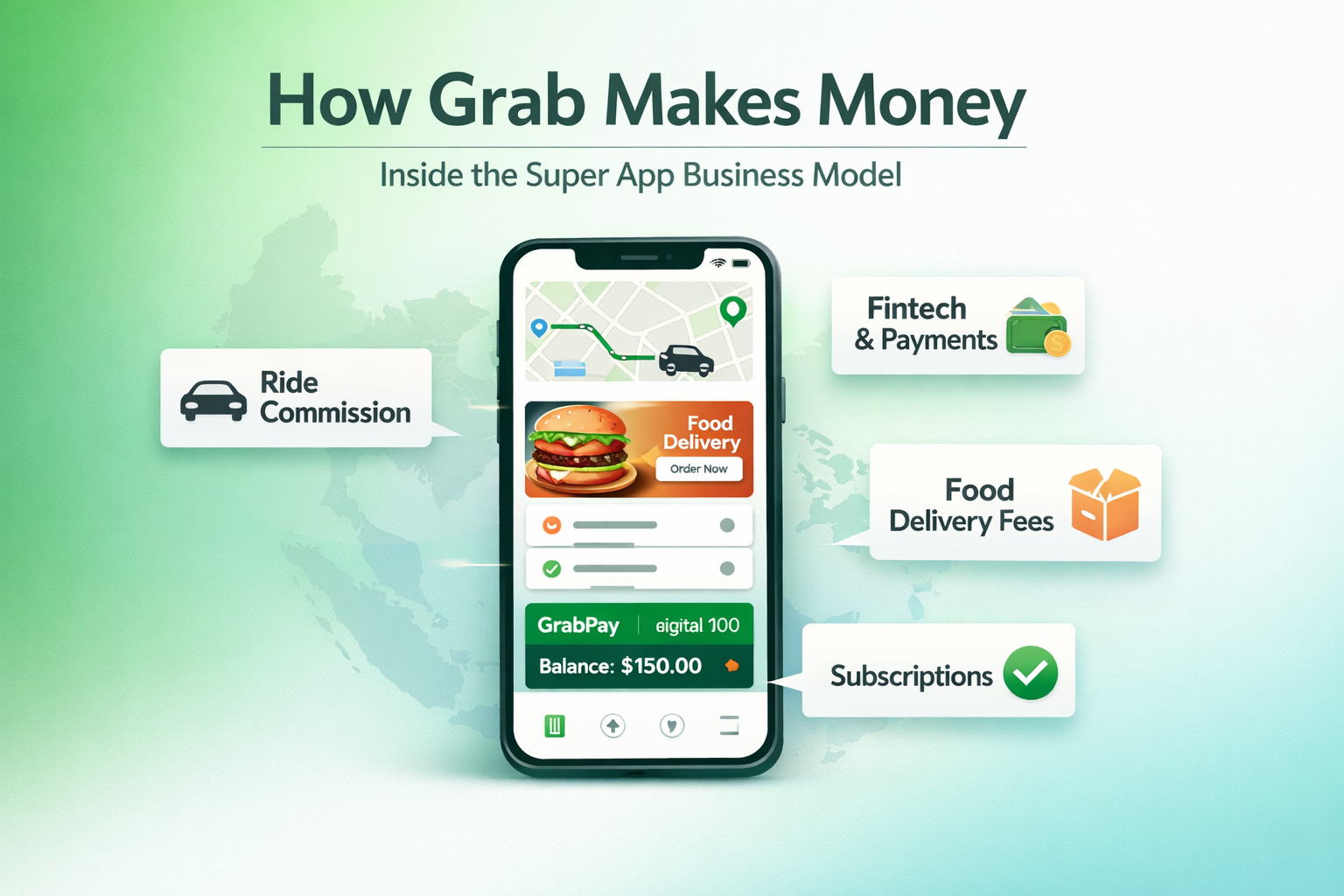
Grab makes money through ride-hailing commissions, food delivery fees, financial services, in-app advertising, and subscriptions. It operates as a super app, meaning users handle multiple daily needs inside one platform.
What Is Grab?
Grab was founded in 2012 in Malaysia by Anthony Tan and Tan Hooi Ling. It launched as MyTeksi, a basic taxi-booking service designed to solve a real problem: unsafe, unreliable cabs in Kuala Lumpur.
Within a few years, it expanded aggressively across Southeast Asia and rebranded as Grab. It then moved beyond ride-hailing into food delivery (GrabFood), digital payments (GrabPay), lending, insurance, and grocery delivery.
Today Grab operates in Singapore, Malaysia, Indonesia, the Philippines, Thailand, Vietnam, Cambodia, and Myanmar. It went public on Nasdaq in December 2021 through a SPAC merger.
The Grab Business Model (Core Concept)
Grab operates on a platform model. It does not own the cars, cook the food, or hold most of the financial risk itself. Instead, it connects supply and demand and takes a cut from every transaction.
The bigger idea is the super app strategy. Rather than building one great service, Grab built one app that hosts many services. Every new service added to the app creates another reason for users to stay inside the Grab ecosystem.
The more services a user adopts, the harder it becomes to leave. That is the lock-in strategy.
Grab serves four core groups at the same time:
- Everyday consumers (rides, food, payments)
- Drivers and delivery partners
- Restaurants and merchants
- Small businesses using financial tools
Serving all four groups simultaneously is what makes the model powerful and difficult to replicate quickly.
How Grab Makes Money
Ride-Hailing Commissions
Ride-hailing is where Grab started and still one of its biggest revenue sources. When a user books a ride, Grab takes a commission from the driver, typically ranging from 15% to 30% of the fare.
Grab also uses dynamic pricing. During peak hours, bad weather, or high-demand periods, prices go up automatically. This surge pricing increases revenue per trip without adding more cars.
Drivers technically set their income by accepting more trips, but Grab controls the pricing algorithm. That is a significant structural advantage.
Food Delivery (GrabFood)
GrabFood is now one of the fastest-growing segments in Grab’s business. Revenue here comes from two directions.
Restaurants pay a commission on every order placed through the platform, typically ranging from 25% to 30%. Consumers pay a delivery fee, which varies by distance and demand.
Grab has also moved into cloud kitchen partnerships. Cloud kitchens are delivery-only cooking spaces with no dine-in option. Grab connects these kitchens directly to consumers, often at higher margins since there is no physical restaurant overhead involved.
GrabFood competes directly with Gojek’s GoFood and regional players like Foodpanda. The market is crowded, which keeps delivery fees competitive and margins tight.
Financial Services
This is the segment Grab is most excited about for long-term growth. GrabPay, its digital wallet, allows users to pay for rides, food, bills, and in-store purchases.
Revenue from financial services comes through several channels:
Transaction fees. Every payment processed through GrabPay generates a small fee. Multiply that by millions of daily transactions and it adds up fast.
Lending. Grab offers personal loans and working capital loans to drivers, delivery partners, and small merchants. Interest income from these loans is a growing revenue line. Many of Grab’s borrowers are underbanked, meaning they have limited access to traditional bank loans, which gives Grab a real market opportunity.
Insurance. Grab sells micro-insurance products through the app. Coverage options include ride accident insurance, device protection, and health plans. Grab earns through commissions and partnerships with licensed insurers.
In 2022, Grab received a digital banking license in Singapore through its Grab-Singtel consortium. This opens the door to full banking services including savings accounts, credit products, and more.
Advertising and Promotions
This revenue stream is smaller but growing. Restaurants and merchants can pay for sponsored placement inside the GrabFood and Grab app interface.
A restaurant that pays for a sponsored listing appears higher in search results or on the homepage. That increased visibility drives more orders, so merchants are willing to pay a premium.
Grab also sells in-app banner ads and promotional slots. Brands targeting Southeast Asian consumers find Grab attractive because of its detailed behavioral data and high daily active user base.
As Grab’s user base grows, this advertising inventory becomes more valuable. It is a high-margin revenue stream since it requires no physical fulfillment.
Subscription Model (GrabUnlimited)
GrabUnlimited is Grab’s subscription plan. Users pay a monthly fee and receive benefits like free or discounted deliveries, ride discounts, and bonus GrabRewards points.
The subscription model benefits Grab in two ways. First, it creates predictable recurring revenue. Second, subscribers tend to use Grab more frequently to get full value from their subscription, which drives higher transaction volume across all services.
This is the same flywheel model used by Amazon Prime. Pay once, use more, stay longer.
Grab Business Model Canvas
Customer Segments
Grab does not serve one type of customer. It serves four simultaneously.
Everyday consumers use Grab for rides, food, and payments. Drivers and delivery partners use Grab as an income platform. Restaurants and merchants use it as a sales and distribution channel. Small businesses and gig workers use its financial services.
Serving multiple segments at once creates network effects. More drivers mean faster pickups. More restaurants mean better food selection. Better selection brings more users. More users attract more merchants. The loop reinforces itself.
Value Propositions
For consumers: One app replaces five. Transport, food, payments, insurance, and loans all in one place. That convenience is genuinely hard to match.
For drivers and delivery partners: Access to a steady stream of jobs with transparent earnings and flexible hours.
For restaurants and merchants: A delivery channel with millions of existing users, no need to build their own logistics.
For small businesses: Access to financing that traditional banks often deny.
Channels
The mobile app is the primary channel and by design, almost everything happens inside it. Grab also uses digital marketing, referral programs, and merchant partnerships to acquire users.
Customer Relationships
Grab maintains relationships through GrabRewards (a points program), GrabUnlimited subscriptions, and constant in-app promotions and cashback offers.
Retention is driven by habit and rewards. The more services a user tries, the more points they earn, and the harder it is to switch to a competitor.
Key Resources
Grab’s most valuable assets are its technology platform, its proprietary algorithms for pricing and logistics, its massive user data, and its network of drivers and merchants. None of these are easy to build quickly.
Key Activities
Running the logistics behind millions of daily rides and deliveries is complex. Grab also handles platform maintenance, customer support, merchant onboarding, financial services operations, and continuous product development.
Key Partnerships
Grab depends on restaurant and cloud kitchen partners, driver and fleet operators, payment processors, banks, and insurance companies. Its 2018 acquisition of Uber’s Southeast Asia operations was the most significant partnership move in its history.
Cost Structure
Grab’s largest costs are driver and delivery partner incentives, marketing and customer acquisition, and technology infrastructure.
Driver subsidies were especially heavy during Grab’s growth phase. Grab would offer guaranteed minimum earnings or bonuses to attract drivers away from competitors. These incentives are expensive and a key reason Grab has taken years to reach profitability.
Grab’s Super App Strategy
The super app strategy is built on a simple idea: if users can do everything inside one app, they will not need to leave.
Every service Grab adds increases the average revenue per user. A user who only books rides generates less revenue than a user who also orders food, pays bills with GrabPay, and holds a GrabUnlimited subscription.
The cross-sell path often looks like this: a user books a ride, sees a GrabFood promo, tries food delivery, starts earning GrabRewards points, links a GrabPay wallet to earn more points, and eventually subscribes to GrabUnlimited to maximize benefits.
Each step in that journey deepens the relationship and increases switching costs. Moving to a competitor means losing points, losing subscription benefits, and giving up the convenience of having everything in one place.
Grab also has a data advantage. Every interaction inside the app generates behavioral data. Where users travel, what they eat, when they spend, how much they borrow. That data improves recommendations, informs pricing, and enables better credit scoring for lending.
Grab vs Competitors
Grab vs Uber
Uber focuses on rides and food delivery (Uber Eats) in markets across the globe. It exited Southeast Asia in 2018, selling its operations to Grab in exchange for a stake in the company.
Uber operates a more focused model. Grab operates a super app model. Neither is objectively better. Uber’s focused model works well in developed markets with strong existing financial infrastructure. Grab’s super app model works well in Southeast Asia where many users are underbanked and rely on mobile-first services.
Grab vs Gojek
Gojek is Grab’s closest competitor and mirrors its super app approach. Founded in Indonesia in 2010, Gojek also offers rides, food, payments, and services like GoMart and GoSend.
The key difference is home turf. Gojek is strongest in Indonesia, the world’s fourth most populous country. Grab is strongest in Singapore, Malaysia, and Thailand.
Both companies have pushed into financial services aggressively. Gojek merged with Tokopedia to form GoTo in 2021, which gave it a major e-commerce arm that Grab does not have.
Why Southeast Asia Supports Super Apps
Three factors make super apps more viable in Southeast Asia than in the US or Europe.
First, many users skipped desktop internet entirely and went straight to smartphones. The mobile app is the internet for a large portion of the population.
Second, the region has a large underbanked population. Traditional banks have not served everyone. Digital wallets and app-based lending fill a real gap.
Third, infrastructure gaps in logistics and transportation made app-based coordination more valuable than in markets with well-developed public transport and delivery networks.
How Grab Scaled
Heavy Early Subsidies
Grab’s early growth was funded by investor capital poured into driver incentives and user promotions. Cheap rides and free deliveries brought users in fast. This is the classic platform playbook: lose money early, win market share, then monetize.
The Uber SEA Deal
Acquiring Uber’s Southeast Asian operations in 2018 was a turning point. Overnight, Grab eliminated its biggest international competitor and absorbed Uber’s driver network and user base. Uber received a 27.5% stake in Grab in exchange.
Local Market Adaptation
Grab did not apply a one-size-fits-all model. It adapted to local payment preferences (cash was supported from early on), local regulations, and local food cultures. GrabFood menus and restaurant partnerships vary meaningfully by country.
Strategic Acquisitions and Partnerships
Beyond Uber, Grab acquired companies in fintech, logistics, and mapping to strengthen its platform. It also partnered with major banks and telecom companies to expand financial services distribution.
Challenges in the Grab Business Model
Profitability Has Been Slow
Grab has burned significant cash over the years. Heavy subsidies, high marketing spend, and infrastructure costs have made the path to sustained profitability long. The company has made progress but profitability at scale remains a work in progress.
Competition Is Relentless
Gojek, Foodpanda, local fintech players, and regional banks all compete with pieces of Grab’s business. No single competitor threatens everything at once, but the collective pressure keeps margins thin.
Regulatory Risk
Operating across eight countries means navigating eight different regulatory environments. Rules around digital banking, gig worker classification, and data privacy vary widely and can change quickly. Singapore’s digital banking license framework, Indonesia’s fintech regulations, and Philippine transport rules all affect Grab differently.
Driver and Delivery Partner Dependency
Grab’s service quality depends entirely on its network of independent contractors. Driver shortages hurt ride availability. Delivery partner dissatisfaction can lead to slowdowns. Grab does not employ these workers directly, which limits control over service consistency.
The Future of Grab
Fintech Is the Biggest Opportunity
Digital banking, lending, and insurance in Southeast Asia are still underpenetrated. Grab is positioned to capture a large share of this market as smartphone adoption and financial literacy grow. The digital banking license in Singapore is a major step toward building a full financial services business.
AI and Logistics Optimization
Grab is investing in AI to improve route efficiency, demand forecasting, and personalized recommendations. Better logistics directly reduce costs and improve driver and user experience.
Advertising as a High-Margin Growth Driver
As Grab’s daily active user base grows, its advertising business becomes more valuable. This is a high-margin revenue line that does not require more drivers or delivery partners to scale.
Regional Expansion and Deeper Penetration
Rather than entering new geographies, Grab’s near-term focus is deepening penetration in existing markets, particularly in tier-two and tier-three cities where it is less dominant than in capital cities.
Key Takeaways
- Grab generates revenue from multiple streams: commissions, delivery fees, financial services, advertising, and subscriptions
- The super app model creates ecosystem lock-in that makes it hard for users to switch
- Financial services (GrabPay, lending, insurance, banking) represent the biggest long-term growth opportunity
- Heavy subsidies and operational costs have made profitability a slow journey
- Grab’s strongest competitive advantage is its data, its network, and its embedded position in users’ daily lives
- The Uber SEA acquisition was a defining moment that accelerated Grab’s dominance
Wrapping Up
Grab is not just a ride-hailing company that got big. It is a platform economy built on the idea that owning daily habits is more valuable than owning any single service.
The super app model makes sense in Southeast Asia right now. The region’s demographics, smartphone adoption rates, and underbanked population all create ideal conditions for an all-in-one digital platform.
The real question is whether Grab can convert its scale into consistent profitability before competition, regulation, or market shifts change the rules.
And here is something worth thinking about: will super apps like Grab eventually go global, or will they always be a product of specific regional conditions that simply do not exist elsewhere?
FAQs
Grab earns through commissions on rides and food orders, transaction fees on GrabPay, interest on loans, insurance commissions, in-app advertising, and monthly subscription fees from GrabUnlimited members.
Grab has been working toward profitability for years. It has made progress in reducing losses and improving segment-level margins, particularly in deliveries and financial services. Full sustained profitability at the group level remains an ongoing goal as of its latest reported results.
Grab operates a super app platform model. It connects consumers, drivers, merchants, and financial service users through one app and earns revenue from every transaction that flows through the platform.
Grab’s main competitors are Gojek in Indonesia, Foodpanda in food delivery, regional fintech companies in financial services, and traditional banks expanding into digital products. Uber exited Southeast Asia in 2018 and is no longer a direct competitor in the region.
Discover more from PratsDigital
Subscribe to get the latest posts sent to your email.