Quick Answer
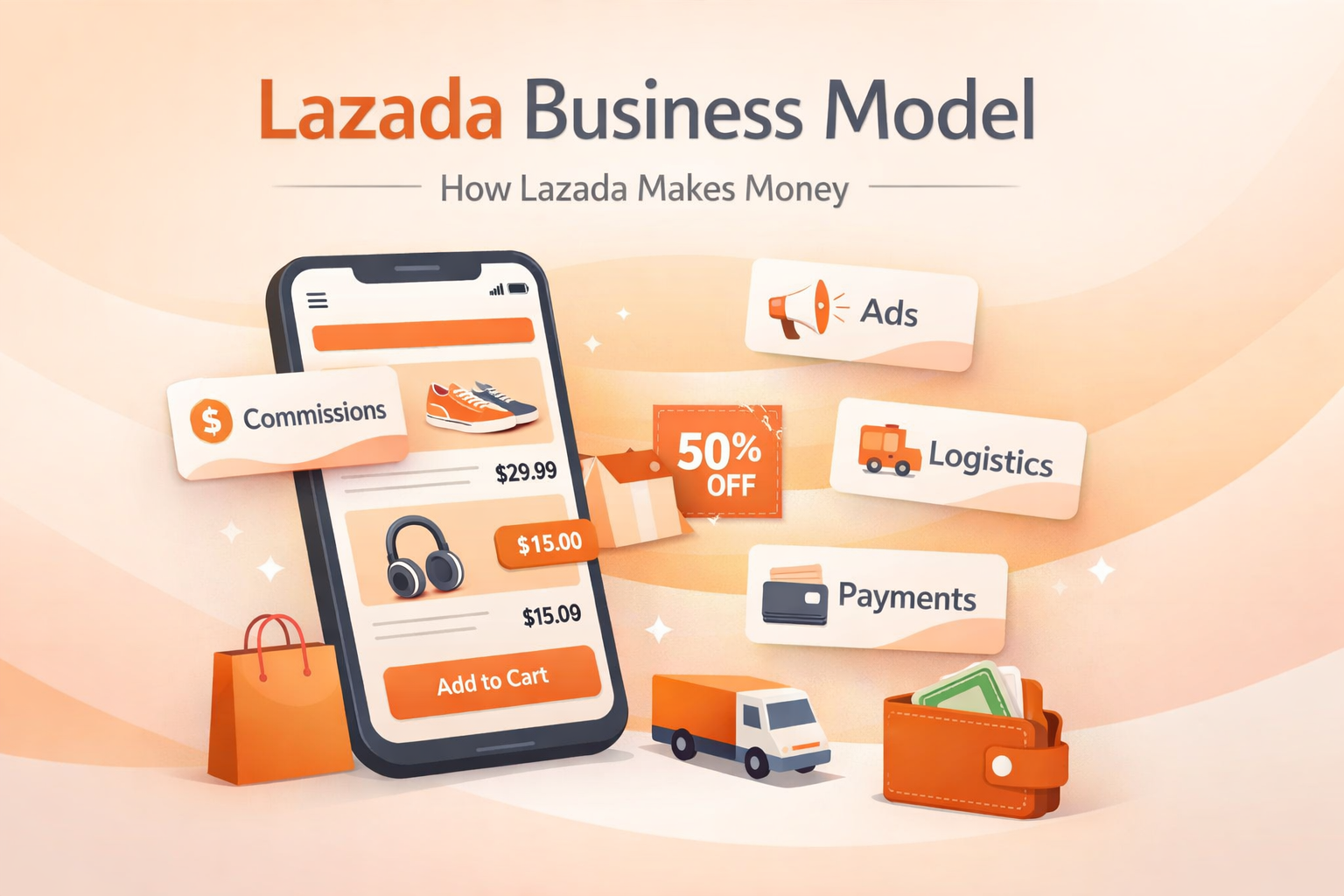
Lazada runs a hybrid marketplace plus logistics plus fintech business model. It makes money through seller commissions, advertising, logistics services, and digital payments, all while leveraging deep ecosystem support from Alibaba Group.
This is not a simple buy-and-sell platform. Lazada built the infrastructure layer that powers commerce across six countries in Southeast Asia.
What Is Lazada?
Lazada is a Southeast Asian e-commerce platform founded in 2012. It operates across six countries: Indonesia, Malaysia, the Philippines, Thailand, Vietnam, and Singapore.
The simplest way to understand it: think Amazon meets Alibaba, but built specifically for Southeast Asia. It connects buyers and sellers, handles payments, manages logistics, and runs a fintech layer underneath all of it.
Alibaba Group acquired a controlling stake in Lazada in 2016. Since then, Lazada has operated as Alibaba’s primary vehicle for Southeast Asian e-commerce expansion.
Key numbers to know:
- Founded: 2012
- Markets: Six Southeast Asian countries
- Parent company: Alibaba Group
- Business type: Hybrid marketplace and ecosystem platform
The Core Idea Behind Lazada’s Business Model
Lazada does not own most of the products sold on its platform. That is the starting point for understanding how it operates.
Instead, it connects buyers to sellers. It then builds the infrastructure that makes those connections work at scale: logistics, payments, data tools, and seller services.
This is the core insight: Lazada is not an e-commerce company. It is an infrastructure company that enables e-commerce.
The business model has three layers:
Layer one is the marketplace. Sellers list products, buyers purchase them, Lazada takes a cut.
Layer two is logistics. Lazada moves the goods through its own network and charges for that service.
Layer three is fintech. Lazada processes payments, runs a digital wallet, and offers buy-now-pay-later options.
Each layer generates revenue. Each layer also makes the other layers stickier. That is what makes this model durable.
How Lazada Works: The Step-by-Step Flow
Understanding the operational flow helps clarify exactly where money enters the system.
Step one: A seller creates an account and lists products on the Lazada platform. This is free to start, but premium features cost money.
Step two: Customers browse through the Lazada app or website. The algorithm surfaces products based on search behavior, past purchases, and sponsored placements.
Step three: A customer places an order. The payment is processed through Lazada’s payment system, which includes credit cards, digital wallets, and cash-on-delivery options.
Step four: The order is routed to the seller. Depending on the seller’s setup, fulfillment happens either through the seller directly or through Lazada’s logistics arm, Lazada eLogistics (LEL).
Step five: The product is delivered. Last-mile delivery is handled either by Lazada’s own fleet or third-party courier partners.
Step six: After delivery is confirmed, Lazada releases payment to the seller, minus commissions and fees.
Every step in this process is a potential revenue touchpoint for Lazada.
Lazada’s Business Model Breakdown
The Marketplace Model
The marketplace is the foundation. Third-party sellers list their products, set their own prices, and handle their own customer service. Lazada provides the platform, traffic, and transaction infrastructure.
Lazada earns a commission on every sale. Commission rates vary by product category. Electronics typically carry lower commission rates due to thin margins. Fashion and beauty products carry higher rates.
This model is asset-light. Lazada does not need to buy inventory, manage stock, or take on the risk of unsold goods. That risk stays with the seller.
The Inventory-Led Hybrid Layer
Lazada also sells products directly in certain categories. This is the inventory-led layer that sits on top of the marketplace model.
Direct sales give Lazada control over pricing, availability, and customer experience in key categories. It is a smaller part of the business but strategically important for high-demand product lines.
This hybrid approach mirrors what Amazon does with its first-party and third-party seller mix. It lets Lazada compete on price when needed while staying asset-light everywhere else.
Lazada eLogistics (LEL)
Logistics is where Lazada invested heavily and where it has a meaningful edge over pure-marketplace competitors.
Lazada eLogistics handles warehousing, fulfillment, and last-mile delivery. Sellers can store inventory in Lazada warehouses. When an order comes in, Lazada picks, packs, and ships it. This is the Fulfillment by Lazada (FBL) program.
For sellers, the benefit is speed and reliability. For Lazada, the benefit is a new revenue stream and tighter control over the customer experience.
The Cainiao network, Alibaba’s logistics arm, powers a significant portion of Lazada’s cross-border logistics. This gives Lazada access to infrastructure that would take years to build independently.
The Fintech Layer
Lazada Wallet is the digital payment product that sits at the center of the fintech layer. Customers can load money into their wallet, use it to pay for purchases, and access credit products.
This layer is important for two reasons. First, it captures transaction fee revenue. Second, it generates data. Every payment processed through Lazada’s system gives the company insight into customer spending behavior, which feeds back into advertising and personalization.
Buy-now-pay-later (BNPL) is a growing part of this layer, particularly in markets where credit card penetration is low. Lazada partners with fintech providers to offer installment payment options, and earns fees from that arrangement.
How Lazada Makes Money: All Revenue Streams
Seller Commissions
This is the primary revenue driver. Every time a third-party seller completes a sale, Lazada takes a percentage. The exact rate depends on product category, seller tier, and promotional arrangements.
Commission rates are not publicly disclosed in full, but they typically range from three percent to as high as ten percent or more in high-margin categories like fashion and beauty. For electronics and appliances, rates are lower because margins are thin.
The commission model scales directly with Gross Merchandise Value (GMV). More sales equals more commission revenue. This is why Lazada invests in driving traffic and conversion on the platform.
Advertising Revenue
Advertising is the highest-margin revenue stream Lazada operates. Sellers pay to appear in prominent positions within the app and website. This includes:
Sponsored product listings: Sellers bid to appear at the top of search results for specific keywords. This is a pay-per-click model similar to Google Shopping ads.
Banner advertising: Brands buy display space on the homepage, category pages, and within the app interface.
Brand stores and premium placements: Brands pay for dedicated storefront experiences within the Lazada app.
This revenue stream is particularly valuable because it does not require Lazada to do much beyond providing the ad inventory. The margins are extremely high relative to the effort involved.
As Lazada’s user base has grown, its advertising business has become increasingly important. Sellers essentially subsidize their own visibility, which creates a self-reinforcing dynamic: more sellers compete for attention, which drives up ad prices, which increases Lazada’s ad revenue.
Logistics and Fulfillment Fees
Sellers who use Fulfillment by Lazada pay for warehousing space, picking and packing, and delivery. These fees are charged based on product dimensions, weight, and distance.
For cross-border sellers, logistics fees are a significant line item. Lazada’s integration with the Cainiao network gives it a competitive price advantage on international shipping from China.
Last-mile delivery fees are charged to either the seller or the buyer depending on the seller’s shipping policy. Lazada subsidizes shipping costs during major sale events to drive conversion, but standard delivery charges apply outside of promotions.
Payment and Fintech Revenue
Transaction fees are charged on every payment processed through Lazada’s system. For credit card transactions, Lazada pays interchange fees to card networks but typically captures a processing margin on top.
Lazada Wallet generates revenue through:
- Transaction fees on wallet-funded purchases
- Foreign exchange margins on cross-currency transactions
- Interest income from BNPL and credit products
- Partnership fees from fintech providers integrated into the checkout flow
In markets where digital wallet adoption is high, fintech revenue is growing quickly. In markets where cash-on-delivery is still dominant, this revenue stream remains smaller but is expanding as mobile payment infrastructure improves.
Value-Added Seller Services
Beyond commissions and logistics, Lazada sells a range of tools and services to sellers who want to perform better on the platform.
Data analytics tools: Sellers can access detailed performance data, category insights, and competitor benchmarking. Premium tiers of these tools cost money.
Premium storefronts: Brands can upgrade their shop presence with custom design, video content, and enhanced product display features.
Campaign participation fees: Certain major sale events require sellers to pay participation fees or commit to minimum discounts in order to join.
Training and seller education: Lazada University offers paid training programs to help sellers improve their operations and marketing.
These services generate relatively small individual revenue amounts, but they add up across a large seller base and improve platform stickiness.
Lazada’s Business Model Canvas
The business model canvas breaks down how Lazada creates, delivers, and captures value across all nine dimensions.
Customer Segments
Lazada serves two primary customer segments. The first is buyers: individual consumers across six Southeast Asian countries looking for electronics, fashion, home goods, beauty products, and more. The second is sellers: small and medium businesses, large brands, and cross-border merchants primarily from China who want access to Southeast Asian consumers.
Value Propositions
For buyers, Lazada offers a wide product selection, competitive pricing, reliable delivery, and flexible payment options including cash-on-delivery.
For sellers, Lazada offers access to a large regional customer base, logistics infrastructure, advertising tools, payment processing, and data analytics.
Channels
Lazada reaches customers primarily through its mobile app, which is the dominant channel across all six markets. The website serves as a secondary channel. Offline marketing, influencer partnerships, and social media are used to drive app downloads and platform awareness.
Sellers are reached through direct sales teams, online onboarding portals, and the Lazada University seller education ecosystem.
Customer Relationships
With buyers, Lazada builds relationships through personalization, loyalty programs, and customer service. The LazMall branding (for verified brand stores) creates trust with buyers who are concerned about counterfeit products.
With sellers, Lazada maintains relationships through dedicated account management for large sellers and self-serve tools for smaller ones.
Revenue Streams
As detailed above: commissions, advertising, logistics fees, fintech revenue, and value-added seller services.
Key Resources
Lazada’s most important resources are its technology platform, logistics infrastructure, brand reputation in Southeast Asia, and its relationship with Alibaba’s ecosystem including Cainiao, Alipay technology, and Alibaba Cloud.
Key Activities
Running the marketplace platform, managing logistics operations, processing payments, acquiring and retaining sellers and buyers, and running major promotional events like 11.11 and 12.12.
Key Partnerships
Alibaba Group is the most important partner, providing technology, supply chain infrastructure, and capital. Cainiao provides logistics backbone. Third-party courier companies handle last-mile delivery in markets where Lazada does not operate its own fleet. Fintech partners provide BNPL and credit services. Brands and cross-border sellers from China provide a significant portion of product inventory.
Cost Structure
Lazada’s major costs include technology development and maintenance, logistics infrastructure and operations, marketing and customer acquisition, seller support and account management, and payment processing costs. Logistics is particularly expensive in Southeast Asia given the geographic fragmentation and infrastructure gaps across markets.
Lazada’s Growth Strategy
Mobile-First Approach
Southeast Asia is one of the most mobile-dominant regions in the world. In markets like Indonesia, the Philippines, and Vietnam, a large proportion of internet users access the web exclusively through smartphones.
Lazada built its product strategy around this reality early. The app is the primary interface for both buyers and sellers. Features like live shopping, flash sales, and gamified reward systems are all designed for mobile interaction patterns.
Localization Strategy
Southeast Asia is not a single market. It is six distinct markets with different languages, cultures, payment preferences, and regulatory environments.
Lazada runs separate operations in each country with localized interfaces, local language support, local payment methods, and country-specific promotional calendars. This level of localization is expensive but necessary. A one-size-fits-all approach does not work in this region.
Mega Sale Events
The 11.11 Single’s Day sale and 12.12 year-end sale are the two biggest revenue events on Lazada’s calendar. Both were adapted directly from Alibaba’s playbook in China.
These events serve multiple purposes. They drive enormous GMV in short windows. They create urgency and habit among buyers. They generate advertising revenue from sellers competing for visibility during peak traffic periods. And they generate significant media coverage that functions as free marketing.
Lazada also runs its own branded sale events like Lazada Birthday Sale and seasonal shopping festivals tied to regional holidays.
Ecosystem Integration with Alibaba
Alibaba’s involvement goes far beyond capital. The technology stack, logistics network, and seller ecosystem that Lazada operates today are deeply integrated with Alibaba’s global infrastructure.
Alibaba Cloud powers Lazada’s platform. Cainiao handles cross-border logistics. Alipay technology underlies parts of the payment infrastructure. And Alibaba’s vast network of Chinese manufacturers and sellers gives Lazada a supply-side advantage that competitors cannot easily replicate.
The Role of Alibaba in Lazada’s Success
Alibaba acquired a controlling stake in Lazada in 2016 for one billion dollars. It has invested several billion more since then.
What did Alibaba bring to the table beyond capital?
Technology: Alibaba transferred its e-commerce technology stack to Lazada, dramatically accelerating platform capabilities that would have taken years to build independently.
Logistics: The Cainiao network gave Lazada access to a sophisticated cross-border logistics operation, making it possible to ship products from Chinese sellers to Southeast Asian buyers efficiently.
Seller ecosystem: Alibaba connected Lazada to its vast network of Chinese manufacturers and merchants on Taobao and Tmall. This expanded Lazada’s product catalog significantly.
Data and AI: Alibaba’s AI and data capabilities have been integrated into Lazada’s recommendation engine, search algorithm, and advertising targeting systems.
The honest assessment is straightforward: without Alibaba, Lazada would likely not have the logistics depth or technology sophistication it has today.
Competitive Advantages
Logistics infrastructure: Lazada has built one of the most extensive e-commerce logistics networks in Southeast Asia. This is hard to replicate quickly.
Alibaba backing: Access to Alibaba’s technology, supply chain, and capital is a structural advantage that most competitors cannot match.
Regional presence: Lazada has operated across six Southeast Asian markets for over a decade. The local knowledge, regulatory relationships, and brand recognition built over that time are genuine assets.
LazMall: The verified brand store program gives Lazada credibility with consumers who are concerned about product authenticity. This is particularly important in electronics and luxury goods categories.
Lazada vs. Shopee: The Real Comparison
Shopee has overtaken Lazada in user engagement metrics across most Southeast Asian markets. Understanding why requires looking at how the two models differ.
Business model: Lazada runs a hybrid model with significant infrastructure investment. Shopee started as a pure marketplace and stayed asset-lighter for longer, which let it move faster in the early growth phase.
User experience: Shopee built a highly gamified experience with games, coins, and rewards built directly into the shopping flow. This drove higher daily active usage. Lazada’s experience is more structured and less entertainment-focused.
Seller fees: Shopee initially charged very low or no commission to attract sellers. This undercut Lazada’s seller base in multiple markets.
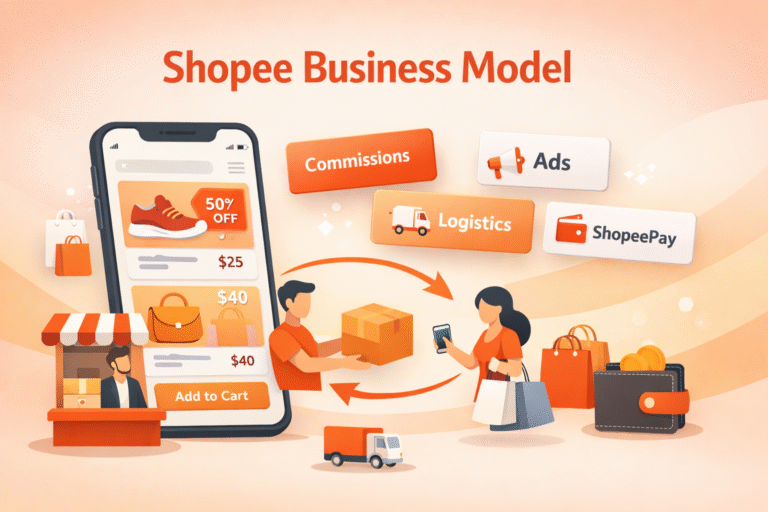
Backing: Lazada has Alibaba. Shopee has Sea Group, which also owns Garena (gaming) and SeaMoney (fintech). Sea’s gaming revenue subsidized Shopee’s growth in ways that were difficult to counter.
Where Lazada still competes: Lazada maintains stronger positions in logistics reliability, brand store experiences, and cross-border product availability. In certain product categories and markets, it remains highly competitive.
Challenges in Lazada’s Business Model
High Logistics Costs
Southeast Asia’s geography is punishing for logistics operations. Island nations like Indonesia and the Philippines require sea or air freight between major population centers. Road infrastructure in many areas is underdeveloped. Last-mile delivery in dense urban areas is expensive and complex.
These costs are difficult to reduce without massive scale, and achieving that scale requires continued investment.
Cash-on-Delivery Complexity
A significant portion of e-commerce transactions in Southeast Asia still happen via cash-on-delivery. This creates operational complexity: failed deliveries, return management, and cash collection all add cost without adding proportional revenue.
Digital payment adoption is growing, but COD remains significant in markets like Vietnam, Indonesia, and the Philippines.
Competition from Shopee
Shopee’s dominance in user engagement across most markets has put pressure on Lazada’s seller base and advertising revenue. Sellers follow traffic. When buyers spend more time on Shopee, sellers shift advertising budgets and sometimes exclusive listings there.
Lazada has responded with product improvements and seller incentives, but closing the engagement gap is a long-term challenge.
Profitability Pressure
Alibaba has faced its own financial pressures in recent years, which has led to cost discipline across its portfolio companies including Lazada. Lazada has undergone significant workforce reductions and operational restructuring. Reaching profitability in the core marketplace business is a key priority.
The Future of Lazada
AI-Driven Personalization
Lazada is investing in AI-powered product recommendations, search improvements, and personalized pricing. The goal is to increase conversion rates by showing buyers products they are more likely to purchase.
Alibaba’s AI capabilities, including large language model applications, are being integrated into the Lazada experience.
Faster Delivery Infrastructure
Same-day and next-day delivery in major urban areas is the next battleground in Southeast Asian e-commerce. Lazada is expanding its warehouse footprint in key cities to support faster fulfillment.
Fintech Expansion
The fintech layer has significant growth potential, particularly as digital payment infrastructure improves across Southeast Asia. Lazada Wallet expansion, BNPL scaling, and merchant financial services are all areas of active development.
Live Commerce
Live shopping, where sellers demonstrate products in real-time video streams and viewers can purchase instantly, is exploding in China and growing fast in Southeast Asia. Lazada has invested in live commerce features and is positioning this as a major growth driver for seller revenue and buyer engagement.
Wrapping Up
Lazada’s real strength is not selling products. It is controlling the infrastructure of commerce across Southeast Asia.
The marketplace generates commissions. The logistics network generates fees. The payment layer generates transaction revenue. The advertising platform generates high-margin media revenue. Each layer reinforces the others.
This is the system-building approach to business. Lazada does not just compete on price or selection. It competes by making itself the platform that everything else in Southeast Asian e-commerce runs on top of.
The lesson for anyone building a business in a competitive market is simple. A product can be copied. Infrastructure is much harder to replicate. Lazada bet on infrastructure early, and that bet, backed by Alibaba’s resources, is what gives it staying power even as Shopee has captured more consumer attention.
The next phase of Lazada’s story will be defined by whether it can translate infrastructure advantage into profitability, and whether it can find its engagement edge in a market that has shifted toward entertainment-first shopping experiences. Those are real challenges. But the foundation, built over more than a decade, is real too.
Discover more from PratsDigital
Subscribe to get the latest posts sent to your email.