
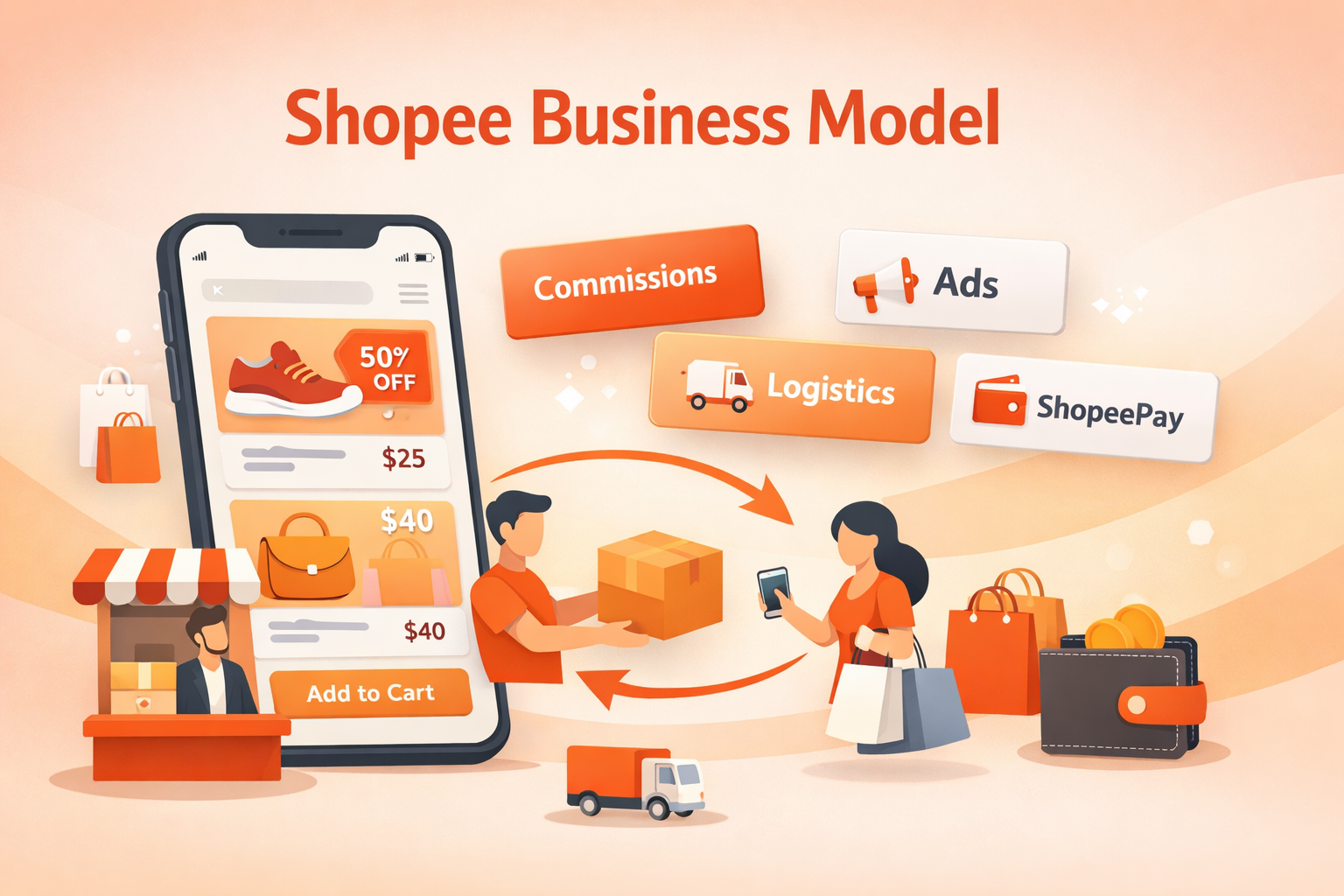
Shopee operates as a marketplace-based eCommerce platform that connects buyers and sellers. It makes money through commissions, seller services, ads, logistics fees, and fintech solutions like ShopeePay. Its growth is driven by a mobile-first strategy, aggressive discounts, and integrated logistics.
What Is Shopee?
Shopee is a Southeast Asian eCommerce platform founded by Sea Limited and launched in 2015. It operates across Singapore, Malaysia, Indonesia, Thailand, Vietnam, the Philippines, Taiwan, and several other markets.
The platform is built mobile-first. That means the entire experience, from product discovery to checkout, is designed around smartphone users. This was a smart bet in a region where millions of people access the internet primarily through their phones.
Think of Shopee as Amazon and Flipkart combined, but rebuilt from scratch for mobile users in emerging markets. It does not own inventory. It connects buyers and sellers on a single platform and takes a cut along the way.
Sea Limited, Shopee’s parent company, also runs Garena (gaming) and SeaMoney (fintech). That broader ecosystem gives Shopee a structural advantage that pure-play eCommerce companies do not have.
Shopee Business Model Overview
Shopee runs on a marketplace model. It does not stock or sell products directly. Instead, it provides the infrastructure for third-party sellers to list, promote, and sell products to buyers.
Here is what makes the model work:
Low barrier for sellers. Anyone can open a Shopee shop. There are no steep upfront fees, no complicated approval processes. This keeps seller supply high, which keeps product variety high, which keeps buyers coming back.
Heavy use of discounts and subsidies. Shopee spends aggressively on free shipping, cashback, and flash deals. This burns cash in the short term but builds user habit fast.
Gamification at every layer. Shopee Coins, daily check-ins, spin-the-wheel games, live commerce, and flash sales create an app that people open not just to buy something, but out of habit. It blurs the line between shopping and entertainment.
The core philosophy: Shopee sacrifices short-term profit for long-term market dominance. It is playing a land-grab game, and so far, it has worked.
How Shopee Works: Step-by-Step Flow
Understanding the mechanics helps explain why the model scales so well.
Step one: Sellers list products. Sellers create accounts, upload product photos, set prices, and go live. Shopee provides templates and tools to simplify this.
Step two: Buyers browse via the app. Most Shopee traffic comes through its mobile app. The homepage is personalized based on browsing history, location, and ongoing promotions.
Step three: Orders are placed. The buyer selects a product, applies vouchers or coins, and checks out through integrated payment options including ShopeePay, credit cards, and cash on delivery.
Step four: Shopee handles payments. Shopee acts as the payment intermediary. Funds are held in escrow until the buyer confirms delivery. This protects both sides of the transaction.
Step five: Logistics kick in. Shopee’s logistics arm, Shopee Express (or SLS, Shopee Logistics Service), handles last-mile delivery in many markets. In others, Shopee partners with third-party couriers.
Step six: Delivery and tracking. Buyers can track orders in real time through the app. Shopee sends push notifications at each stage.
Step seven: Shopee takes its cut. Once the order is confirmed, Shopee deducts its commission and releases the remaining payment to the seller.
Simple loop. Scalable infrastructure.
How Shopee Makes Money
This is the core of the business. Shopee has built multiple revenue streams that compound on each other as the platform grows.
Commission Fees
Shopee charges sellers a percentage of each completed transaction. The commission rate varies by product category and market.
For example, electronics may have a lower commission than fashion or beauty products. Rates typically range from one percent to a few percent per transaction, depending on the country and seller tier.
This is the foundational revenue stream. As Gross Merchandise Volume (GMV) grows, commission revenue scales directly with it.
Advertising Revenue
This is one of Shopee’s fastest-growing revenue sources.
Sellers pay to appear at the top of search results through sponsored listings. They bid on keywords relevant to their products, similar to how Google Ads works.
Sellers also pay for banner placements, homepage features, and category page promotions. Brands running campaigns during mega sales like 11.11 and 12.12 spend heavily on in-app advertising.
As Shopee’s user base grows, the value of its ad placements increases. More eyeballs mean higher bids, which means higher ad revenue without adding incremental cost.
Transaction and Payment Processing Fees
Shopee charges a small fee on each payment processed through the platform. This applies to ShopeePay transactions and in some cases to other payment methods.
As payment volume increases, even tiny per-transaction fees add up to significant revenue at scale.
Logistics and Shipping Fees
Shopee Logistics Service (SLS) handles fulfillment in several of its core markets. When Shopee manages delivery, it charges for that service.
In some markets, Shopee subsidizes shipping to attract buyers. But as the platform matures and its logistics network becomes more efficient, shipping becomes a profitable business unit rather than a cost center.
Shopee Express, its in-house courier brand, is now one of the largest delivery networks in Southeast Asia. Owning logistics gives Shopee both a cost advantage and a data advantage.
Seller Services and Premium Tools
Shopee offers a suite of paid tools for sellers who want to grow faster.
These include:
- Analytics dashboards showing traffic and conversion data
- Preferred Seller and Shopee Mall status, which gives listings a verified badge and higher search visibility
- Campaign participation slots during major sales events
- Bulk listing and inventory management tools
Sellers who want to move up the platform hierarchy pay for access to these services.
ShopeePay: The Fintech Layer
ShopeePay is Shopee’s digital wallet and financial services arm. It is one of the most strategically important parts of the entire business.
Here is what ShopeePay does:
Payments. Users top up their ShopeePay wallet and use it to pay for orders. This keeps money inside the Shopee ecosystem.
Cashback and rewards. ShopeePay offers cashback on transactions, which incentivizes users to keep using the wallet instead of switching to external payment methods.
Buy Now, Pay Later. Shopee has rolled out installment payment options in several markets. This increases basket size because users can afford higher-priced items.
Insurance and loans. Through SeaMoney, Shopee connects users to microinsurance products and small business loans. This is particularly valuable for sellers who need working capital.
Money transfers. In markets like Indonesia and the Philippines, ShopeePay functions as a general-purpose digital wallet beyond just shopping.
The fintech layer is where Shopee’s long-term monetization upside really lives. Financial services carry higher margins than eCommerce commissions.
Shopee’s Growth Strategy: Why It Works
Shopee did not just build a good app. It engineered a growth machine. Here is how.
Mobile-First UX
Shopee was built for mobile from day one. Competitors like Lazada started as desktop platforms and retrofitted mobile. Shopee started the other way around.
The app is lightweight, fast, and designed for users on slower connections and lower-end Android devices. That matters in markets like Indonesia and Vietnam where not everyone has a flagship smartphone.
Heavy Discounts and Free Shipping
Shopee subsidizes shipping aggressively. Free shipping vouchers are available almost daily. Flash deals run around the clock.
This costs a lot of money. But it builds a critical habit: users check Shopee first because they know they will find the best deal there. Once that habit is established, it is very hard for competitors to break it.
Gamification
Shopee turned shopping into a game.
Users earn Shopee Coins on purchases. Those coins can be redeemed for discounts on future orders. There are daily check-in rewards, spin-the-wheel games for coins, and interactive mini-games during mega sale events.
This creates daily active user behavior. People open Shopee not just when they need something, but as part of a daily routine.
Localization
Shopee does not run one global playbook. It tailors its strategy country by country.
In Indonesia, it leans into cash on delivery because many buyers do not have bank accounts. In Taiwan, it competes head-to-head with local platforms by offering superior UX. In Vietnam, it focuses heavily on social commerce and live streaming.
Local language support, local payment methods, local seller communities, and locally relevant marketing campaigns give Shopee an edge that global platforms struggle to replicate.
Mega Sale Campaigns
11.11 (Singles’ Day), 12.12 (Year-End Sale), and other campaigns create massive spikes in transaction volume.
These events are not just sales. They are cultural moments. Shopee backs them with TV ads, celebrity endorsements, in-app concerts, and gamified countdowns. The result is an event that buyers plan for weeks in advance.
Shopee vs Competitors
Shopee vs Amazon
| Factor | Shopee | Amazon |
|---|---|---|
| Model | Pure marketplace | Marketplace plus owned inventory |
| Primary Market | Southeast Asia | US, Europe, global |
| Profit Focus | Growth-first | Profitable at scale |
| Logistics | Shopee Express plus partners | Amazon Fulfillment Centers |
| Fintech | ShopeePay integrated | Amazon Pay, less central |
| UX | Gamified, mobile-native | Functional, desktop-origin |
Amazon is more profitable today. Shopee is more aggressive in its core markets. They are not in direct competition yet, but if Amazon ever seriously pushes into Southeast Asia, the battle would be interesting.
Shopee vs Lazada
Lazada is Shopee’s most direct regional competitor. Backed by Alibaba, Lazada had a head start.
But Shopee overtook Lazada in most Southeast Asian markets within a few years of launching. Here is why:
Seller experience. Shopee made it easier to open a store. Lazada had more friction.
UX simplicity. Shopee’s app felt cleaner and faster to Southeast Asian users.
Marketing aggression. Shopee outspent Lazada on TV, digital, and influencer campaigns.
Localization depth. Shopee adapted faster to local preferences in each country.
Lazada still operates and still has significant scale. But Shopee holds the lead in most markets.
Challenges in Shopee’s Business Model
The model is not without real problems. Being clear-eyed about them matters.
High burn rate. Shopee has spent billions subsidizing shipping, running discounts, and building logistics infrastructure. Sea Limited has had to raise capital multiple times to fund this growth.
Dependency on discounts. Users have been trained to expect free shipping and heavy deals. Walking back those subsidies risks losing users to competitors. That creates a long-term structural cost problem.
Logistics complexity. Running last-mile delivery across dozens of cities in multiple countries with different regulations, infrastructure quality, and labor markets is operationally very hard.
Competition pressure. TikTok Shop entered Southeast Asia aggressively and captured significant GMV quickly. ByteDance’s distribution power through TikTok’s social feed is a genuine threat. Tokopedia (merged with TikTok Shop in Indonesia) is another strong competitor.
Profitability timeline. Investors have grown more impatient with loss-making growth companies since 2022. Sea Limited has had to cut costs, pull back from some markets (including India and parts of Europe), and demonstrate a credible path to profitability. That shift in priorities changes how Shopee can operate.
Shopee Business Model Canvas
Key Partners
- Third-party sellers and brand merchants
- Logistics providers and Shopee Express network
- Payment gateways and banking partners
- Technology infrastructure providers (AWS, etc.)
- Marketing and influencer partners
Key Activities
- Platform development and maintenance
- Seller acquisition and onboarding
- Buyer acquisition and retention
- Logistics coordination and fulfillment
- Payment processing via ShopeePay
- Running promotions and campaigns
Value Proposition
For buyers: Wide product selection, competitive prices, fast delivery, easy returns, and a rewarding shopping experience.
For sellers: Access to a massive buyer base, low setup cost, marketing tools, and integrated logistics and payments.
Customer Segments
- Individual consumers across Southeast Asia and Taiwan
- Small and medium businesses selling online
- Large brands using Shopee Mall for official storefronts
- Sellers using ShopeePay for business banking
Revenue Streams
- Transaction commissions
- Advertising and sponsored listings
- Logistics and shipping fees
- Seller subscription and tool fees
- ShopeePay payment processing and financial services
Cost Structure
- Technology development and infrastructure
- Marketing and user acquisition
- Logistics subsidies and operations
- Seller incentives and support
- Personnel across all markets
What Founders Can Learn from Shopee
Shopee’s playbook has lessons that apply far beyond eCommerce.
Start with growth, not profit. Shopee deliberately chose to lose money for years to capture market share. In winner-take-most markets, being second is almost as bad as being last. If the market is big enough and you can fund the burn, growth-first makes strategic sense.
Focus on user experience obsessively. Shopee’s app was better than its competitors. That sounds simple, but it is rare. Faster load times, fewer steps to checkout, cleaner UI. Small UX improvements compound into massive retention advantages over time.
Reduce friction for your supply side. Shopee made it incredibly easy to become a seller. The more sellers there are, the more products there are. The more products there are, the more reasons buyers have to come back. Investing in your supply side is often more leverage than investing in demand.
Build an ecosystem, not just a product. Shopee did not just build a shopping app. It built payments, logistics, and financial services around the shopping app. Each piece makes the others stickier. Users who pay with ShopeePay earn more rewards. Sellers who use SLS get faster fulfillment. The ecosystem creates switching costs that a single-product competitor cannot match.
Use behavioral psychology intentionally. Shopee Coins, countdown timers, limited-quantity flash deals, and daily rewards are not accidents. They are deliberate applications of scarcity, variable reward schedules, and loss aversion. Founders should understand these mechanisms and use them responsibly to drive engagement and retention.
Localize deeply, not superficially. Shopee did not just translate its app into local languages. It built different payment options, different logistical partnerships, and different marketing strategies for each country. Real localization is expensive and slow. But it creates a moat that global platforms moving at speed cannot clear.
The Future of Shopee
Shopee is at an inflection point. The growth-at-all-costs era is slowing down. Here is where the platform goes next.
Moving toward profitability. Sea Limited has publicly committed to making Shopee profitable. That means pulling back subsidies in lower-priority markets, raising take rates, and reducing seller incentives over time. It is a careful balance because too much pullback accelerates user churn.
Expanding fintech through ShopeePay. The financial services layer is where Shopee’s future margin expansion lives. Digital payments, lending, insurance, and investment products carry significantly better margins than marketplace commissions. Expect heavy investment here.
Logistics optimization. Shopee Express is becoming a more mature operation. As volume scales, cost per delivery drops. Shopee may eventually open its logistics network to third parties as a revenue line, similar to what Amazon did with FBA.
AI-driven personalization. Shopee is investing heavily in recommendation algorithms. Showing users the right product at the right moment increases conversion rates without increasing subsidy spend. AI is the most cost-efficient growth lever available at Shopee’s current scale.
Live commerce and social shopping. TikTok Shop proved that entertainment-driven commerce works. Shopee has been running live streams for years, and it will double down on this format. Sellers who can create engaging live content will have outsized advantages on the platform.
Selective international expansion. After pulling back from some Western markets, Shopee is likely to focus expansion energy on markets adjacent to its Southeast Asian stronghold rather than making bets in highly competitive Western markets.
Conclusion
Shopee’s business model is not complicated. It is a marketplace. But what Shopee built around that marketplace is what makes it exceptional.
Payments, logistics, gamification, localization, and fintech all stack on top of a core buying-and-selling engine. Each layer adds convenience for users and switching costs for competitors.
The company has not been profitable by traditional metrics for most of its life. But it has built something that is genuinely hard to replicate: a deeply embedded daily habit across hundreds of millions of users in one of the fastest-growing consumer markets in the world.
That is what the Shopee business model is really about. Not selling products. Building an ecosystem where shopping, payments, logistics, and engagement are all locked together so tightly that leaving feels like a loss.
Whether Shopee can now flip that scale into durable profitability is the most important question in Southeast Asian eCommerce right now. The infrastructure is built. The users are there. The next chapter is about making it all pay off.
Discover more from PratsDigital
Subscribe to get the latest posts sent to your email.
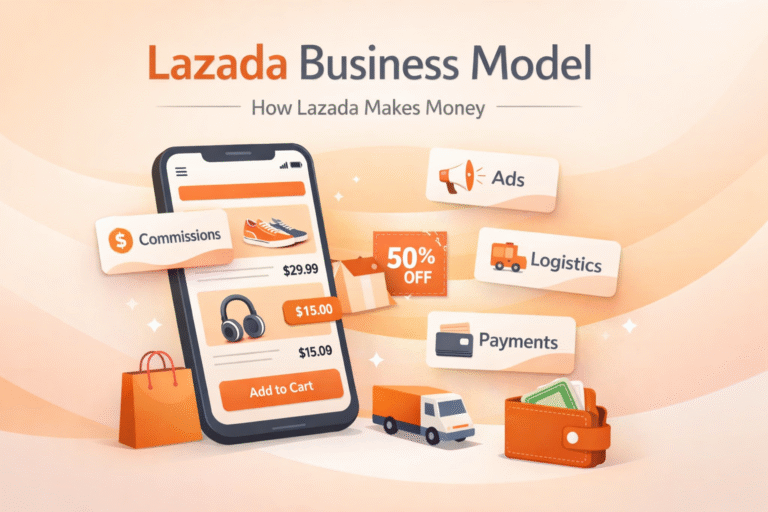
[…] Shopee’s dominance in user engagement across most markets has put pressure on Lazada’s seller base and advertising revenue. Sellers follow traffic. When buyers spend more time on Shopee, sellers shift advertising budgets and sometimes exclusive listings there. […]