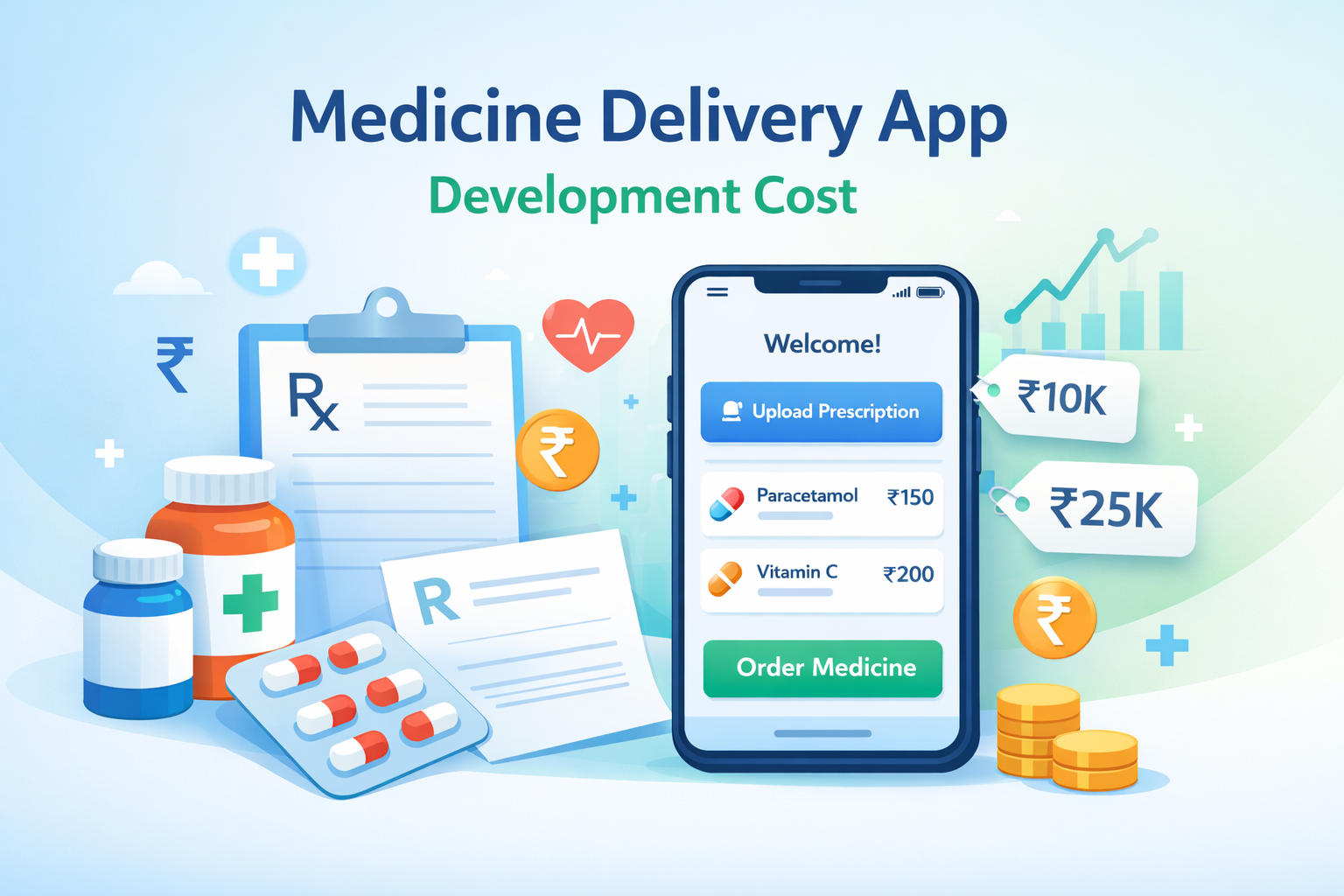
Building a medicine delivery app in India costs anywhere from ₹5 lakh to ₹60+ lakh depending on how complex your product is. A basic single-pharmacy app starts around ₹5 to 10 lakh. A mid-level marketplace with standard features runs ₹10 to 25 lakh. A full-scale platform like PharmEasy or Tata 1mg with AI features, telemedicine, and multi-vendor support can exceed ₹60 lakh. The final number depends on features, technology stack, team location, number of platforms, and regulatory compliance requirements.
Introduction
Demand for online medicine delivery has grown dramatically in India. The pandemic accelerated adoption, and platforms like PharmEasy, Netmeds, and Tata 1mg turned online pharmacy from a niche convenience into a mainstream habit.
Today, pharmacies of all sizes from local stores to hospital chains are exploring digital delivery. Startups see a large addressable market. Established pharmacies want to retain customers who shifted online.
The challenge is understanding what this actually costs to build. There is no single number. Development cost depends on which features you include, how many panels you need, which platforms you target, where your development team is located, and how much you invest in compliance. This guide breaks it all down.
What Is a Medicine Delivery App?
A medicine delivery app lets users order prescription and over-the-counter medicines from pharmacies, get the order processed, and receive delivery at home. Some apps also allow users to upload prescriptions, consult pharmacists, and set refill reminders.
There are three main types:
Single pharmacy app. Built for one pharmacy or chain. The pharmacy manages its own inventory, pricing, and delivery. Simpler and cheaper to build.
Aggregator model. Multiple pharmacies listed on one platform. Users compare prices and availability. The platform takes a commission. This is how PharmEasy and Netmeds operate.
On-demand delivery model. Focuses on real-time order fulfillment within a geographic area. Medicines are delivered within hours. Requires logistics integration and real-time tracking.
Types of Medicine Delivery Apps and Their Cost Impact
Single Pharmacy App
This is the lowest-cost option. The app connects one pharmacy to its customers. Features are limited to browsing, ordering, payment, and delivery tracking. No multi-vendor backend is needed. Development cost typically ranges from ₹5 to 12 lakh.
Aggregator Model
This model requires a multi-vendor backend, pharmacy onboarding flows, separate dashboards for each pharmacy, and a central admin system. It is significantly more complex. Cost typically starts at ₹25 lakh and can go much higher depending on scale and automation.
On-Demand Delivery Model
This model requires real-time inventory checks, live driver tracking, route optimization, and push notifications. It sits between the two above in complexity. Expect ₹15 to 30 lakh for a solid on-demand platform.
Core Features That Affect Development Cost
Features are the biggest driver of cost. Here is a breakdown by panel:
User App Features
Registration and login. Email, phone, and social login. OTP verification is standard in India.
Prescription upload. Users must be able to upload photos or PDFs. The system must flag prescription-only medicines and route them for pharmacist review.
Medicine search. Filter by brand, generic name, category, and availability. Autocomplete and search suggestions add development time.
Order tracking. Real-time updates from order confirmation to delivery. Push notifications at each stage.
Payments. UPI, debit/credit cards, net banking, and cash on delivery. Multiple payment gateways mean more integration work.
Order history and reorder. Users should be able to view past orders and reorder in one tap.
Pharmacy Panel
Inventory management. Add products, manage stock levels, set prices, flag out-of-stock items.
Order processing. Accept, reject, or modify orders. Handle prescription validation workflow.
Pricing control. Pharmacies in an aggregator model need independent pricing tools.
Admin Panel
User management. View and manage customer accounts, pharmacies, and delivery partners.
Vendor control. Approve or deactivate pharmacies. Monitor performance.
Analytics dashboard. Orders, revenue, popular products, delivery times. This requires significant backend work to build well.
Delivery Partner App
Order assignment. Auto-assign or manually dispatch orders to delivery agents.
Route tracking. Real-time GPS for tracking delivery agents. Integrates with Google Maps or similar.
Delivery confirmation. Photo confirmation, OTP-based delivery verification.
Advanced Features That Boost Cost
These are optional features that add significant value but also significant cost.
AI-based medicine suggestions. Based on purchase history or uploaded prescriptions. Requires ML model integration.
Subscription and refill reminders. Users set up recurring orders for chronic medications. Adds backend scheduling and notification logic.
Telemedicine integration. In-app video or chat consultation with doctors. Adds a separate feature set and compliance requirements.
Chat with pharmacist. Text-based support for medicine queries. Requires live chat infrastructure.
Multi-language support. Critical for India-wide reach. Each language adds translation work and UI testing.
Dark store or inventory hub model. If you operate your own warehouse, the app needs warehouse management integration.
Each advanced feature adds ₹2 to 10 lakh to total development cost depending on complexity.
Technology Stack Used
The technology choices affect both cost and long-term scalability.
Frontend (mobile app). Flutter and React Native are the top cross-platform choices. Both allow Android and iOS development from a single codebase, reducing cost. Native development (Swift for iOS, Kotlin for Android) is more expensive but offers better performance.
Backend. Node.js is popular for real-time features and high concurrency. Django (Python) is a strong choice for data-heavy applications with complex business logic.
Database. MongoDB works well for unstructured data like product catalogs. PostgreSQL is preferred for transactional data like orders and payments.
Third-party APIs. Payment gateways (Razorpay, PayU), maps (Google Maps), SMS (Twilio, MSG91), and email services add integration cost.
Cloud infrastructure. AWS and Google Cloud are the standard choices. Cloud costs scale with user growth. Initial setup and configuration is part of development cost.
Choosing cross-platform tools like Flutter instead of building two separate native apps can save ₹5 to 15 lakh.
Medicine Delivery App Development Cost Breakdown
UI and UX Design Cost
Design covers wireframes, user flow diagrams, and high-fidelity screen designs for all panels. A clean, well-tested UI for a medicine app typically costs ₹1 to 5 lakh. Complex apps with multiple user types need more screens and cost more.
Frontend Development
Building the actual user-facing app from the designs. For cross-platform (Flutter or React Native), expect ₹3 to 10 lakh. Native development on both platforms can reach ₹15 lakh or more.
Backend Development
The backend handles all logic: order processing, inventory, user authentication, notifications, and data storage. This is usually the largest cost item. Budget ₹5 to 20 lakh depending on complexity.
API Integrations
Payment gateways, maps, SMS, email, and any third-party service integration. Each integration requires development, testing, and maintenance. Total API integration cost typically runs ₹2 to 8 lakh.
Testing and QA
Manual and automated testing across devices and scenarios. Testing a healthcare app needs special attention because errors affect users directly. Budget ₹1 to 5 lakh.
Maintenance Cost
Post-launch maintenance covers bug fixes, OS updates, security patches, and feature updates. Standard industry rate is 15 to 25 percent of total development cost per year. For a ₹20 lakh app, expect ₹3 to 5 lakh annually.
Cost Based on App Complexity
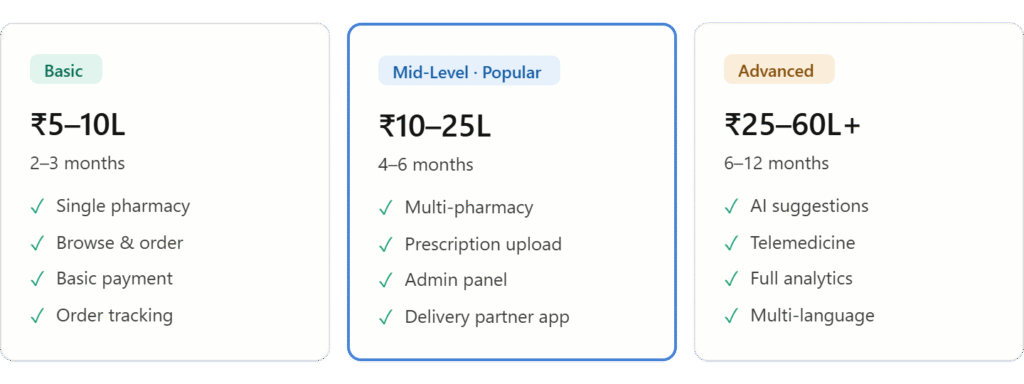
Basic app (₹5 to 10 lakh). One pharmacy, limited features, Android or iOS only. Good for testing the concept or serving a local market.
Medium app (₹10 to 25 lakh). Multi-pharmacy or marketplace features, prescription handling, separate admin and delivery partner panels. This is where most new entrants start.
Advanced app (₹25 to 60 lakh+). Full-scale product with AI features, telemedicine, analytics, multi-language support, and a robust backend that can handle high order volume.
Factors That Influence Development Cost
App complexity. More features mean more development time. Every additional panel or workflow adds cost.
Number of platforms. Building for Android only is cheaper than Android and iOS combined. Adding a web version adds another 30 to 50 percent to frontend costs.
Development team location. Indian development teams charge ₹1,500 to ₹4,000 per hour. US-based teams charge ₹8,000 to ₹15,000 per hour. Eastern European teams fall in between. Most Indian startups hire locally to reduce cost.
Third-party integrations. Every external service requires API integration, testing, and sometimes licensing fees.
Compliance requirements. Health apps in India must follow regulations around drug dispensing, prescription handling, and patient data. Building compliance into the app architecture adds development time.
Team size and expertise. A larger, more experienced team costs more per hour but delivers faster. A smaller freelance team is cheaper but riskier for complex products.
Hidden Costs You Should Know
Many founders budget for development but miss the ongoing costs that follow launch.
App store fees. Google Play charges a one-time $25 registration fee. Apple charges $99 per year for the developer program.
Server and cloud costs. AWS or Google Cloud infrastructure runs ₹10,000 to ₹1 lakh per month depending on traffic. This scales as your user base grows.
Payment gateway charges. Razorpay, PayU, and similar gateways charge 1.5 to 2.5 percent per transaction plus monthly fees.
Customer support. Users will have issues. Support staff or a chat tool costs money.
Marketing and user acquisition. Building the app is only half the investment. Getting users costs money through paid ads, SEO, referral programs, or partnerships with pharmacies.
Security audits. Healthcare apps handling patient data need periodic security reviews. Budget ₹50,000 to ₹3 lakh per audit.
How to Reduce Development Cost
Start with an MVP. Build only the core features: browse, order, pay, track. Validate demand before adding advanced features.
Use cross-platform technology. Flutter or React Native lets you build one codebase for Android and iOS. You save 30 to 40 percent compared to building two native apps.
Avoid feature creep. Every feature added before launch delays the product and increases cost. Save nice-to-have features for version 2.
Use ready-made APIs. Don’t build payment, SMS, or map features from scratch. Use reliable third-party APIs. This saves weeks of development time.
Outsource to experienced teams. A team that has built healthcare or delivery apps before makes fewer mistakes and works faster. The hourly rate may be higher but total cost is often lower.
Prioritize Android first. In India, Android has over 95 percent market share. Launch Android first, validate, then build iOS.
Monetization Strategies
Commission per order. You take a percentage of each order from the pharmacy. PharmEasy and Netmeds use this model.
Delivery charges. Charge users for delivery, especially for small orders.
Subscription model. Offer users a monthly or annual plan with free delivery, priority support, and refill reminders.
Featured listings. Pharmacies or brands pay to appear at the top of search results or category pages.
Ads and partnerships. Health brands, diagnostics companies, and insurance providers pay for access to your user base.
Development Timeline
A basic single-pharmacy app takes 2 to 3 months. A medium-complexity marketplace takes 4 to 6 months. An advanced platform with AI, telemedicine, and full analytics takes 6 to 12 months.
These timelines assume a focused team. Delays happen when requirements change mid-project or when compliance reviews take longer than expected.
Legal and Compliance Requirements
This section matters more than most founders realize. Ignoring compliance can result in fines or forced shutdown.
Drug license. Any platform that facilitates the sale of medicines needs a valid drug license under the Drugs and Cosmetics Act, 1940. The license must be held by the pharmacy, but your platform must verify it.
Prescription validation. Schedule H and Schedule H1 drugs require a valid prescription. Your app must have a workflow to collect, store, and verify prescriptions. Selling these drugs without prescription validation is illegal.
Data privacy. Patient health data is sensitive. India’s Digital Personal Data Protection Act requires proper consent, data minimization, and secure storage. International users may also be subject to GDPR.
Telemedicine guidelines. If you include telemedicine, the Telemedicine Practice Guidelines (2020) issued by the Medical Council of India apply. Doctors must be registered, and certain prescriptions cannot be issued via telemedicine.
GST and invoicing. Medicine orders require valid GST-compliant invoices. Build this into your pharmacy panel from day one.
Real-World Case Studies
PharmEasy started as a simple prescription upload and delivery service in 2015. It scaled by adding warehouse operations, diagnostics, and a private label medicines business. The platform invested heavily in supply chain infrastructure before profitability, raising over $1.5 billion before its IPO plans.
Tata 1mg began as a medicine information platform, added e-pharmacy, then diagnostics and teleconsultation. The multi-step evolution kept development investment focused at each stage rather than building everything at once.
The takeaway from both: they did not build a super app on day one. Each phase validated demand before the next phase was built.
Is It Worth Investing in a Medicine Delivery App?
The Indian online pharmacy market is projected to reach $18 billion by 2030 according to multiple industry reports. Chronic disease management, an aging population, and deep smartphone penetration are structural drivers.
Post-COVID, consumer comfort with ordering medicines online is high and sticky. Users who shifted online during the pandemic have largely stayed online.
Profitability is achievable but not fast. Margins on medicines are thin. Volume, subscriptions, and adjacent revenue streams (diagnostics, insurance, telemedicine) are where the real opportunity lies.
For a local pharmacy, a basic app to retain and grow their customer base is very achievable at ₹5 to 10 lakh. For a startup looking to build at scale, the investment is significant but the market justifies it if execution is right.
Conclusion
Building a medicine delivery app in India costs ₹5 lakh for a basic single-pharmacy solution and ₹60 lakh or more for a full-scale marketplace. The right investment depends entirely on your target market, competitive position, and growth plan.
The smartest approach is to start small, validate quickly, and scale based on real user data. An MVP that gets 500 active users in your city tells you more than a full-scale app that launches to low adoption.
Before you start development, get your drug license sorted, pick a focused feature set for version one, and choose a development team that has healthcare or delivery app experience. Those three decisions will have more impact on your outcome than almost anything else.
Frequently Asked Questions
Costs range from ₹5 lakh for a basic app to ₹60+ lakh for an advanced marketplace. Most startups spend ₹10 to 25 lakh for a functional first version.
A basic app takes 2 to 3 months. A mid-level app takes 4 to 6 months. An advanced app takes 6 to 12 months.
Yes. The pharmacy partner must hold a valid drug license. If you are operating your own pharmacy, you need the license directly. Prescription medicine sales require documented prescription verification.
Yes. A focused MVP with core features (browse, order, pay, track) can be built for ₹5 to 10 lakh. Start with one platform (Android), one city, and a limited pharmacy network. Expand after validation.
Ready-made pharmacy platforms (white-label SaaS) are faster and cheaper upfront, typically ₹50,000 to ₹2 lakh per year. However, they offer limited customization and you depend on the vendor’s roadmap. Custom development gives full control and is better if you plan to scale or differentiate significantly. For early-stage testing, a white-label solution is often the right starting point.
Discover more from PratsDigital
Subscribe to get the latest posts sent to your email.