Aldi is one of the most profitable grocery chains in the world. Not because it sells premium products or runs flashy promotions. But because it has mastered the art of doing less, better.
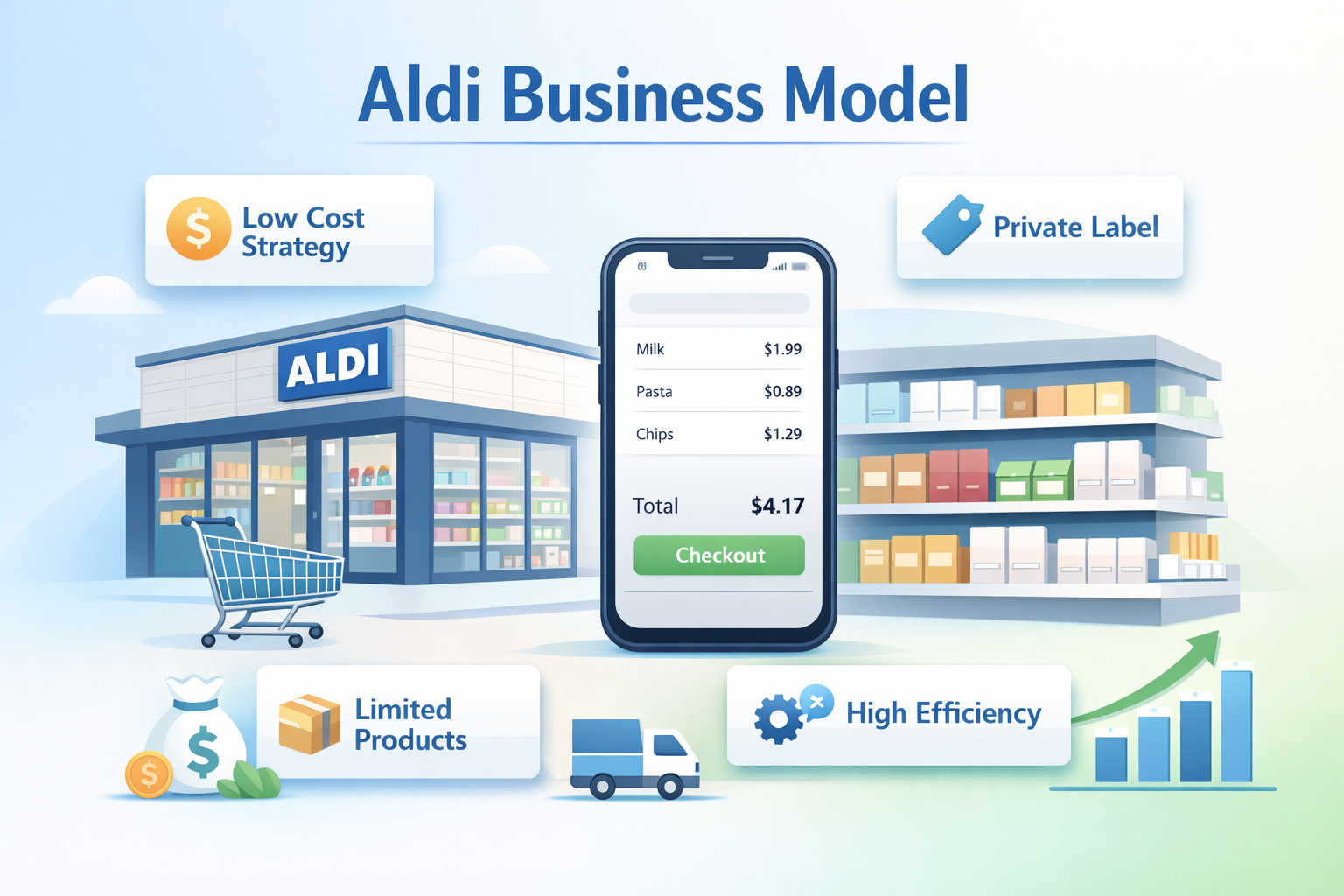
The Aldi business model is built on radical simplicity. Low costs, private labels, limited variety, and lean operations. That combination lets Aldi price lower than almost every competitor while still generating strong margins.
This blog breaks down exactly how Aldi makes money, why its model works, and what founders and business thinkers can learn from it.
What Is Aldi?
Aldi is a German discount supermarket chain founded by brothers Karl Albrecht and Theo Albrecht in 1946. The name “Aldi” comes from Albrecht Diskont, meaning Albrecht Discount.
After a disagreement over whether to sell cigarettes, the brothers split the company in 1960 into two separate entities:
Aldi Nord operates across northern Germany and several European countries including France, Belgium, the Netherlands, Spain, and Poland.
Aldi Sud covers southern Germany and has expanded internationally into the US, UK, Australia, and Ireland.
In the United States, Aldi Sud operates all Aldi locations. Trader Joe’s is also owned by Aldi Nord, though the two chains operate completely independently.
Together, Aldi operates over 10,000 stores across 20+ countries. It is one of the largest retailers on the planet, and it got there without loyalty programs, fancy store designs, or massive advertising budgets.
The Core Idea Behind the Aldi Business Model
The Aldi business model can be summed up in one sentence:
Cut costs aggressively, pass savings to the customer, and build loyalty through price.
This is not a discount model in the traditional sense. Aldi does not slash prices on name-brand products to attract shoppers. Instead, it is structured from the ground up to operate at minimum cost. Every decision, from store layout to product selection to staffing, is made with cost efficiency as the primary filter.
Aldi is cheap by design, not by discounting.
That distinction matters. A retailer that discounts name brands is dependent on supplier pricing and promotions. Aldi controls its own cost structure through private labels, bulk purchasing, and operational discipline.
The result is a model that is extremely hard to replicate because it requires systemic discipline, not just a few smart tactics.
How Aldi Makes Money: Revenue Streams Explained
The Private Label Strategy
The single biggest driver of Aldi’s profitability is its private label strategy.
Roughly 90% of products sold in Aldi stores are Aldi’s own in-house brands. You will not find Heinz ketchup or Kellogg’s cereal prominently stocked. Instead, you will find Aldi’s own versions at significantly lower price points.
Why does this matter for margins?
When a retailer sells a national brand product, the brand manufacturer captures a large portion of the margin. The retailer is essentially a middleman. When Aldi sells its own private label product, it captures the full margin from production to shelf.
Private label products also give Aldi complete control over pricing. There is no negotiation with a brand. No price increases passed down from a manufacturer. Aldi sets the price, controls the supplier relationship, and keeps the margin.
The quality of Aldi’s private label products is consistently rated highly in consumer studies. This is not an accident. Aldi sources private label products from many of the same manufacturers that produce national brands. The product inside the package is often comparable in quality. The difference is the packaging, the branding, and the price.
This is central to the Aldi business model. Customers get quality they trust at prices they cannot find elsewhere.
Limited SKU Inventory Model
Most traditional grocery stores carry between 25,000 and 40,000 SKUs (stock keeping units). A SKU is simply a unique product variant. Different sizes, flavors, and brands all count as separate SKUs.
Aldi carries approximately 1,500 SKUs.
That is not a typo. Aldi stocks roughly 1,500 products compared to tens of thousands at a conventional supermarket.
This has a cascading effect on profitability.
Faster inventory turnover. With fewer products, each product sells more frequently. High turnover means fresher stock, lower waste, and better cash flow.
Lower complexity in operations. Fewer products mean simpler supply chains, simpler store layouts, and simpler staff training. Every SKU added to a store adds operational complexity and cost.
Stronger supplier leverage. When Aldi buys one type of canned tomato in massive quantities rather than eight different brands in smaller quantities, it gets a far better price per unit from suppliers.
Less shelf space needed. Aldi stores are typically between 8,000 and 17,000 square feet. A standard grocery store runs 40,000 to 60,000 square feet. Smaller stores mean lower rent, lower utilities, and lower maintenance costs.
The limited SKU model forces customers to choose from fewer options, but Aldi has found that most shoppers do not need 15 varieties of pasta sauce. They need one or two good options at a fair price.
Supplier Relationships and Bulk Buying
Aldi’s approach to supplier relationships is built on volume and long-term commitment.
Because Aldi operates thousands of stores globally and carries a very limited product range, it can commit to enormous purchase volumes from a small number of suppliers. This gives Aldi significant leverage in negotiations.
Suppliers benefit from predictable, large-volume orders. Aldi benefits from lower cost per unit. Both sides have an incentive to maintain the relationship long term.
Aldi also keeps supplier contracts streamlined. Fewer SKUs mean fewer supplier relationships to manage. The simplicity of the buying model reduces administrative overhead and keeps procurement costs low.
Aldi also sources locally in many markets, which reduces logistics costs and can improve product freshness. This is especially true in produce and dairy categories.
Cost Optimization Across Operations
The Aldi business model is not just about what it sells. It is about how it operates.
Every touchpoint in the customer journey has been designed to minimize labor and overhead costs.
Cart deposit system. Customers insert a quarter to unlock a shopping cart and retrieve it when they return the cart. This eliminates the need for employees to collect carts from parking lots. It is a small detail with a real operational impact.
Customers bag their own groceries. There is no dedicated bagger at Aldi checkouts. Customers bag their own groceries, often at a separate counter after paying. This reduces the number of staff needed per store.
Products sold in original packaging. Aldi often displays products directly in the shipping boxes they arrive in rather than individually stacking items on shelves. This cuts restocking time significantly.
Lean staffing model. An average Aldi store operates with fewer employees than a comparable conventional grocery store. Fewer staff means lower wage costs, which is one of the largest expense categories in retail.
No loyalty programs or heavy advertising. Aldi does minimal traditional advertising. It does not run a loyalty card program. These programs are expensive to operate and maintain. Aldi’s position is that low prices are the loyalty program.
Efficient checkout. Aldi cashiers are trained to scan items quickly, sometimes without even picking them up. Speed at checkout reduces the number of registers needed and increases throughput per hour.
Each of these optimizations is small on its own. Together, they create a cost structure that is dramatically lower than traditional grocery retail.
Key Features of the Aldi Business Model
Small, Efficient Store Format
Aldi stores are intentionally small. The no-frills layout is easy to navigate and cheap to maintain. There are no elaborate displays, no in-store bakeries, and no staffed deli counters in most locations.
The simplicity is a feature, not a limitation. Smaller stores cost less to lease, heat, cool, and staff. Customers can complete a shopping trip quickly, which appeals to value-oriented shoppers who are not looking for a leisure experience.
Limited Product Range
The 1,500 SKU limit is one of the most important structural features of the Aldi model. It touches everything from supplier negotiations to store size to staff training requirements.
Aldi does offer seasonal or limited-time specialty products called “ALDI Finds” (previously called Special Buys). These are non-grocery items like cookware, electronics, exercise equipment, or seasonal goods sold in limited quantities. They create urgency and drive additional foot traffic without bloating the permanent product range.
Fast Checkout Experience
Aldi stores are designed for efficiency. Cashiers are among the fastest in retail. The store layout funnels customers directly to checkout. There is no meandering through departments looking for items.
This speed benefits both the customer and Aldi’s operational throughput.
No-Frills Shopping Environment
There are no elaborate store designs, no mood lighting, no branded shopping experiences. Aldi stores are functional and straightforward.
This is a deliberate choice. Design and ambiance cost money. Aldi passes those savings to the customer in the form of lower prices.
Why Aldi Prices Are So Low
This is the question most shoppers and business observers ask. The answer is not a single tactic. It is the entire system working together.
Private label dominance removes brand premium costs. When you buy a national brand, part of what you are paying for is decades of marketing spend and brand equity. Aldi’s private labels carry none of that overhead.
Low advertising spend. Aldi does not run Super Bowl ads or sponsor major events. Its marketing budget is a fraction of what traditional grocers spend. Lower marketing costs mean lower prices are possible without sacrificing margin.
Operational efficiency reduces overhead. Every cost saved in operations, whether through lean staffing, smaller stores, or self-bagging, is a cost that does not need to be recovered through higher prices.
Supply chain simplicity. Fewer SKUs, bulk purchasing, and long-term supplier contracts reduce procurement costs across the board.
No premium for variety. Traditional retailers charge a premium for the convenience of having many options. Aldi does not offer that variety, and it does not price in a premium for it.
All of these factors compound. Aldi does not win on price because of one clever trick. It wins because its entire business model is built around cost discipline from the ground up.
The Aldi Business Model Canvas
Key Partners
Aldi’s partnerships are deliberately limited and focused.
Private label manufacturers produce the majority of products Aldi sells. Many are the same factories that produce national brands, contracted to produce Aldi versions.
Logistics and distribution providers handle the movement of goods from suppliers to Aldi’s regional distribution centers and then to stores.
Long-term suppliers in produce, dairy, and packaged goods provide consistent volume at negotiated rates.
Aldi keeps its partner network lean. Fewer partners mean simpler management and stronger relationships with those who remain.
Key Activities
Procurement and sourcing is the heartbeat of the model. Aldi’s buyers are skilled negotiators who manage a limited but high-volume product portfolio.
Inventory management at the SKU level is critical. With only 1,500 products, each one must perform. Slow-moving items get cut quickly.
Store operations are standardized across locations to ensure consistent execution and control labor costs.
Cost optimization is an ongoing activity, not a one-time project. Aldi continuously looks for ways to reduce costs at every level of the business.
Key Resources
The private label brand portfolio is one of Aldi’s most valuable assets. Years of product development and quality control have made Aldi’s in-house brands trusted by millions of shoppers.
The supplier network built on long-term contracts and bulk volumes is difficult for competitors to replicate quickly.
The store infrastructure including owned or long-term leased properties and efficient layouts represents a significant physical asset.
Operational systems and processes that enable lean staffing and fast throughput are institutional knowledge built over decades.
Value Propositions
Low prices on everyday essentials. This is the primary value proposition. Aldi consistently underprices traditional grocers by 20 to 50% on comparable items.
Reliable quality. Aldi has worked hard to overcome the perception that cheap means low quality. Its private label products regularly win taste tests and consumer ratings.
Simple, fast shopping experience. For busy, budget-conscious shoppers, Aldi’s no-frills format is an advantage, not a drawback.
Consistent pricing. Aldi does not run complex weekly sales cycles. Prices are low all the time, which simplifies the shopping experience and builds trust.
Customer Relationships
Aldi operates primarily on a self-service model. There are minimal staff interactions beyond checkout.
Customer relationships are built through price trust, not personal service. Shoppers return to Aldi because they know they will get a fair price every time they visit. That consistency is the relationship.
Aldi does engage with customers through digital channels and occasional promotions, but these are secondary to the core value of price reliability.
Channels
Physical retail stores are Aldi’s dominant channel. The vast majority of its revenue comes from in-store purchases.
Limited digital presence. Aldi has expanded some online and curbside pickup capabilities in recent years, particularly in the US and UK, but digital remains a small part of the overall business. This is an area of active development.
ALDI Finds marketing. Limited-time specialty product announcements drive store visits and social media engagement without significant advertising spend.
Customer Segments
Price-sensitive consumers are Aldi’s core audience. These are shoppers who prioritize value above brand loyalty, store experience, or variety.
Budget-conscious families shopping for household staples find Aldi’s combination of low prices and reliable quality particularly compelling.
Value-focused shoppers across income levels. Aldi has found that its customer base is not exclusively low-income. As economic pressures have increased, middle and upper-middle income shoppers have adopted Aldi as a primary or secondary grocery destination.
Efficiency-oriented shoppers. Consumers who want to get in and out quickly without navigating a massive store appreciate the Aldi format regardless of their income level.
Revenue Streams
Product sales are essentially the only revenue stream. Aldi does not run advertising programs for brands, does not offer financial services, and does not operate a loyalty program that generates data revenue.
High-margin private label sales within the product sales category are the primary profit driver. Selling your own brand at competitive retail prices while controlling production costs creates strong unit economics.
ALDI Finds specialty products can carry higher margins and create additional revenue during seasonal periods.
Cost Structure
Procurement costs are the largest expense category. Aldi manages these through bulk buying and long-term contracts.
Store operations including rent, utilities, and maintenance are kept low through small store formats and efficient layouts.
Logistics and supply chain costs are controlled through regional distribution center networks and simplified inventory.
Employee wages are actually not as low as you might expect. Aldi pays above-average wages for retail in many markets. However, because there are fewer employees per store, total labor costs remain low.
Aldi’s Growth Strategy
Global Expansion
Aldi has been expanding steadily into new markets. In the United States, Aldi has invested billions of dollars in store expansion and renovation, with a target of becoming one of the top three grocery retailers in the country.
The US expansion has accelerated significantly over the past decade. Aldi now operates over 2,000 stores in the US and continues to open new locations.
Competing with Walmart and Lidl
Aldi’s primary competitor in the discount grocery space is Lidl, another German discounter with a similar model. In the US, Aldi competes directly with Walmart on price and increasingly with Kroger and other conventional supermarkets.
Aldi wins by being more price-aggressive than Walmart on core grocery items and simpler to shop than larger format stores.
Targeting Price-Sensitive Markets
Aldi’s growth strategy focuses on markets where consumers are particularly price-sensitive or where existing grocery retail is expensive relative to consumer incomes. This includes suburban US markets, the UK, and several emerging European markets.
Gradual Digital Expansion
Aldi has been cautious about e-commerce, largely because the economics of online grocery delivery are difficult to align with Aldi’s cost discipline. However, it has introduced curbside pickup in select US markets and continues to test digital formats.
The digital expansion is gradual and measured, consistent with Aldi’s overall approach of not adopting a strategy until it can be done profitably.
Store Renovation and Modernization
Aldi has invested in renovating its US and UK stores to make them more visually appealing without abandoning the core no-frills format. These renovations include improved lighting, wider aisles, and expanded fresh food sections.
This signals that Aldi is not static. It is evolving to meet changing consumer expectations while protecting the cost structure that makes it competitive.
What Makes Aldi Different From Other Discounters
Many retailers claim to offer low prices. Few have built the systemic discipline that Aldi has maintained over decades.
Extreme cost discipline. Aldi does not make exceptions. The cost discipline applies to advertising, store design, staffing, product range, and operations. There is no department that gets a pass.
Operational simplicity. Simplicity is a competitive advantage. Every process at Aldi is designed to be repeatable, efficient, and scalable. This makes expansion predictable and training faster.
The limited SKU strategy is a moat. Adding more products seems like an easy way to attract more customers. But every additional SKU adds cost, complexity, and risk. Most retailers cannot resist the temptation to expand. Aldi has resisted it for decades.
Supplier relationships built on volume. The depth of Aldi’s supplier relationships, built on consistent bulk orders and long-term contracts, takes years to develop. A new entrant cannot replicate these overnight.
The Aldi model is hard to copy not because it involves complex technology or proprietary secrets, but because it requires discipline that most organizations cannot sustain over the long term.
Challenges Facing the Aldi Business Model
Limited Product Variety
The limited SKU model is a strength, but it is also a constraint. Some shoppers want specific brands or product varieties that Aldi does not carry. These customers will shop at Aldi for staples but go elsewhere for specialty items.
As consumer preferences diversify and demand for specialty, organic, and international products grows, Aldi faces pressure to expand its range without compromising the simplicity that makes the model work.
Competition From Other Discount Retailers
Lidl is Aldi’s closest global competitor and operates a very similar model. In markets where both operate, price competition is intense and margins can compress.
Walmart and Target have also improved their private label offerings, making them more competitive with Aldi on price and quality.
The Growth of Online Grocery
E-commerce is the biggest structural challenge to Aldi’s model. Online grocery requires significant investment in technology, logistics, and last-mile delivery. These costs are difficult to absorb while maintaining Aldi’s price position.
Instacart partnerships and curbside pickup are partial solutions, but they do not fully resolve the tension between Aldi’s cost model and the economics of e-commerce fulfillment.
Changing Consumer Expectations
Shoppers increasingly expect a broader range of fresh, organic, and health-focused products. They also expect digital convenience. Aldi is adapting, but these shifts require investment that must be balanced against cost discipline.
Lessons From the Aldi Business Model for Founders
One Clear Value Proposition
Aldi does not try to be everything to everyone. It is the low-price leader, full stop. That clarity drives every decision from product selection to store design to staffing.
Founders who try to serve too many customer needs with too many products often end up being mediocre at all of them. Aldi shows what happens when you pick one thing and commit to it completely.
Cut Costs Systematically, Not Just Tactically
Most businesses cut costs reactively, during downturns or when margins compress. Aldi builds cost discipline into the structure of the business from day one.
The cart deposit system. The self-bagging model. The limited SKU count. These are not responses to a bad quarter. They are foundational choices that create permanent cost advantages.
Build Efficient Systems Early
Aldi’s operational systems, from checkout speed to restocking processes to supplier management, are the result of decades of refinement. They work because they were built with efficiency as the primary goal, not convenience or flexibility.
Early-stage founders who build sloppy systems and plan to fix them later often find that bad habits and inefficient processes become deeply embedded and expensive to change.
Simplicity Scales Better Than Complexity
A business with 1,500 products is dramatically easier to scale than one with 40,000 products. Fewer variables mean fewer failure points, faster training, and more consistent execution.
Complexity is seductive because it looks like capability. Aldi proves that simplicity is often the smarter long-term strategy.
Trust Is Built Through Consistency
Aldi does not win customer loyalty through rewards programs or personalized offers. It wins loyalty by being reliably cheap, every day, in every store.
Consistency is underrated as a brand strategy. Customers who can predict exactly what they will get from you keep coming back.
Final Words on the Aldi Business Model
The Aldi business model is a masterclass in strategic clarity.
It is not built on innovation in the traditional sense. There is no proprietary technology. No algorithmic pricing engine. No data moat. What Aldi has is a system of interlocking decisions that each reinforce the others, all oriented around the single goal of operating at minimum cost and passing those savings to the customer.
Private labels capture margin. Limited SKUs reduce complexity and cost. Bulk buying drives down procurement expenses. Lean staffing and small stores minimize overhead. No advertising keeps marketing costs near zero. All of it adds up to a price position that is almost impossible to beat.
The model has proven durable across economic cycles. When times are tough, shoppers flood into Aldi to stretch their budgets. When times are good, shoppers who discovered Aldi stay because the value is real.
Aldi’s growth into one of the world’s largest retailers without losing its cost discipline is rare. Most businesses that scale add complexity. Aldi has managed to scale by doubling down on simplicity.
For anyone studying business models, the Aldi story is required reading. It proves that you do not need to be the most exciting company in your industry to be one of the most successful. You just need to be the most disciplined.
Simplicity plus discipline equals long-term success. Aldi has been proving that for over 75 years.
Discover more from PratsDigital
Subscribe to get the latest posts sent to your email.